Family-based behavioral interventions increased smoking cessation rates in low-income households
Effectiveness of family-based behavioral intervention for smoking cessation in low-income households: a systematic review and meta-analysis
Systematic review and meta-analysisBenefit found
Are family-based behavioral interventions effective for smoking cessation in low-income households?
Who
5292
Smoking parents from low-income households with co-living children
Compared
Family-based behavioral interventions: RR:1.70
Usual care
Main outcome
Self-reported 7-day point prevalence abstinence or biochemically validated abstinence
Result: relative risk 1.70 (95% CI 1.16 to 2.48)
Bottom line: Family-based behavioral interventions significantly increase smoking abstinence in low-income households, especially when combined with nicotine replacement therapy.
eClinicalMedicine · 2025-08-11Download image
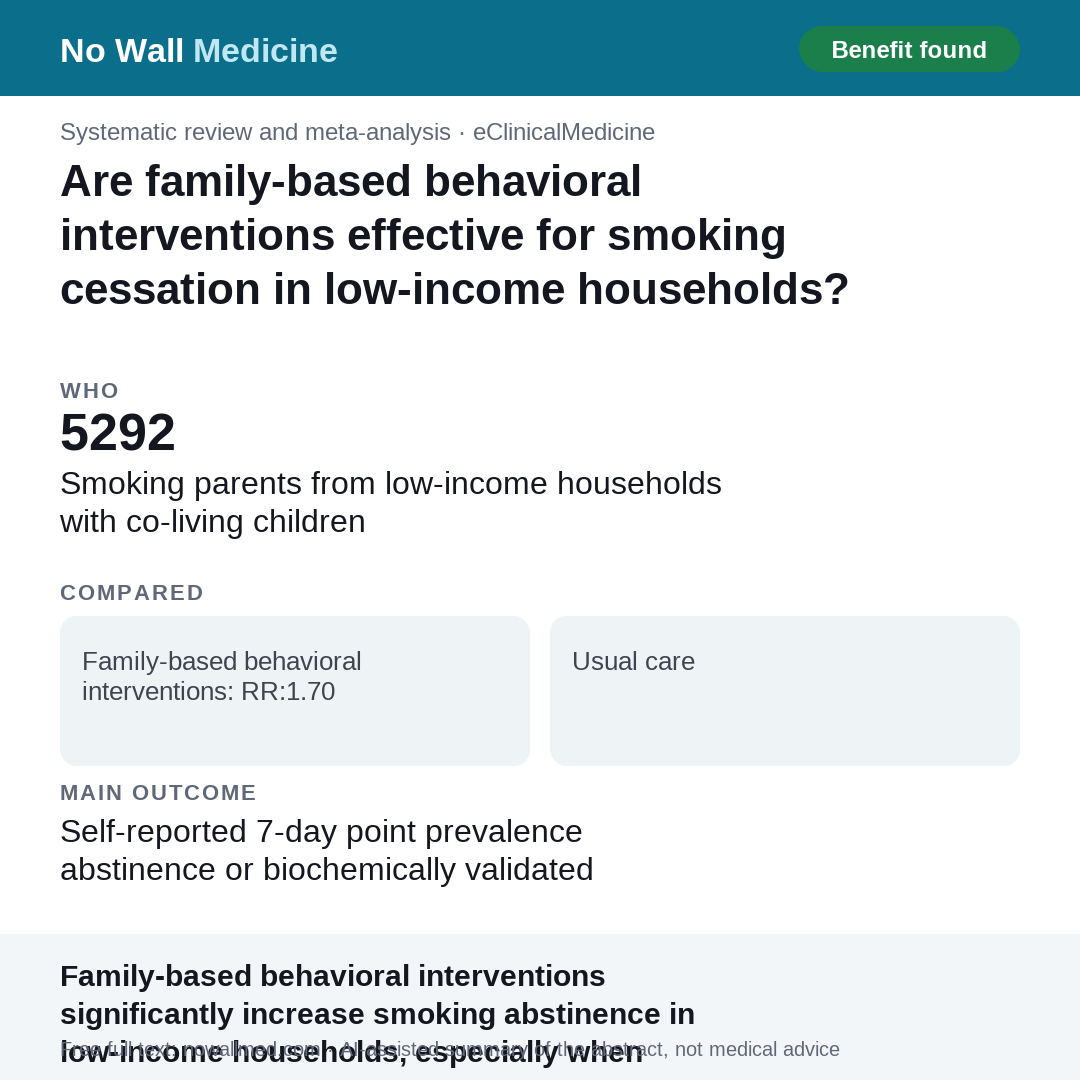
Clinical question: Are family-based behavioral interventions effective for smoking cessation in low-income households?
Why it matters: The effectiveness of family-based behavioral interventions for smoking cessation in low-income households remains uncertain.
Key points
- Researchers analyzed 22 randomized controlled trials involving 5292 participants to evaluate family-based behavioral interventions for smoking parents in low-income households.
- Family-based interventions increased self-reported 7-day smoking abstinence with a relative risk of 1.70 compared to usual care at 3 months or longer.
- Behavioral counseling combined with nicotine replacement therapy was most effective, showing a relative risk of 2.45 for abstinence.
Headline and key points written with AI from the paper’s abstract, with every number checked against it. Read the paper before relying on them.
Cite this article
Li MY, Luk TT, Cheung DYT, Guo ZQ, Siu KK, Guo J. Effectiveness of family-based behavioral intervention for smoking cessation in low-income households: a systematic review and meta-analysis. eClinicalMedicine. 2025. doi:10.1016/j.eclinm.2025.103420
Spotted a mistake? Suggest a correction
Top studies every Monday
The week’s key trials and guidelines in your specialties, plus any topics you follow. By email, free.
Get the weekly digest