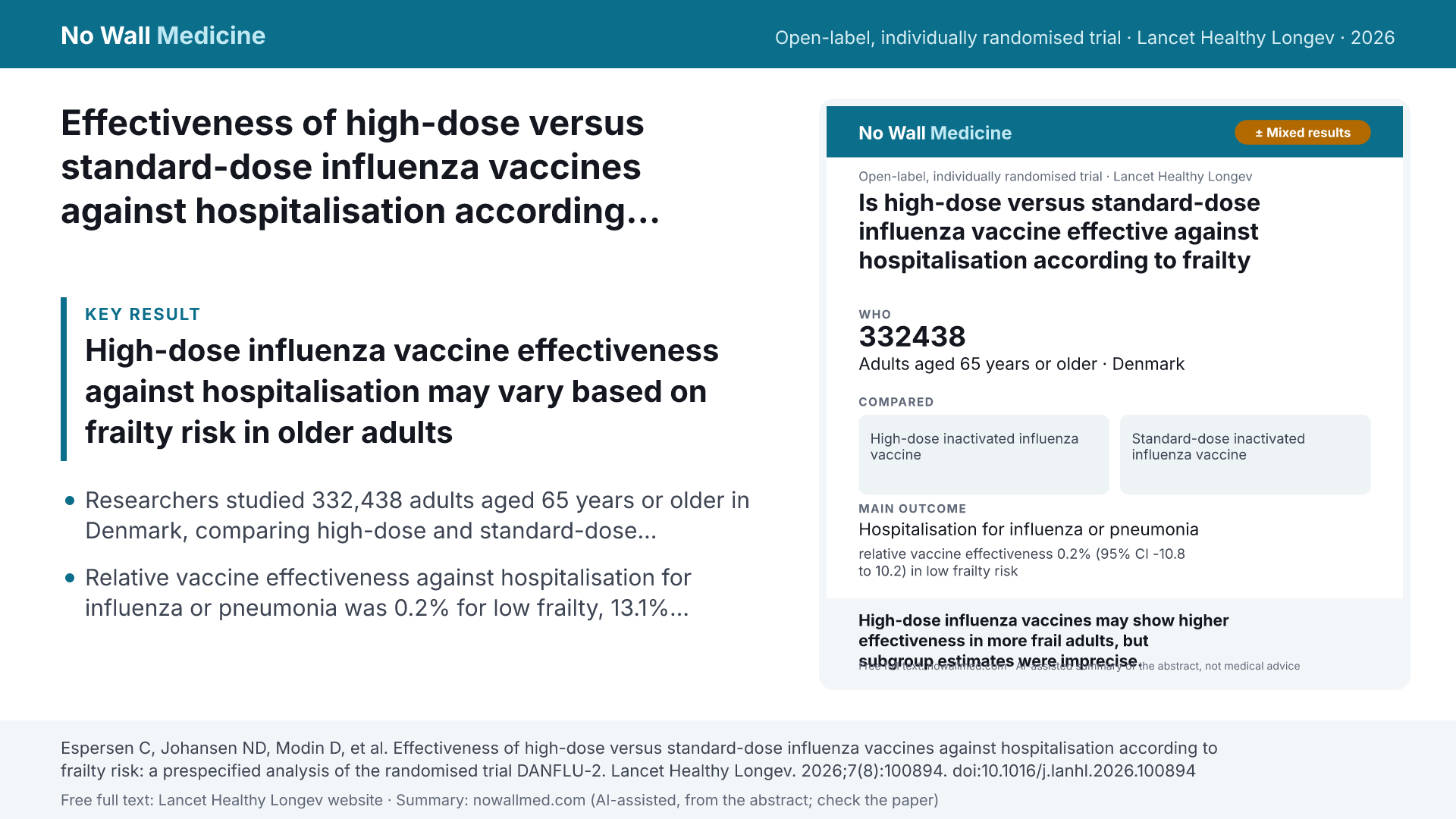
High-dose influenza vaccine effectiveness against hospitalisation may vary based on frailty risk in older adults
Effectiveness of high-dose versus standard-dose influenza vaccines against hospitalisation according to frailty risk: a prespecified analysis of the randomised trial DANFLU-2
Secondary analysis of a trialMixed results
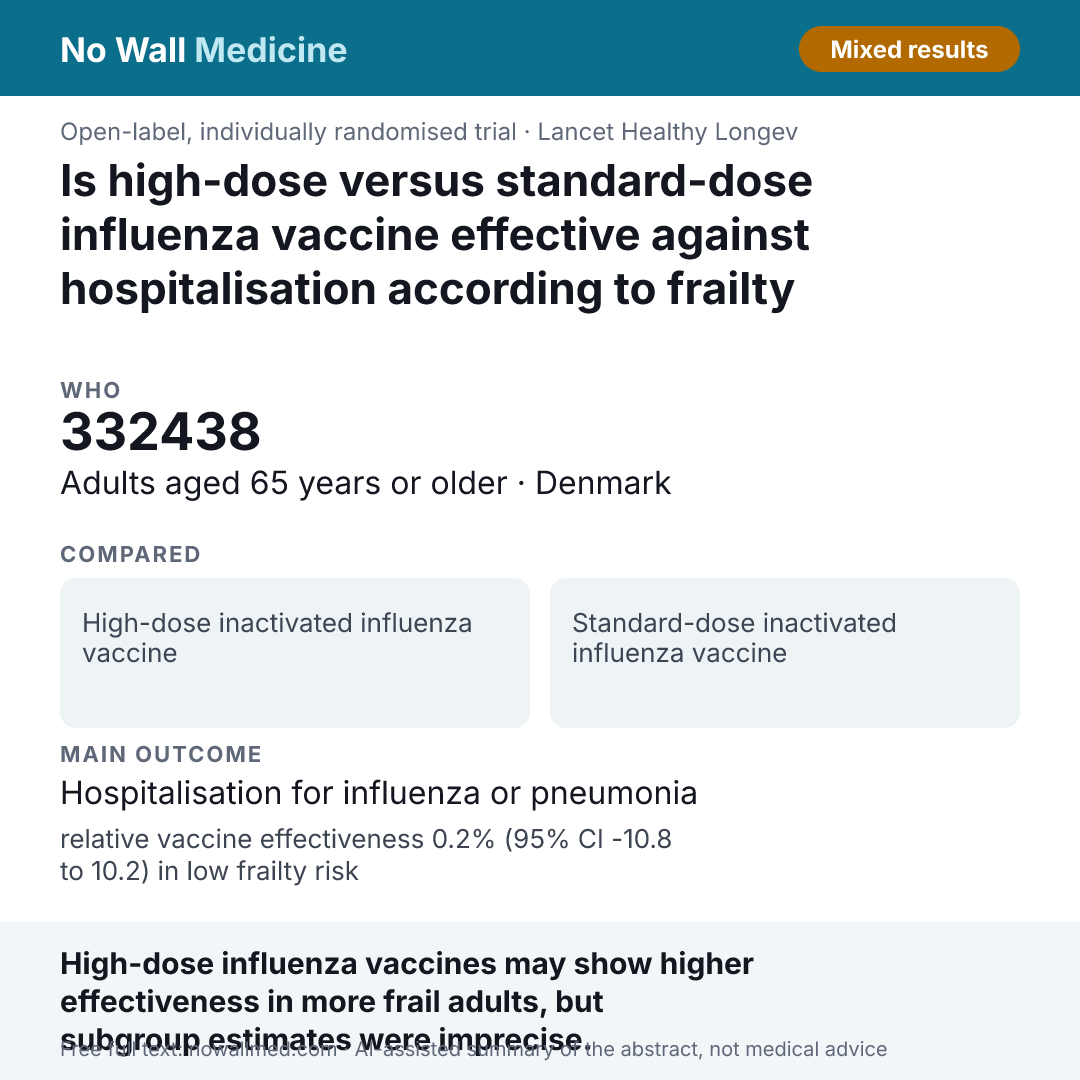
Is high-dose versus standard-dose influenza vaccine effective against hospitalisation according to frailty risk?
Who
332438
Adults aged 65 years or older · Denmark
Compared
High-dose inactivated influenza vaccine
Standard-dose inactivated influenza vaccine
Main outcome
Hospitalisation for influenza or pneumonia
Result: relative vaccine effectiveness 0.2% (95% CI -10.8 to 10.2) in low frailty risk
Bottom line: High-dose influenza vaccines may show higher effectiveness in more frail adults, but subgroup estimates were imprecise.
Limitation: Effect modification was not evident in categorical subgroups and estimates were imprecise with confidence intervals crossing the null.
Funded by: Sanofi
Lancet Healthy Longev · 2026-09-17 · Save PNG
Clinical question: Is high-dose versus standard-dose influenza vaccine effective against hospitalisation according to frailty risk?
Why it matters: Frailty is a major risk factor for influenza-related complications and may influence how well vaccines work.
Key points
- Researchers studied 332,438 adults aged 65 years or older in Denmark, comparing high-dose and standard-dose inactivated influenza vaccines.
- Relative vaccine effectiveness against hospitalisation for influenza or pneumonia was 0.2% for low frailty, 13.1% for intermediate frailty, and 19.9% for high frailty.
- The proportion of participants experiencing at least one serious adverse event increased from 4.8% in the low frailty group to 20.2% in the high frailty group.
Headline and key points written with AI from the paper’s abstract, with every number checked against it. Read the paper before relying on them.
Was this summary helpful?
Subject terms
Headline, design, result, key points, caveat and citation as plain text.
Cite this article
Espersen C, Johansen ND, Modin D, et al. Effectiveness of high-dose versus standard-dose influenza vaccines against hospitalisation according to frailty risk: a prespecified analysis of the randomised trial DANFLU-2. Lancet Healthy Longev. 2026;7(8):100894. doi:10.1016/j.lanhl.2026.100894
Spotted a mistake? Suggest a correction