Effectiveness of Immune Checkpoint Inhibitors in Patients With Advanced Esophageal Squamous Cell Carcinoma: A Meta-analysis Including Low PD-L1 Subgroups
Meta-analysis of randomized clinical trialsMixed results
Do immune checkpoint inhibitors improve survival in advanced esophageal squamous cell carcinoma with low PD-L1 expression?
Who
4752
Patients with advanced esophageal squamous cell carcinoma
Compared
Immunochemotherapy (TPS < 1%)
Chemotherapy (TPS < 1%)
Immunochemotherapy (CPS < 10)
Chemotherapy (CPS < 10)
Main outcome
Overall survival
Result: TPS < 1% HR 0.91 (95% CI 0.74-1.12); CPS < 10 HR 0.77 (95% CI 0.62-0.94)
Bottom line: Immune checkpoint inhibitors show no survival benefit for tumor proportion score < 1% but modest benefit for combined positive score < 10.
JAMA Oncol · 2022-12-09 · Save PNG
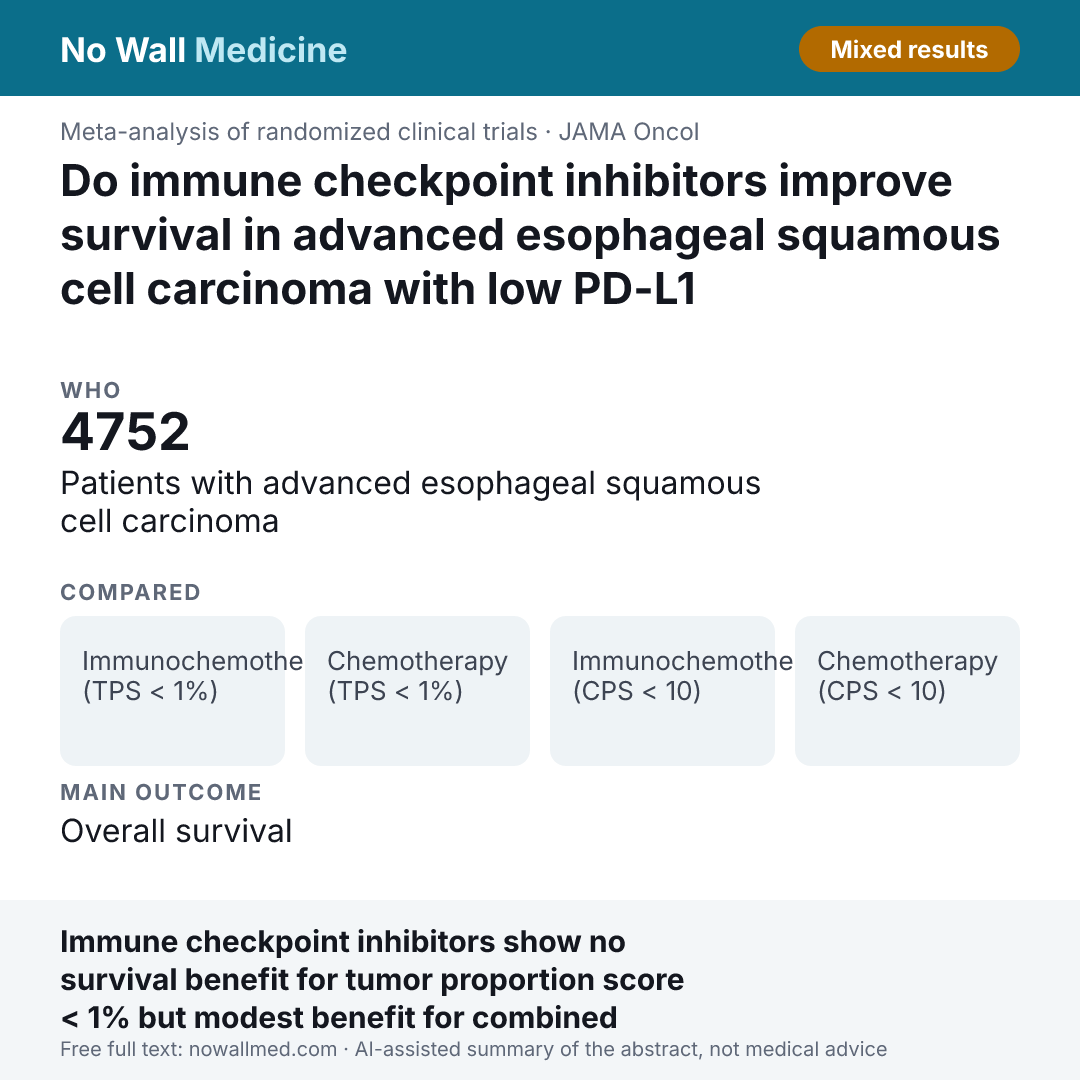
Clinical question: Do immune checkpoint inhibitors improve survival in advanced esophageal squamous cell carcinoma with low PD-L1 expression?
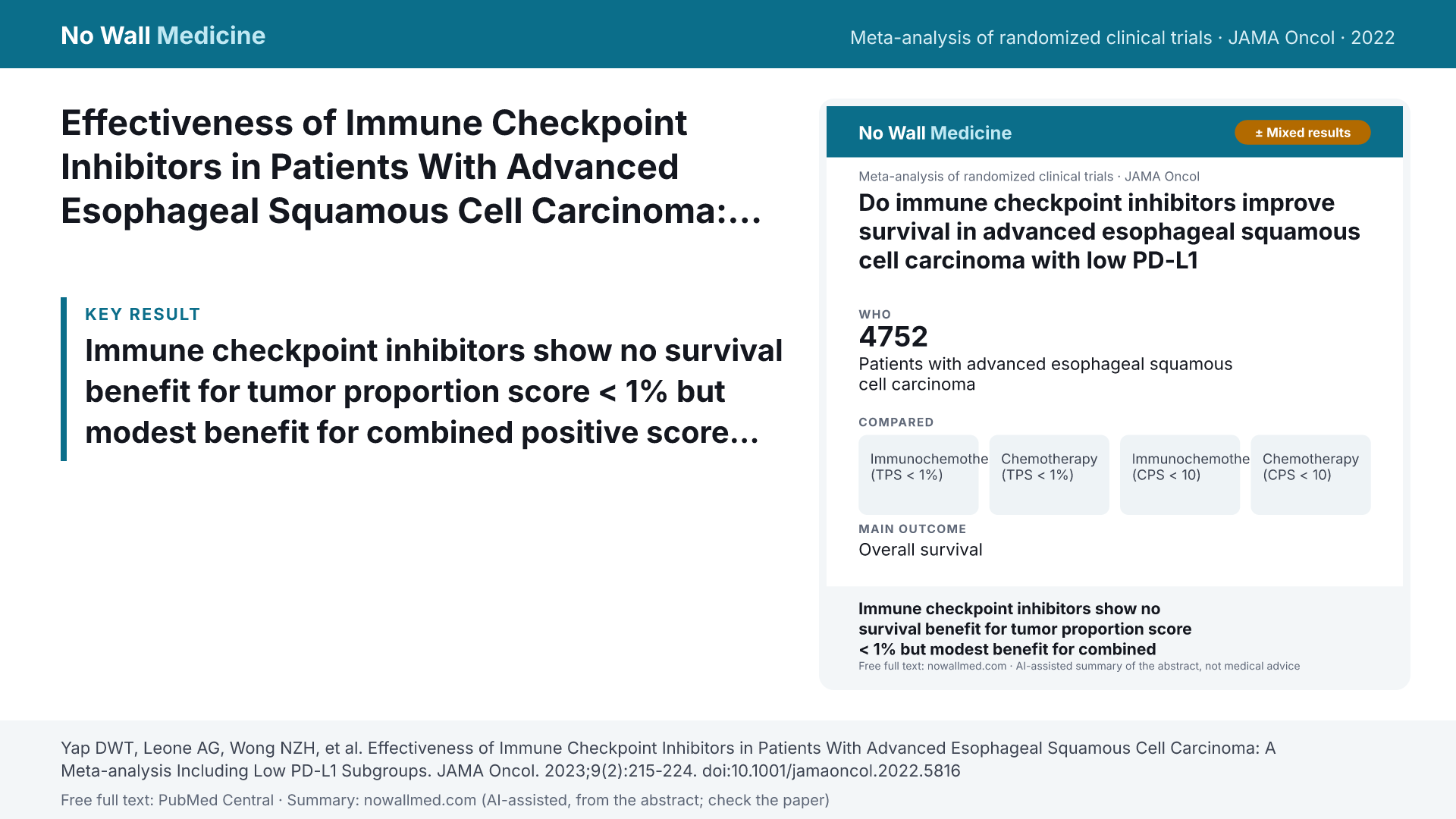
Abstract
Importance
Immune checkpoint inhibitors (ICIs) have improved survival outcomes of patients with advanced esophageal squamous cell carcinoma in both first- and second-line settings. However, the benefit of ICIs in patients with low programmed death ligand 1 (PD-L1) expression remains unclear. Objective
To derive survival data for patient subgroups with low PD-L1 expression from clinical trials comparing ICIs with chemotherapy in esophageal squamous cell carcinoma and to perform a pooled analysis. Data sources
Kaplan-Meier curves from the randomized clinical trials were extracted after a systematic search of Scopus, Embase, PubMed, and Web of Science from inception until October 1, 2021. Study selection
Randomized clinical trials that investigated the effectiveness of anti-PD-1-based regimens for advanced esophageal squamous cell carcinoma and that reported overall survival (OS), progression-free survival, or duration of response were included in this meta-analysis. Data extraction and synthesis
Kaplan-Meier curves of all-comer populations, subgroups with high PD-L1, and those with low PD-L1 (when available) were extracted from published articles. A graphic reconstructive algorithm was used to calculate time-to-event outcomes from these curves. In studies with unreported curves for subgroups with low PD-L1 expression, KMSubtraction was used to impute survival data. KMSubtraction is a workflow to derive unreported subgroup survival data with from subgroups. An individual patient data pooled analysis including previously reported and newly imputed subgroups was conducted for trials with the same treatment line and PD-L1 scoring system. Data analysis was conducted from January 1, 2022, to June 30, 2022. Main outcomes and measures
Primary outcomes included Kaplan-Meier curves and hazard ratios (HRs) for OS for subgroups with low PD-L1 expression. Secondary outcomes included progression-free survival and duration of response. Results
The randomized clinical trials CheckMate-648, ESCORT-1st, KEYNOTE-590, ORIENT-15, KEYNOTE-181, ESCORT, RATIONALE-302, ATTRACTION-3, and ORIENT-2 were included, totaling 4752 patients. In the pooled analysis of first-line trials that evaluated a tumor proportion score (CheckMate-648 and ESCORT-1st), no significant benefit in OS was observed with immunochemotherapy compared with chemotherapy in the subgroup of patients who had a tumor proportion score lower than 1% (HR, 0.91; 95% CI, 0.74-1.12; P = .38) compared with chemotherapy. In the pooled analysis of first-line trials that evaluated combined positive score (KEYNOTE-590 and ORIENT-15), there was a significant but modest OS benefit for immunochemotherapy compared with chemotherapy in the subgroup with a combined positive score lower than 10 (HR, 0.77; 95% CI, 0.62-0.94; P = .01). Conclusions and relevance
Findings suggest a lack of survival benefit of ICI-based regimens in the first-line setting compared with chemotherapy alone in the subgroup with a tumor proportion score lower than 1%.
Subject terms
Headline, design, result, key points, caveat and citation as plain text.
Cite this article
Yap DWT, Leone AG, Wong NZH, et al. Effectiveness of Immune Checkpoint Inhibitors in Patients With Advanced Esophageal Squamous Cell Carcinoma: A Meta-analysis Including Low PD-L1 Subgroups. JAMA Oncol. 2023;9(2):215-224. doi:10.1001/jamaoncol.2022.5816
Spotted a mistake? Suggest a correction