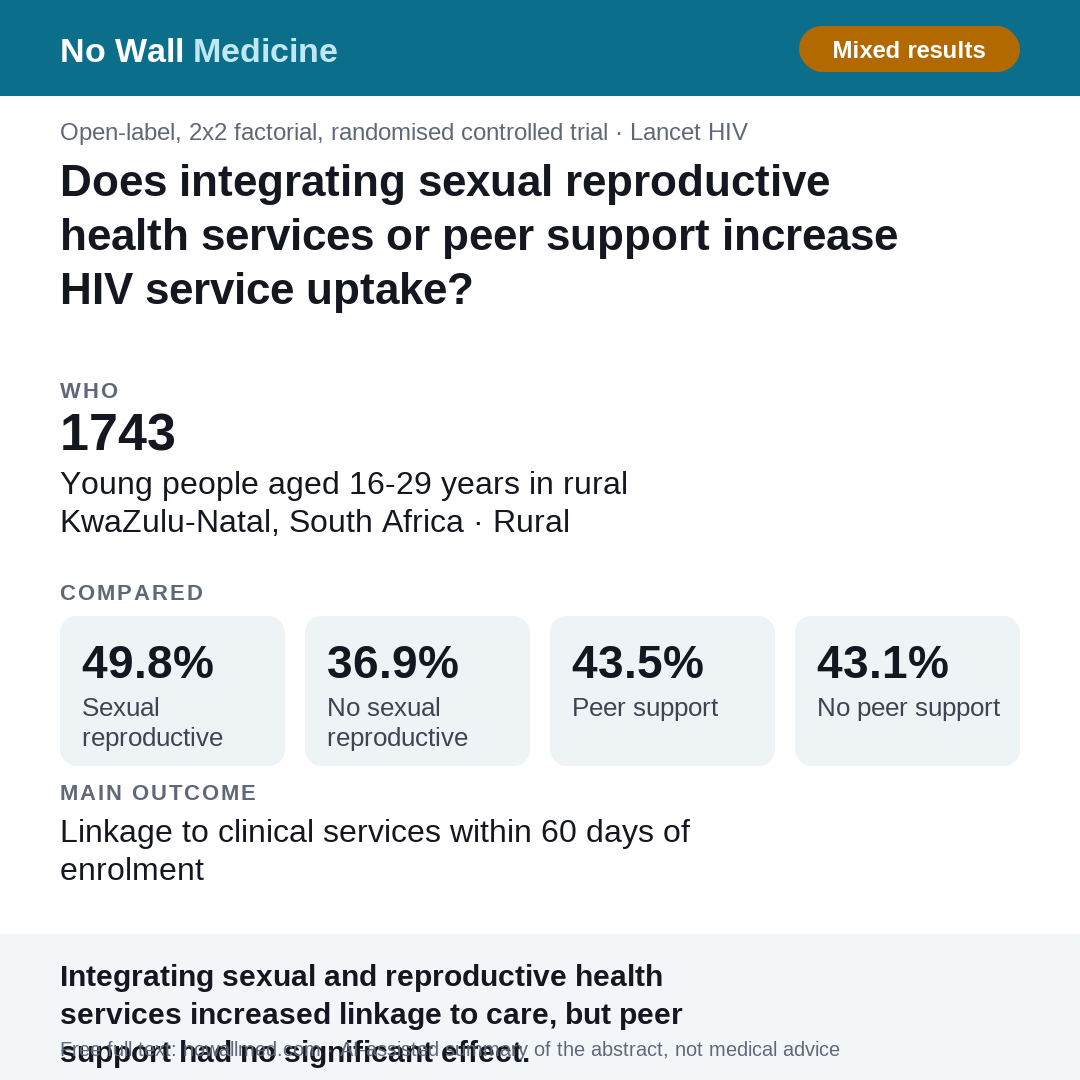
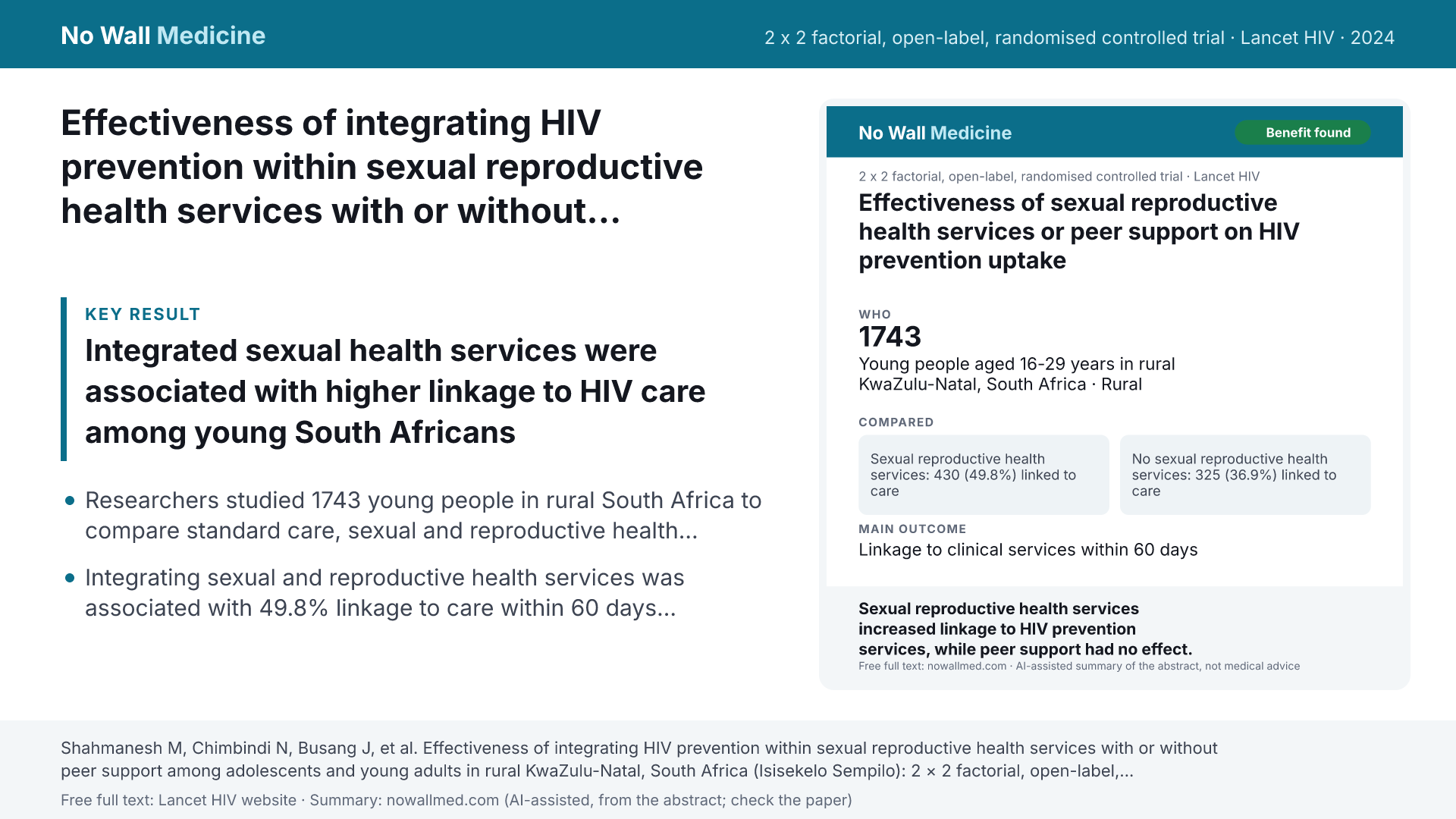
Integrated sexual health services were associated with higher linkage to HIV care among young South Africans
Effectiveness of integrating HIV prevention within sexual reproductive health services with or without peer support among adolescents and young adults in rural KwaZulu-Natal, South Africa (Isisekelo Sempilo): 2 × 2 factorial, open-label, randomised controlled trial
2 x 2 factorial, open-label, randomised controlled trialBenefit found
Effectiveness of sexual reproductive health services or peer support on HIV prevention uptake
Who
1743
Young people aged 16-29 years in rural KwaZulu-Natal, South Africa · Rural KwaZulu-Natal, South Africa
Compared
Sexual reproductive health services: 430 (49.8%) linked to care
No sexual reproductive health services: 325 (36.9%) linked to care
Main outcome
Linkage to clinical services within 60 days
Result: adjusted odds ratio 1.68 (95% CI 1.39-2.04)
Bottom line: Sexual reproductive health services increased linkage to HIV prevention services, while peer support had no effect.
Funded by: US National Institute of Health, Bill & Melinda Gates Foundation, and 3ie
Lancet HIV · 2024-06-27Download image
Why it matters: It is unknown if integrating sexual and reproductive health services or providing peer support improves the uptake of HIV prevention services among adolescents and young adults.
Key points
- Researchers studied 1743 young people in rural South Africa to compare standard care, sexual and reproductive health services, peer support, or a combination of both.
- Integrating sexual and reproductive health services was associated with 49.8% linkage to care within 60 days compared to 36.9% for those without such services.
- Peer support showed no effect on linkage to care, with 43.5% in the peer support group compared to 43.1% in the group without peer support.
Headline and key points written with AI from the paper’s abstract, with every number checked against it. Read the paper before relying on them.
Was this summary helpful?
Abstract
Background
Approximately 200 000 South Africans acquired HIV in 2021 despite the availability of universal HIV test and treat and pre-exposure prophylaxis (PrEP). The aim of this study was to test the effectiveness of sexual and reproductive health services or peer support, or both, on the uptake of serostatus neutral HIV services or reduction of sexually transmissible HIV. Methods
We did an open-label, 2 × 2 randomised factorial trial among young people in a mostly rural area of KwaZulu-Natal, South Africa. Inclusion criteria included being aged 16-29 years, living in the mapped geographical areas that were accessible to the area-based peer navigators, being willing and able to provide informed consent, and being willing to provide a dried blood spot for anonymous HIV testing and HIV viral load measurement at 12 months. Participants were randomly allocated by computer-generated algorithm to one of four groups: those in the standard-of-care group were referred to youth-friendly services for differentiated HIV prevention (condoms, universal HIV test and treat with antiretroviral therapy, and PrEP if eligible); those in the sexual and reproductive health services group received baseline self-collected specimens for sexually transmitted infection (STI) testing and referral to integrated sexual and reproductive health and HIV prevention services; those in the peer support group were referred to peer navigators for health promotion, condom provision, and facilitation of attendance for differentiated HIV prevention services; and those in the final group received a combination of sexual and reproductive health services and peer support. Coprimary outcomes were linkage to clinical services within 60 days of enrolment, proportion of participants who had sexually transmissible HIV at 12 months after enrolment, and proportion of sampled individuals who consented to participation and gave a dried blood spot for HIV testing at 12 months. Logistic regression was used for analyses, and adjusted for age, sex, and rural or peri-urban area of residence. This study is registered with ClinicalTrials.gov (NCT04532307) and is closed. Findings
Between March 2, 2020, and July 7, 2022, 1743 (75·7%) of 2301 eligible individuals were enrolled and followed up. 12-month dried blood spots were collected from 1168 participants (67·0%). The median age of the participants was 21 years (IQR 18-25), 51·4% were female, and 51·1% had secondary level education. Baseline characteristics and 12-month outcome ascertainment were similar between groups. 755 (43·3%) linked to services by 60 days. 430 (49·8%) of 863 who were in the sexual reproductive health services group were linked to care compared with 325 (36·9%) of 880 who were not in the sexual and reproductive health services group (adjusted odds ratio [aOR] 1·68; 95% CI 1·39-2·04); peer support had no effect: 385 (43·5%) of 858 compared with 370 (43·1%) of 885 (1·02, 0·84-1·23). At 12 months, 227 (19%) tested ELISA-positive for HIV, of whom 41 (18%) had viral loads of 400 copies per mL; overall prevalence of transmissible HIV was 3·5%. 22 (3·7%) of 578 participants in the sexual and reproductive health services group had transmissible HIV compared with 19 (3·3%) of 590 not in the sexual and reproductive health services group (aOR 1·12; 95% CI 0·60-2·11). The findings were also non-significant for peer support: 21 (3·3%) of 565 compared with 20 (3·3%) of 603 (aOR 1·03; 95% CI 0·55-1·94). There were no serious adverse events or deaths during the study. Interpretation
This study provides evidence that STI testing and sexual and reproductive health services create demand for serostatus neutral HIV prevention in adolescents and young adults in Africa. STI testing and integration of HIV and sexual health has the potential to reach those at risk and tackle unmet sexual health needs. Funding
US National Institute of Health, Bill & Melinda Gates Foundation, and 3ie.
Abstract reproduced under the article’s CC BY licence.
Subject terms
Cite this article
Shahmanesh M, Chimbindi N, Busang J, et al. Effectiveness of integrating HIV prevention within sexual reproductive health services with or without peer support among adolescents and young adults in rural KwaZulu-Natal, South Africa (Isisekelo Sempilo): 2 × 2 factorial, open-label, randomised controlled trial. Lancet HIV. 2024. doi:10.1016/S2352-3018(24)00119-X
Spotted a mistake? Suggest a correction