Interactive remote rehabilitation showed no significant advantages over conventional rehabilitation after total knee replacement
Effectiveness of Interactive Remote Rehabilitation After Total Knee Arthroplasty: Systematic Review and Meta-Analysis of Randomized Controlled Trials
Systematic review and meta-analysis of randomized controlled trialsNo clear difference
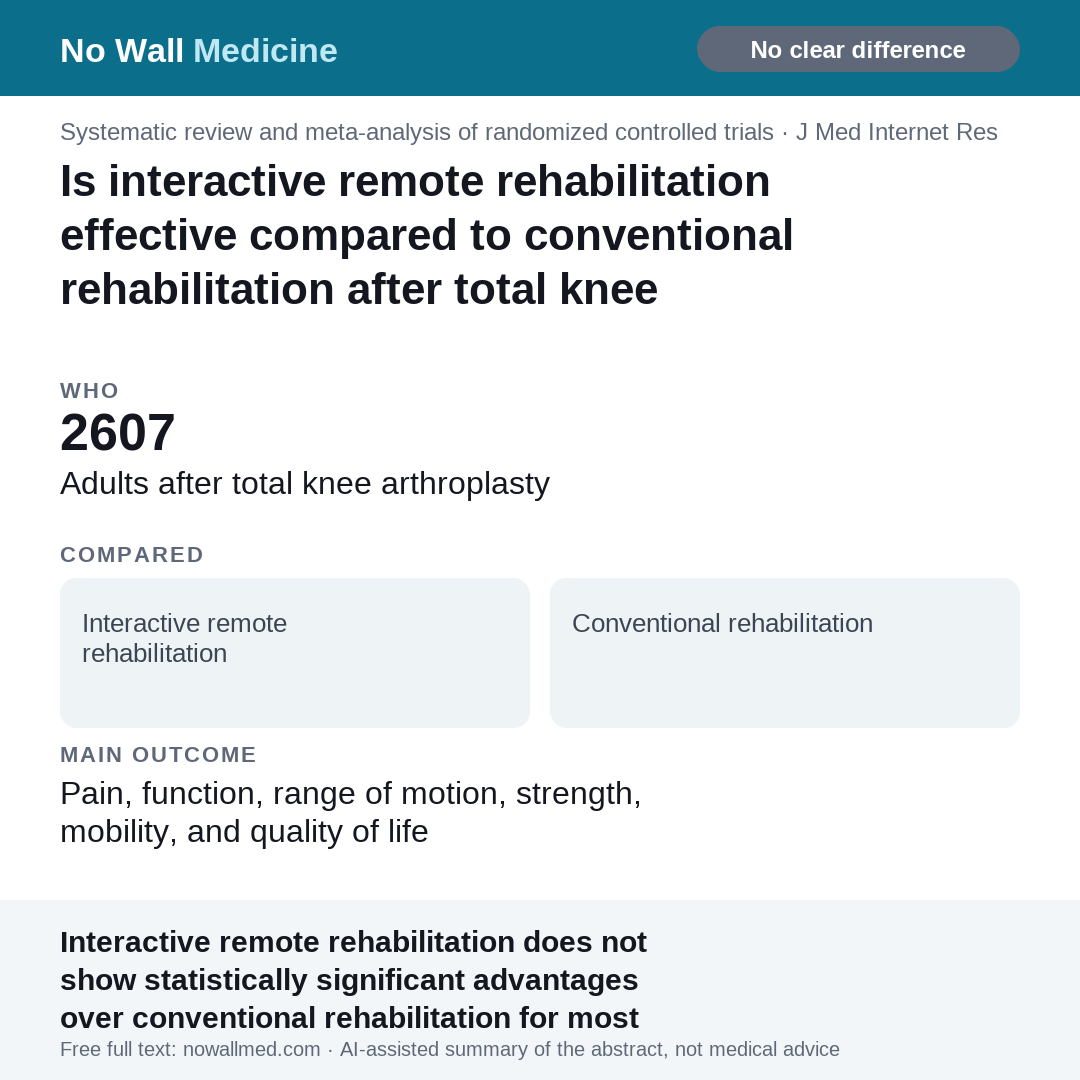
Is interactive remote rehabilitation effective compared to conventional rehabilitation after total knee arthroplasty?
Who
2607
Adults after total knee arthroplasty
Compared
Interactive remote rehabilitation
Conventional rehabilitation
Main outcome
Pain, function, range of motion, strength, mobility, and quality of life
Result: mean difference 0.26 (95% CI 0.04-0.48) for short-term active extension range of motion
Bottom line: Interactive remote rehabilitation does not show statistically significant advantages over conventional rehabilitation for most clinical outcomes after total knee arthroplasty.
Limitation: Heterogeneity was substantial, prediction intervals were frequently wide, and certainty of evidence was low to very low.
J Med Internet Res · 2026-08-07Download image
Clinical question: Is interactive remote rehabilitation effective compared to conventional rehabilitation after total knee arthroplasty?
Why it matters: Existing reviews often pool different types of remote interventions, making it difficult to determine if interactive models with bidirectional communication provide distinct clinical value.
Key points
- Researchers analyzed 23 randomized controlled trials involving 2607 participants to compare interactive remote rehabilitation with conventional rehabilitation after total knee replacement.
- Interactive remote rehabilitation did not show statistically significant advantages over conventional methods for pain, function, mobility, or quality of life across follow-up periods.
- A very small benefit was observed for short-term active extension range of motion with a mean difference of 0.26, though the clinical magnitude was limited.
Limitation the authors note: The certainty of evidence was generally low to very low, and heterogeneity was substantial for several outcomes.
Headline and key points written with AI from the paper’s abstract, with every number checked against it. Read the paper before relying on them.
Topics
Spotted a mistake? Suggest a correction