Internet-based telehealth programs improved function, pain, and self-efficacy for hip and knee osteoarthritis patients
Effectiveness of Internet-Based Telehealth Programs in Patients With Hip or Knee Osteoarthritis: Systematic Review and Meta-Analysis
Systematic review and meta-analysisBenefit found
Are internet-based telehealth programs effective for hip or knee osteoarthritis management?
Who
Patients with hip or knee osteoarthritis
Compared
Internet-based telehealth programs
Conventional interventions
Main outcome
Function, pain, and self-efficacy
Result: SMD 0.30 (95% CI 0.23-0.37) for function, SMD -0.27 (95% CI -0.34 to -0.19) for pain, SMD 0.21 (95% CI 0.08-0.34) for self-efficacy
Bottom line: Internet-based telehealth programs improve function, relieve pain, and improve self-efficacy compared to conventional interventions for osteoarthritis.
Limitation: Limited evidence suggests the inclusion of exercise regimens in internet-based telehealth programs is recommended.
J Med Internet Res · 2024-09-30Download image
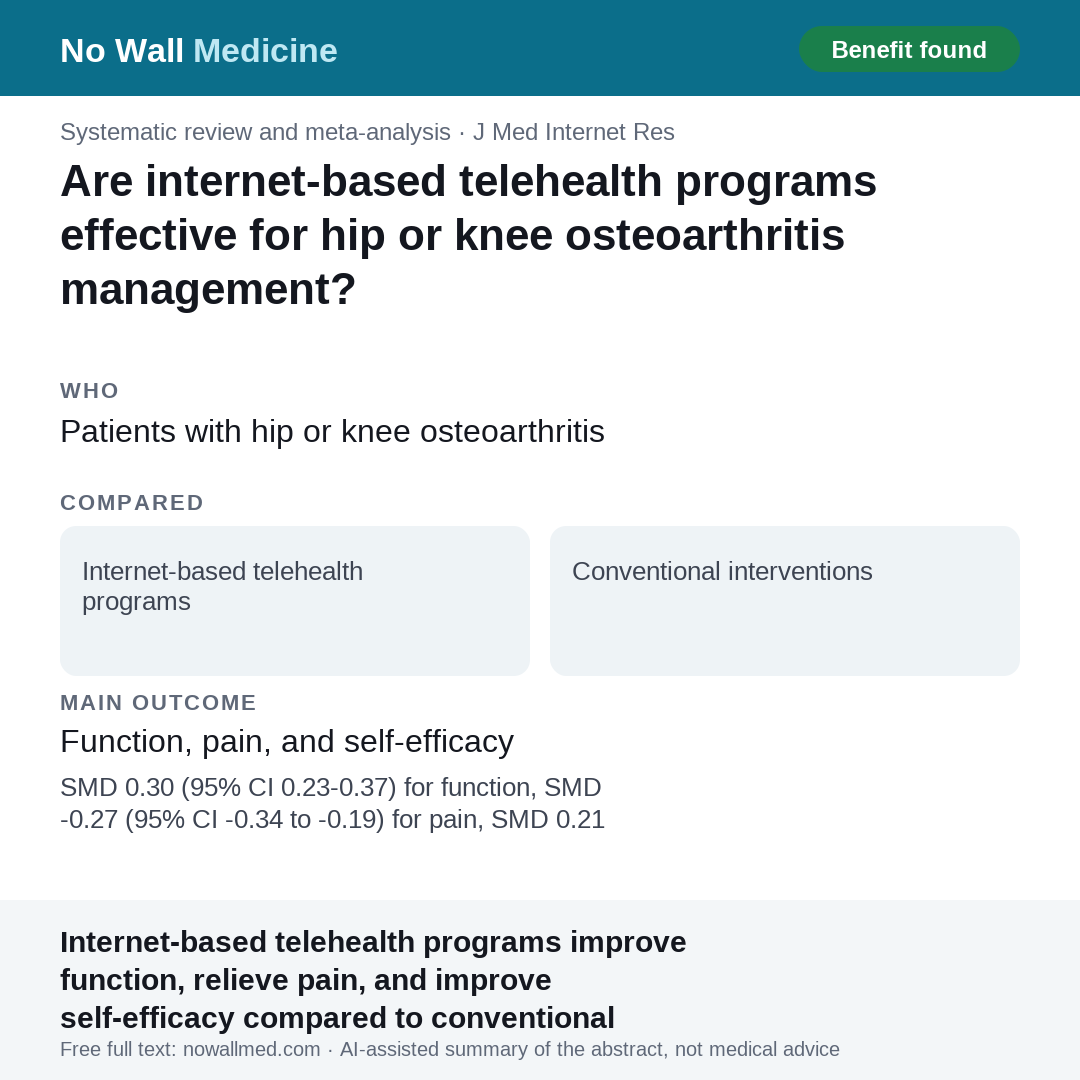
Clinical question: Are internet-based telehealth programs effective for hip or knee osteoarthritis management?
Why it matters: Access to nonpharmacological treatments for osteoarthritis is often limited due to uneven regional availability of local services.
Key points
- Researchers analyzed 21 studies comparing internet-based telehealth programs to conventional treatments for patients with hip or knee osteoarthritis.
- Telehealth programs were associated with increased function (SMD 0.30, 95% CI 0.23-0.37), less pain (SMD -0.27, 95% CI -0.34 to -0.19), and better self-efficacy for pain (SMD 0.21, 95% CI 0.08-0.34).
- Subgroup analysis showed telehealth with exercise improved all three outcomes, while telehealth with cognitive-behavioral therapy only affected pain.
Headline and key points written with AI from the paper’s abstract, with every number checked against it. Read the paper before relying on them.
Was this summary helpful?
Subject terms
Cite this article
Wang HN, Luo P, Liu S, Liu Y, Zhang X, Li J. Effectiveness of Internet-Based Telehealth Programs in Patients With Hip or Knee Osteoarthritis: Systematic Review and Meta-Analysis. J Med Internet Res. 2024. doi:10.2196/55576
Spotted a mistake? Suggest a correction
Top studies every Monday
The week’s key trials and guidelines in your specialties, plus any topics you follow. By email, free.
Get the weekly digest