Different intervention components increase vaccine uptake depending on the age group of the population
Effectiveness of interventions to increase vaccine uptake: component network meta-analysis
Infectious DiseaseAdult and pediatric
Component network meta-analysisMixed results
What intervention components effectively increase vaccine uptake?
Who
4361717
Participants in randomized controlled trials in high and upper middle income countries · High and upper middle income countries
Compared
Children: payments to cover costs: ratio of odds ratios 3.01 (95% CrI 1.49 to 6.06)
Adolescents: community member and healthcare professional delivery: ratio of odds ratios 6.42 (95% CrI 1.94 to 25.62)
Adults: human interaction: ratio of odds ratios 1.86 (95% CrI 1.42 to 2.45)
Main outcome
vaccine uptake
Bottom line: Effective intervention components vary significantly by age group, underserved populations, and the impact of the covid-19 pandemic.
BMJ · 2026-04-15Download image
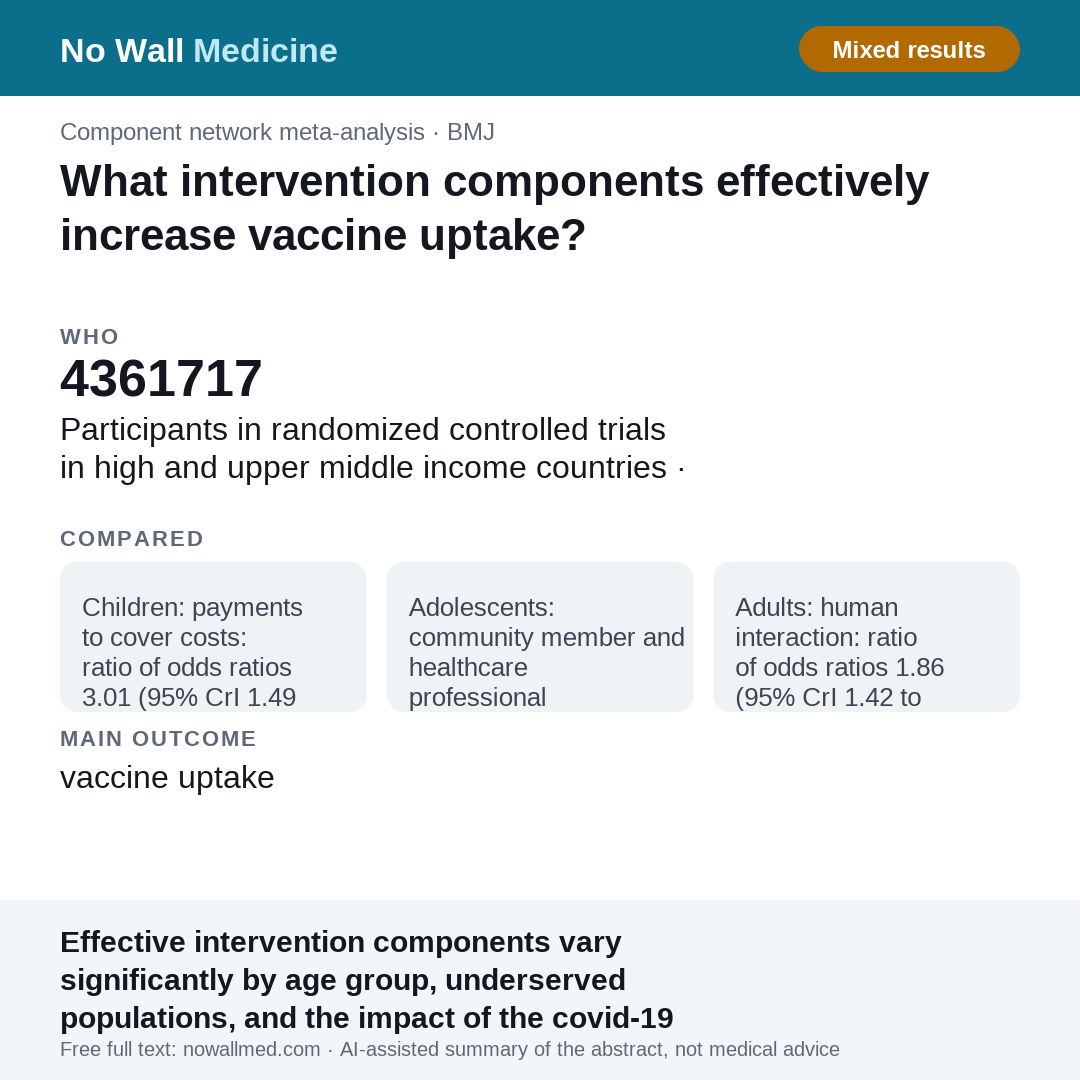
Clinical question: What intervention components effectively increase vaccine uptake?
Why it matters: Researchers sought to identify which specific parts of interventions effectively increase vaccine demand or access across different populations.
Key points
- Researchers analyzed 237 studies involving 4,361,717 participants to identify which intervention parts increase vaccine uptake.
- For children, payments to cover costs (3.01, 95% CrI 1.49 to 6.06) and decision aids (2.73, 1.14 to 7.06) showed beneficial effects.
- In adults, human interaction (1.86, 1.42 to 2.45) and motivational interviewing (1.79, 1.21 to 2.64) were effective components.
Headline and key points written with AI from the paper’s abstract, with every number checked against it. Read the paper before relying on them.
Abstract
Objectives
To identify the effective components of interventions to increase vaccine uptake and to explore variations in effectiveness by population group and in relation to the covid-19 pandemic. Design
Component network meta-analysis. Setting
Systematic review of randomised controlled trials in high and upper middle income countries. Participants
237 studies with 570 intervention arms and 4 361 717 participants. Interventions
Any intervention targeting vaccine recipients or their caregivers aiming to increase demand for, or access to, vaccinations on the UK immunisation schedule. Key content and delivery features of interventions were identified using a bespoke coding framework co-developed with stakeholders. Main outcome measures
The outcome of interest was vaccine uptake. Bayesian component level meta-regression estimated relative effects of intervention components as ratios of odds ratios with 95% credible intervals (CrIs). Results
Of the included studies, 110 were at low risk of bias, 96 had some concerns, and 31 were at high risk. 40% (n=1 744 686) of the participants were male. For children, there was evidence of beneficial effects for payments to cover costs (ratio of odds ratios 3.01, 95% CrI 1.49 to 6.06) and decision aids (2.73, 1.14 to 7.06), and some evidence for extended opportunities (1.37, 0.98 to 1.95) and social factors (1.27, 0.99 to 1.65). For adolescents and young adults, there were beneficial effects for personal delivery formats (2.13, 1.09 to 4.40), delivery by community members alongside healthcare professionals (6.42, 1.94 to 25.62), and social factors (2.62, 1.45 to 5.04), and negative effects for decision aids (0.43, 0.18 to 0.98) and human versus non-human interaction (0.47, 0.21 to 1.02). For adults, beneficial effects were shown for human interaction (1.86, 1.42 to 2.45), extended opportunities (1.63, 1.35 to 2.00), help with appointment scheduling (1.38, 1.06 to 1.78), payments to cover costs (1.47, 1.03 to 2.16), and motivational interviewing (1.79, 1.21 to 2.64), and there was some evidence for financial incentives (1.15, 0.99 to 1.35) and information on vaccine safety and/or efficacy (1.15, 0.99 to 1.32). For adults, evidence also showed a negative effect of non-human interaction versus no interaction (0.72, 0.57 to 0.92). Subgroup analyses showed variation for underserved populations and in relation to the covid-19 pandemic (before 2020 and 2020 onwards). Conclusion
Overall, extended opportunities, appointment scheduling help, financial incentives, payments to cover costs, and motivational interviewing were effective content components of interventions to increase vaccine uptake. Effective delivery components overall were human interaction and delivery by community members alongside healthcare professionals. However, effective components varied by age group, for underserved populations, and in analyses investigating the impact of the covid-19 pandemic. These findings have important implications for designing, optimising, and implementing targeted interventions, highlighting which components are effective across different populations and contexts. Consideration of the economic data on interventions should further support resource informed decision making.
Abstract reproduced under the article’s CC BY licence.
Topics
Spotted a mistake? Suggest a correction