Home visits and self-test kits increased couples HIV testing rates among pregnant women in Kenya
Effectiveness of interventions to promote couples-based HIV testing and family health during pregnancy and postpartum in Kenya: a multicentre, couples-based, randomised controlled trial
Multicentre, couples-based, randomised controlled trialBenefit found
Are couples-focused interventions effective for HIV testing and family health during pregnancy and postpartum?
Who
800
HIV status-concordant and HIV status-discordant pregnant couples aged 15 years or older · 24 antenatal clinics in Migori and Kisumu counties, Kenya
Compared
56.2%home visit group
50.0%HIV self-test group
13.6%standard care group
Main outcome
both couple members reporting couples HIV testing and counselling uptake
Result: adjusted risk ratio 4.22 (95% CI 2.88-6.18)
Bottom line: Home visits and HIV self-test kits increased couples HIV testing uptake compared to standard care in Kenya.
Funded by: National Institute of Mental Health
Lancet HIV · 2026-06-29Download image
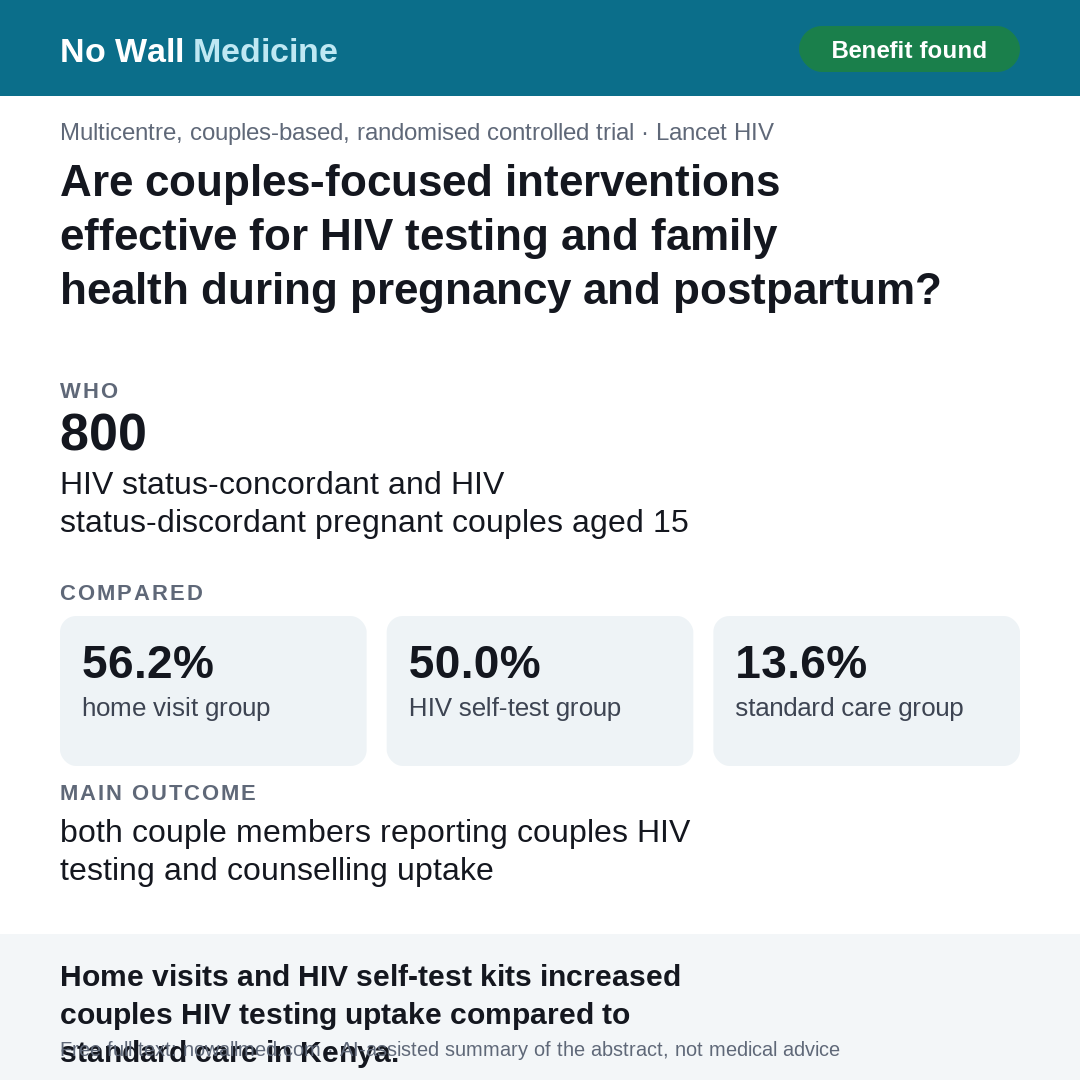
Clinical question: Are couples-focused interventions effective for HIV testing and family health during pregnancy and postpartum?
Why it matters: Engaging couples during pregnancy may improve HIV prevention and family health, but the effectiveness of specific interventions remains understudied.
Key points
- Researchers studied 800 pregnant couples in Kenya assigned to home visits, HIV self-test kits, or standard health facility care.
- Couples receiving home visits had a 56.2% uptake of couples HIV testing and counseling, while the self-test group had 50.0% compared to 13.6% for standard care.
- The study reported 54 severe adverse pregnancy outcomes and 37 adverse events, including two that were possibly related to study procedures.
Headline and key points written with AI from the paper’s abstract, with every number checked against it. Read the paper before relying on them.
Abstract
Background
Engaging couples during pregnancy can improve HIV prevention and family health. We examined the effectiveness of two couples-focused interventions on uptake of couples HIV testing and counselling (CHTC) and maternal and child health outcomes. Methods
In this multicentre, couples-based, randomised controlled trial, HIV status-concordant and HIV status-discordant pregnant couples (aged ≥15 years) from 24 antenatal clinics across Migori and Kisumu counties in Kenya were randomly assigned (1:1:1) to one of three study groups: lay counsellors delivered five couple home visits on health and relationship skills and offered CHTC at home (home visit group); HIV self-test kits were given to women to use with their partners (HIV self-test group); standard care access with routine perinatal health services offered at their health facility, including offers of individual and couples HIV testing (standard care group). Couples were followed up to 18 months postpartum. The primary outcome was both couple members reporting CHTC uptake by 12 months postpartum. For analyses, we used generalised linear and generalised estimating equation models. This trial is registered at ClinicalTrials.gov, NCT03547739, and is complete. Findings
Between March 20, 2019, and July 26, 2022, we recruited and randomly assigned 800 couples to the home visit group (n=267), HIV self-test group (n=266), or standard care group (n=267). Two-thirds (n=533 [66·7%]) of couples included a woman living with HIV. CHTC uptake was higher in the home visit group and HIV self-test group, with 114 (56·2%; adjusted risk ratio 4·22 [95% CI 2·88-6·18]) and 106 (50·0%; 3·69 [2·50-5·45]) couples reporting CHTC by 12 months, compared with 26 (13·6%) in the standard care group. We reported 54 severe adverse events (adverse pregnancy outcomes, none related to study procedures) and 37 adverse events (two possibly related to study procedures). Interpretation
Both home visits and HIV self-test kits offer a gateway for positive health outcomes for perinatal women and families. Home visits, which directly engage both members of the couple, can provide additional advantages for HIV-related health. Funding
National Institute of Mental Health. Translation
For the Kiswahili translation of the abstract see Supplementary Materials section.
Abstract reproduced under the article’s CC BY NC ND licence.
Topics
Spotted a mistake? Suggest a correction