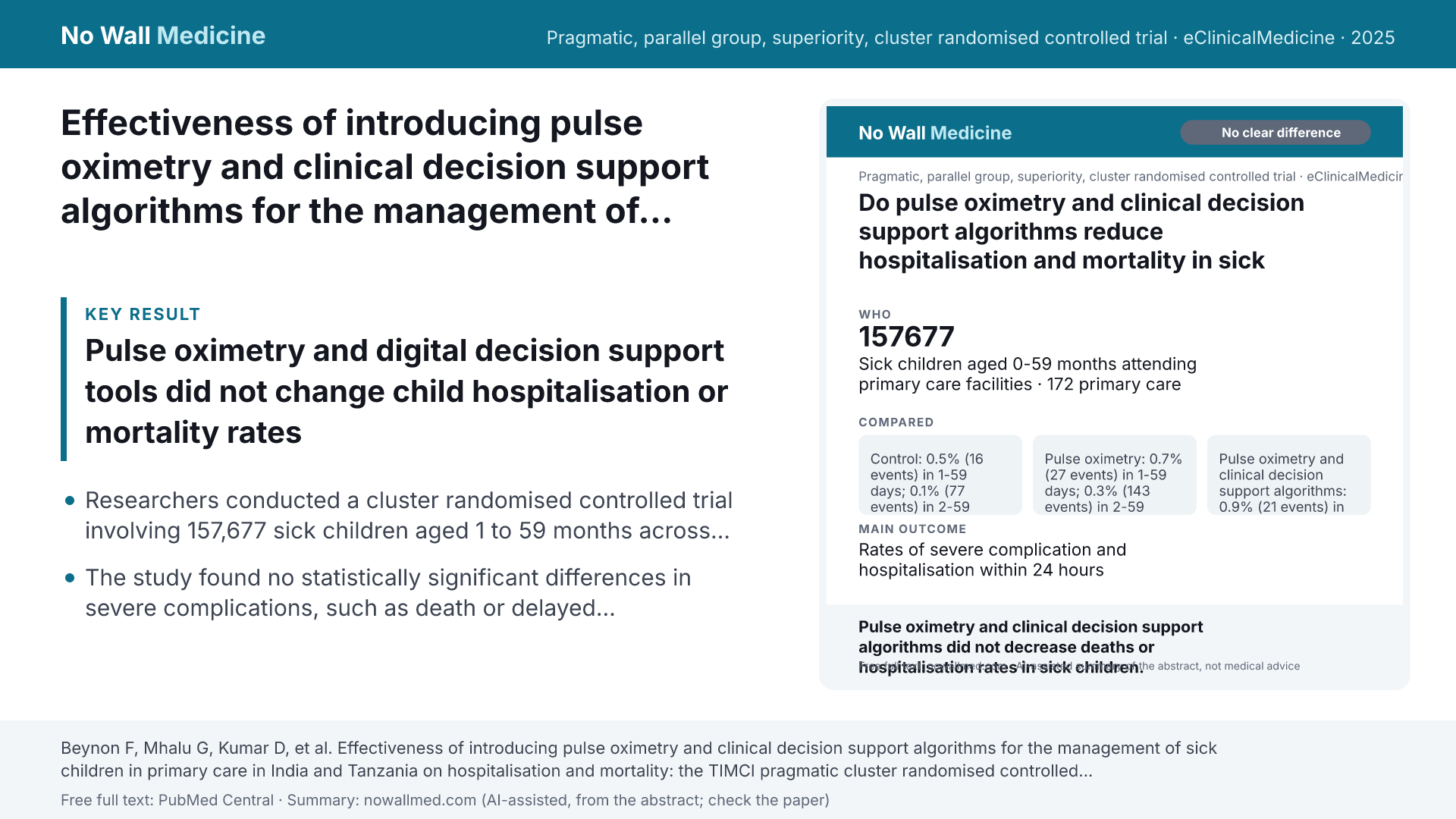
Pulse oximetry and digital decision support tools did not change child hospitalisation or mortality rates
Effectiveness of introducing pulse oximetry and clinical decision support algorithms for the management of sick children in primary care in India and Tanzania on hospitalisation and mortality: the TIMCI pragmatic cluster randomised controlled trial
Pragmatic, parallel group, superiority, cluster randomised controlled trialNo clear difference
Do pulse oximetry and clinical decision support algorithms reduce hospitalisation and mortality in sick children?
Who
157677
Sick children aged 0-59 months attending primary care facilities · 172 primary care facilities in India and Tanzania
Compared
Control: 0.5% (16 events) in 1-59 days; 0.1% (77 events) in 2-59 months
Pulse oximetry: 0.7% (27 events) in 1-59 days; 0.3% (143 events) in 2-59 months
Pulse oximetry and clinical decision support algorithms: 0.9% (21 events) in 1-59 days; 0.3% (128 events) in 2-59 months
Main outcome
Rates of severe complication and hospitalisation within 24 hours
Bottom line: Pulse oximetry and clinical decision support algorithms did not decrease deaths or hospitalisation rates in sick children.
Funded by: Unitaid
eClinicalMedicine · 2025-07-03Download image
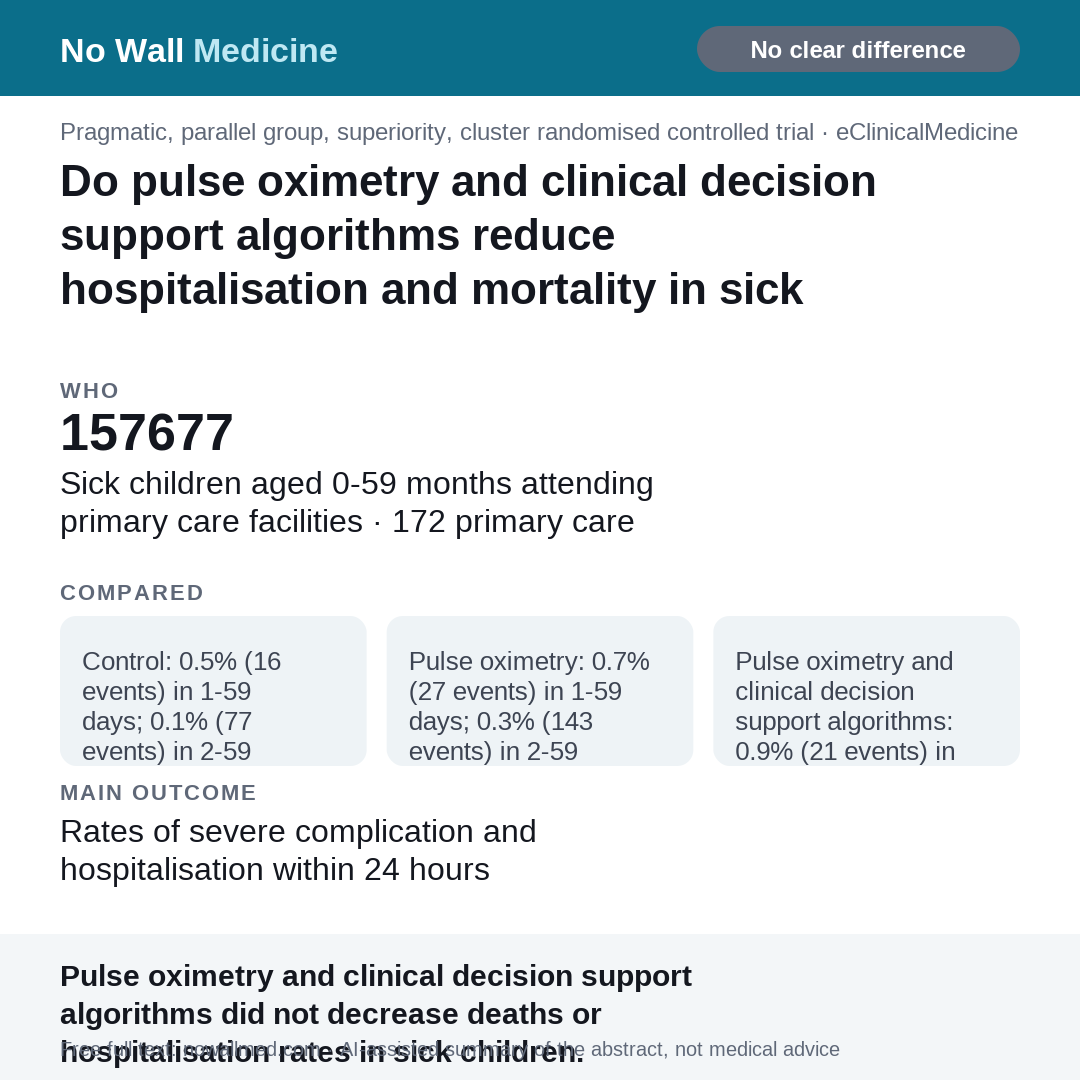
Clinical question: Do pulse oximetry and clinical decision support algorithms reduce hospitalisation and mortality in sick children?
Why it matters: It is unknown if providing pulse oximetry and digital clinical decision support algorithms to primary care providers impacts hospitalisation and mortality for children under five.
Key points
- Researchers conducted a cluster randomised controlled trial involving 157,677 sick children aged 1 to 59 months across 172 primary care facilities in India and Tanzania.
- The study found no statistically significant differences in severe complications, such as death or delayed hospitalisation, when comparing pulse oximetry or digital clinical decision support algorithms to control groups.
- In the 2-59 months age group, the pulse oximetry arm showed a slight increase in severe complications with 143 events (0.3%, adjusted risk difference 0.1% [0.0%; 0.2%]).
Headline and key points written with AI from the paper’s abstract, with every number checked against it. Read the paper before relying on them.
Was this summary helpful?
Cite this article
Beynon F, Mhalu G, Kumar D, et al. Effectiveness of introducing pulse oximetry and clinical decision support algorithms for the management of sick children in primary care in India and Tanzania on hospitalisation and mortality: the TIMCI pragmatic cluster randomised controlled trial. eClinicalMedicine. 2025. doi:10.1016/j.eclinm.2025.103306
Spotted a mistake? Suggest a correction