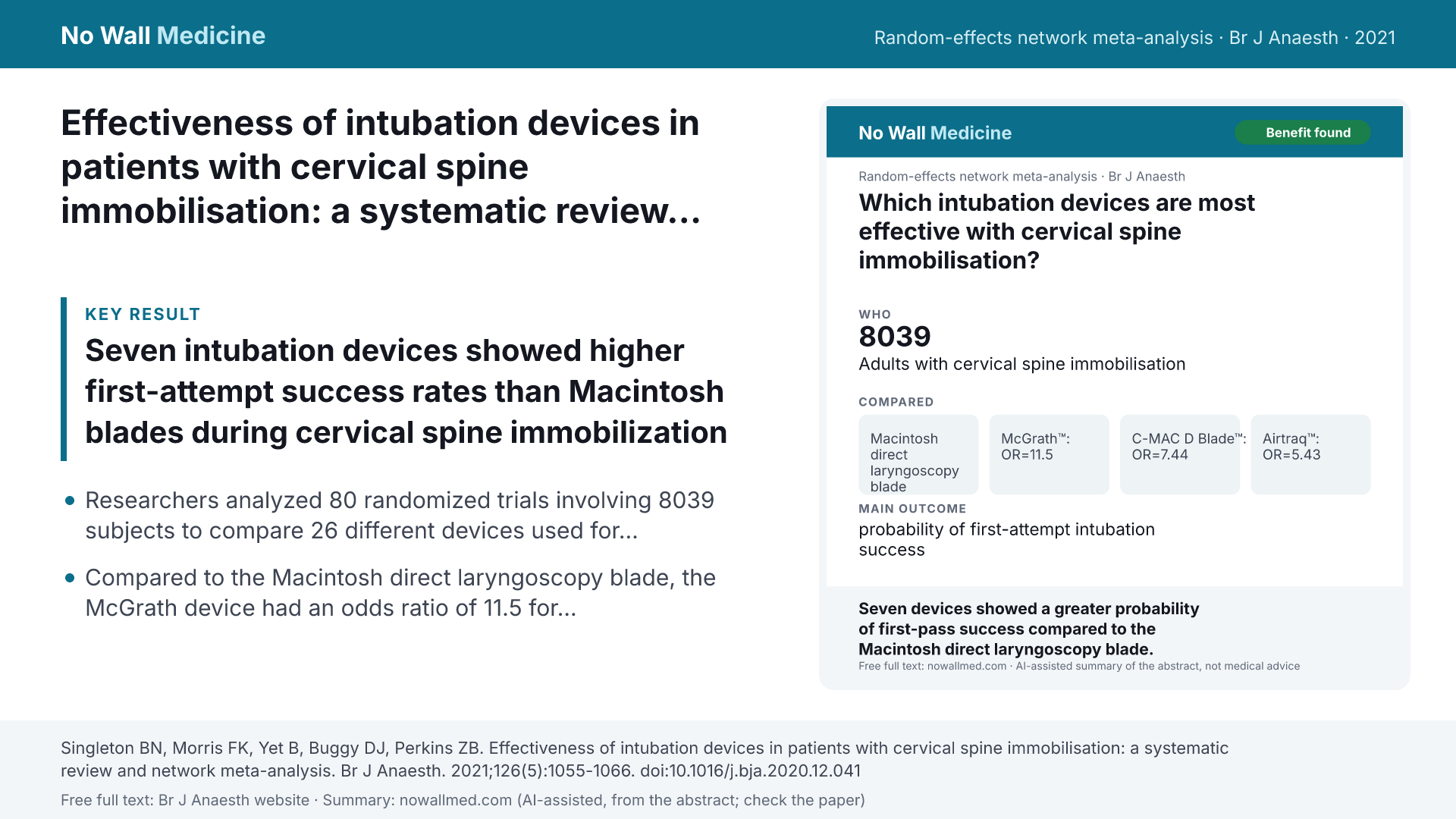
Seven intubation devices showed higher first-attempt success rates than Macintosh blades during cervical spine immobilization
Effectiveness of intubation devices in patients with cervical spine immobilisation: a systematic review and network meta-analysis
Random-effects network meta-analysisBenefit found
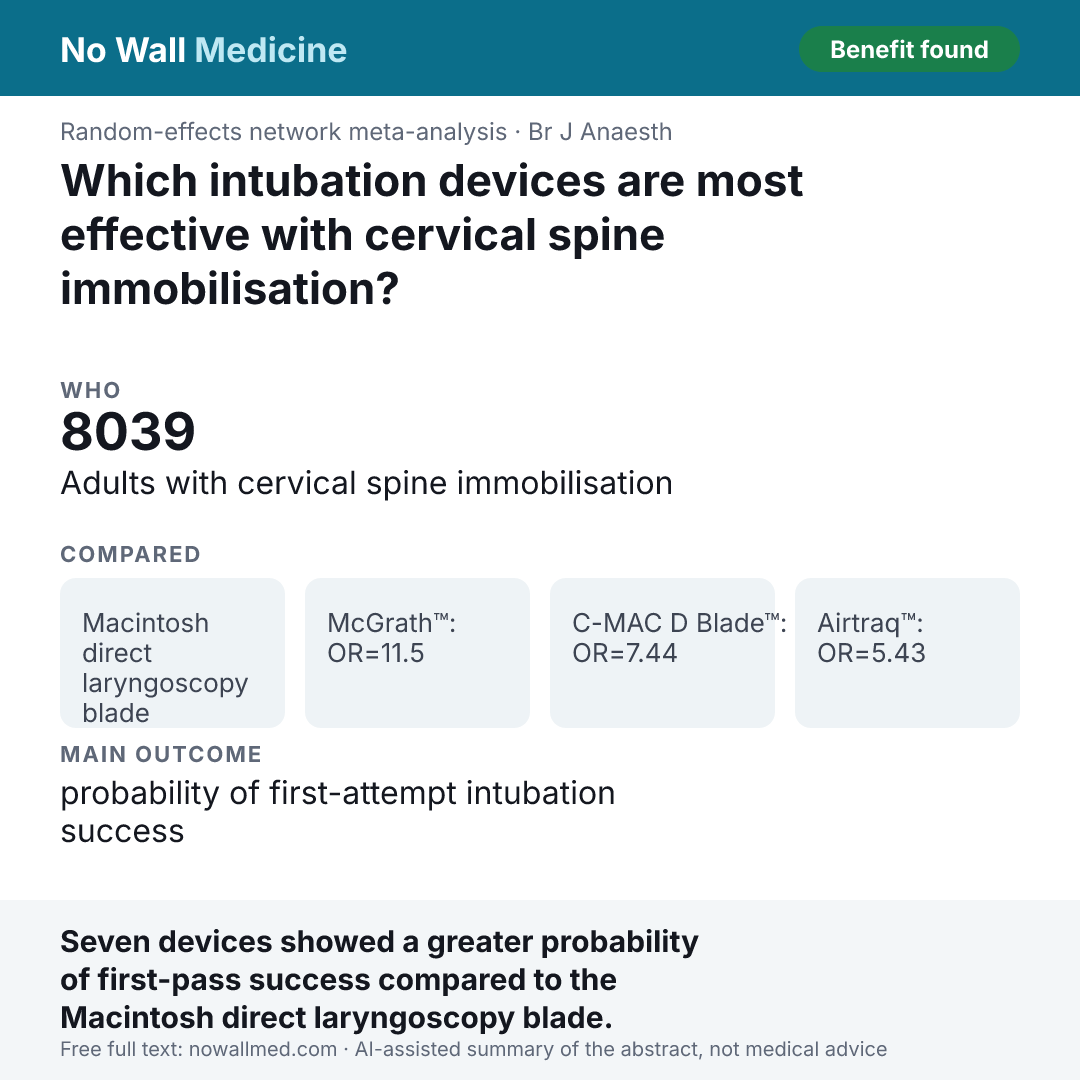
Which intubation devices are most effective with cervical spine immobilisation?
Who
8039
Adults with cervical spine immobilisation
Compared
Macintosh direct laryngoscopy blade
McGrath™: OR=11.5
C-MAC D Blade™: OR=7.44
Airtraq™: OR=5.43
Main outcome
probability of first-attempt intubation success
Result: OR=11.5 (95% CrI 3.19-46.20) for McGrath™
Bottom line: Seven devices showed a greater probability of first-pass success compared to the Macintosh direct laryngoscopy blade.
Limitation: More studies using manual-in-line stabilisation are needed to represent clinical practice.
Br J Anaesth · 2021-02-17 · Save PNG
Clinical question: Which intubation devices are most effective with cervical spine immobilisation?
Why it matters: The relative performance of various breathing tube insertion devices remains uncertain when patients require cervical spine immobilization.
Key points
- Researchers analyzed 80 randomized trials involving 8039 subjects to compare 26 different devices used for inserting breathing tubes.
- Compared to the Macintosh direct laryngoscopy blade, the McGrath device had an odds ratio of 11.5 for first-pass success.
- Other devices with higher success probabilities included the C-MAC D Blade (OR=7.44), Airtraq (OR=5.43), King Vision (OR=4.54), C-MAC (OR=4.20), and GlideScope with a tube guide (OR=3.54).
Headline and key points written with AI from the paper’s abstract, with every number checked against it. Read the paper before relying on them.
Was this summary helpful?
Subject terms
Headline, design, result, key points, caveat and citation as plain text.
Cite this article
Singleton BN, Morris FK, Yet B, Buggy DJ, Perkins ZB. Effectiveness of intubation devices in patients with cervical spine immobilisation: a systematic review and network meta-analysis. Br J Anaesth. 2021;126(5):1055-1066. doi:10.1016/j.bja.2020.12.041
Spotted a mistake? Suggest a correction