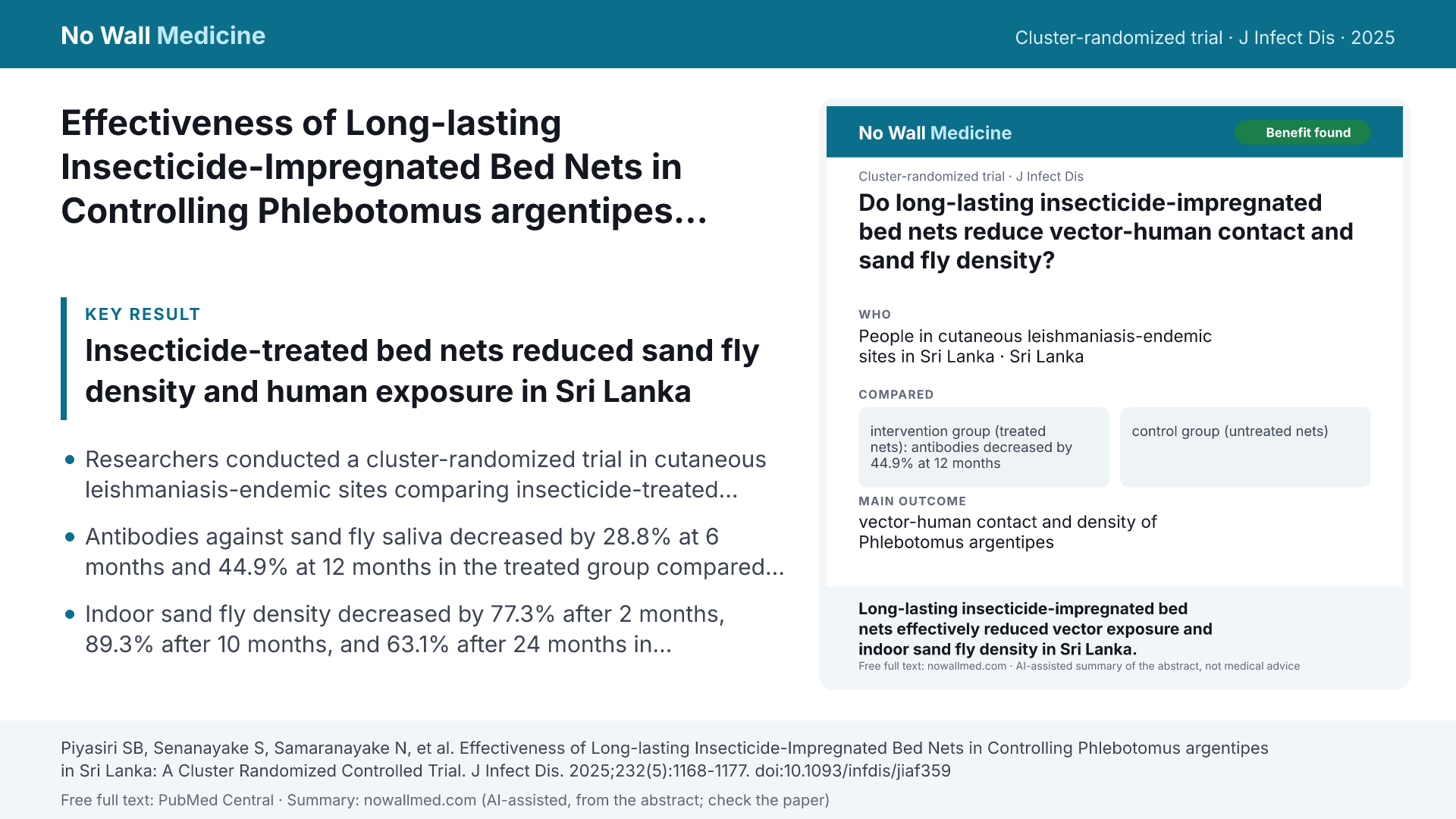
Insecticide-treated bed nets reduced sand fly density and human exposure in Sri Lanka
Effectiveness of Long-lasting Insecticide-Impregnated Bed Nets in Controlling Phlebotomus argentipes in Sri Lanka: A Cluster Randomized Controlled Trial
Cluster-randomized trialBenefit found
Do long-lasting insecticide-impregnated bed nets reduce vector-human contact and sand fly density?
Who
People in cutaneous leishmaniasis-endemic sites in Sri Lanka · Sri Lanka
Compared
intervention group (treated nets): antibodies decreased by 44.9% at 12 months
control group (untreated nets)
Main outcome
vector-human contact and density of Phlebotomus argentipes
Bottom line: Long-lasting insecticide-impregnated bed nets effectively reduced vector exposure and indoor sand fly density in Sri Lanka.
J Infect Dis · 2025-07-07Download image
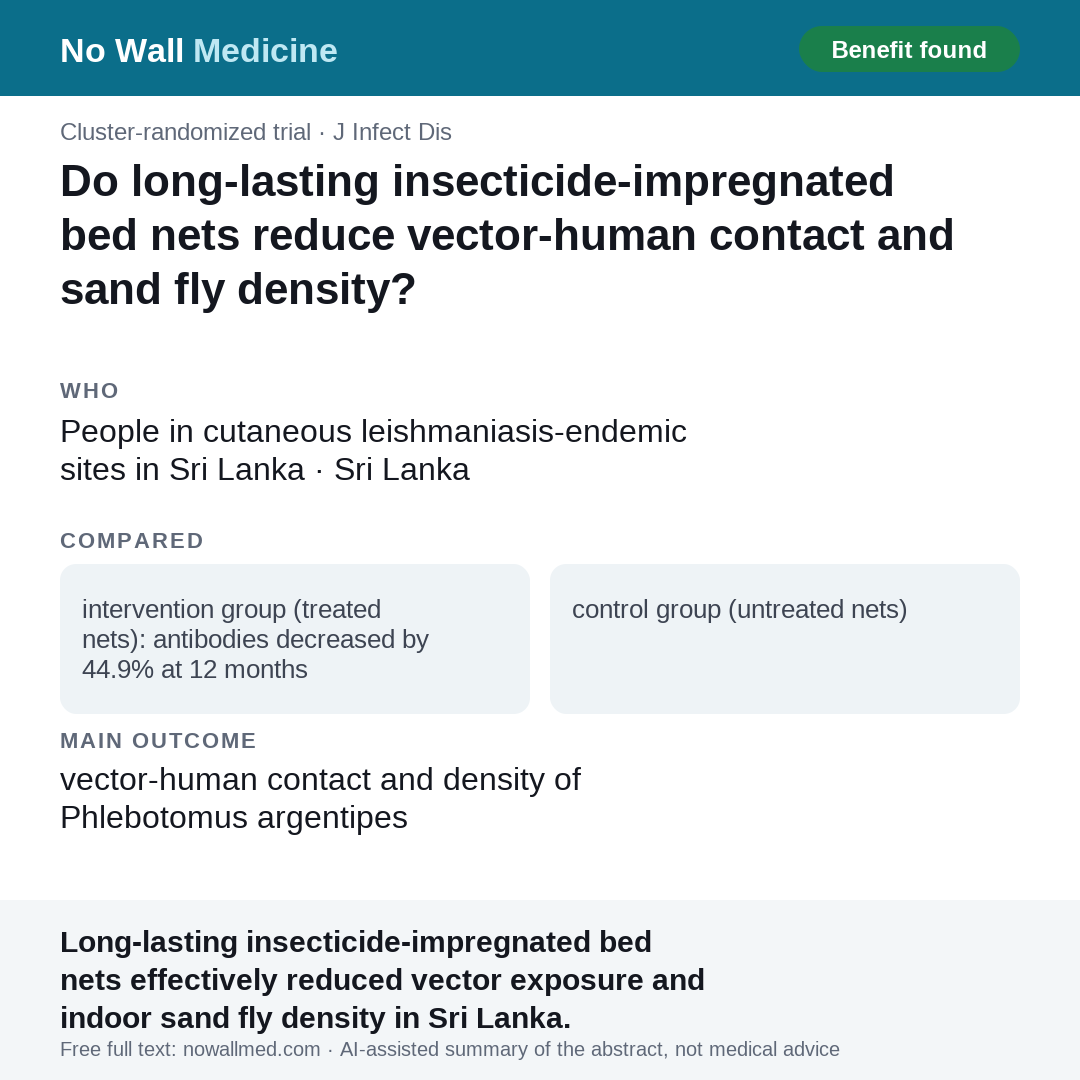
Clinical question: Do long-lasting insecticide-impregnated bed nets reduce vector-human contact and sand fly density?
Why it matters: The impact of long-lasting insecticide-impregnated bed nets on interrupting sand fly bites has not been tested in Sri Lanka.
Key points
- Researchers conducted a cluster-randomized trial in cutaneous leishmaniasis-endemic sites comparing insecticide-treated bed nets to untreated nets.
- Antibodies against sand fly saliva decreased by 28.8% at 6 months and 44.9% at 12 months in the treated group compared to controls.
- Indoor sand fly density decreased by 77.3% after 2 months, 89.3% after 10 months, and 63.1% after 24 months in the intervention group.
Headline and key points written with AI from the paper’s abstract, with every number checked against it. Read the paper before relying on them.
Was this summary helpful?
Subject terms
Cite this article
Piyasiri SB, Senanayake S, Samaranayake N, Iniguez E, Valenzuela JG, Piyasiri NN. Effectiveness of Long-lasting Insecticide-Impregnated Bed Nets in Controlling Phlebotomus argentipes in Sri Lanka: A Cluster Randomized Controlled Trial. J Infect Dis. 2025. doi:10.1093/infdis/jiaf359
Spotted a mistake? Suggest a correction