Maintenance interventions may improve physical activity and quality of life after exercise therapy
Effectiveness of maintenance interventions promoting physical activity following exercise therapy for chronic conditions: an umbrella review
Umbrella review of 19 systematic reviewsBenefit found
Are maintenance interventions effective for physical activity and health after exercise therapy?
Who
136
People with chronic respiratory, cardiovascular, low back, or osteoarthritis
Compared
Digital health interventions: SMD 0.37 (95% CI 0.05 to 0.69)
In-person booster sessions: no beneficial effects
Mixed maintenance interventions: SMD 2.14 (95% CI 0.9 to 3.38)
Main outcome
physical activity, physical function, fitness, and quality of life
Result: SMD 0.37 (95% CI 0.05 to 0.69)
Bottom line: Maintenance interventions may improve physical activity, physical function, and quality of life, though evidence certainty is low.
Limitation: Most reviews had an unclear risk of bias and evidence certainty was low.
Br J Sports Med · 2026-06-12Download image
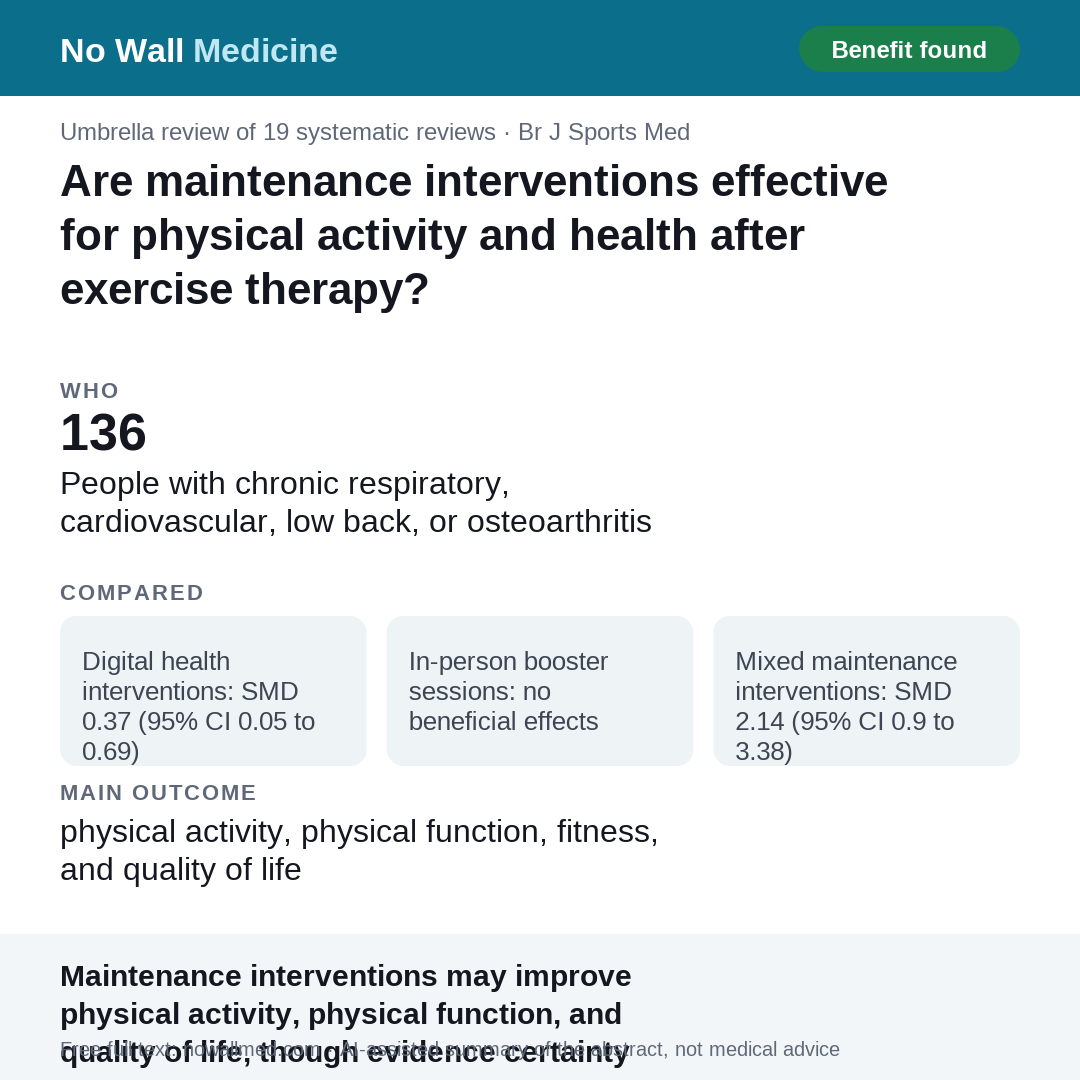
Clinical question: Are maintenance interventions effective for physical activity and health after exercise therapy?
Why it matters: It is unclear how to effectively help people with chronic conditions maintain physical activity levels after completing an initial exercise therapy program.
Key points
- Researchers reviewed 19 systematic reviews containing 136 randomized controlled trials involving people with chronic respiratory, cardiovascular, low back, or knee and hip osteoarthritis.
- Digital interventions improved subjective physical activity, while mixed delivery methods improved health-related quality of life, objective physical activity, and objective physical function.
- The review found no clear effect or inconsistent effects for fitness, adverse events, hospitalisation, or return to work.
Limitation the authors note: The findings are based on low certainty of evidence and many reviews had an unclear risk of bias.
Headline and key points written with AI from the paper’s abstract, with every number checked against it. Read the paper before relying on them.
Abstract
Objective
To investigate the effectiveness of maintenance interventions postexercise therapy on physical activity (PA), physical function, fitness, health-related quality of life, adverse events, hospitalisation and return to work in people with chronic conditions. Design
In this umbrella review, a narrative synthesis was conducted. Risk of bias was assessed using the Risk of Bias in Systematic Reviews tool. The quality and certainty of evidence were evaluated using Grading of Recommendation, Assessment, Development and Evaluation. Data sources
Medline, Embase and CINAHL were searched from inception to 20 August 2024. Eligibility criteria
Systematic reviews of randomised controlled trials (RCTs) investigating the effectiveness of maintenance interventions following exercise therapy in people with chronic conditions. Results
From 10 931 results, 19 systematic reviews (136 unique RCTs) were included. Reviews included people with chronic respiratory disease (n=64), cardiovascular disease (n=54), chronic low back pain (n=4) or knee/hip osteoarthritis (n=14). Most reviews had an unclear risk of bias (n=10). We identified three types of maintenance interventions based on delivery mode: primarily digital, primarily inperson and a mixed category comprising exclusively digital, inperson or hybrid delivery. Beneficial effects were found for digital health interventions on subjective PA (standardised mean difference (SMD) 0.37, 95% CI 0.05 to 0.69, low certainty), but no beneficial effects were found for inperson booster sessions (very low to low certainty). Mixed maintenance interventions showed beneficial effects for health-related quality of life (MD 0.28 points 95% CI 0.05 to 0.52; SMD 0.22 95% CI 0.03 to 0.41; MD -2.69 points 95% CI -4.49 to -0.9; moderate certainty), objective PA (SMD 2.14 95% CI 0.9 to 3.38, low certainty) and objective physical function (SMD 0.48 95% CI 0.19 to 0.77, low certainty). We found no effect or inconsistent effects for fitness, adverse events, hospitalisation and return-to-work (low to moderate certainty). Conclusion
Maintenance interventions may help people continue to be physically active and improve physical function and health-related quality of life. However, this is based on low certainty of evidence. The remaining outcomes were generally inconsistent or indicated no effects. Digital maintenance interventions show some beneficial effects for PA but higher-quality studies are needed across various chronic conditions. Prospero registration number
CRD42024579734.
Abstract reproduced under the article’s CC BY NC licence.
Topics
Spotted a mistake? Suggest a correction
More in Orthopedics & Sports Medicine
Higher pre-treatment expectations associated with less pain and better function after physiotherapy
Higher pre-treatment expectations are associated with less pain and better physical function and quality of life after physiotherapy for knee osteoarthritis
Patellofemoral osteochondritis dissecans patients have distinct knee anatomy
Is There an Association Between Abnormal Patellofemoral Morphology and Patellofemoral Osteochondritis Dissecans in Pediatric Patients?
Newly Diagnosed Dyslipidemia Linked to Higher Risk of Osteoarthritis
Association Between Newly Diagnosed Dyslipidemia and Joint-Specific Incident Osteoarthritis: A Nationwide Propensity-Score-Matched Cohort Study