Motor imagery combined with circuit training improved mobility and balance in people after a stroke
Effectiveness of Motor Imagery Combined with Structured Progressive Circuit Class Training on Functional Mobility in Post-Stroke Individuals: A Randomized Controlled Trial
Randomized controlled trialBenefit found
Does motor imagery plus circuit class therapy improve mobility in post-stroke individuals?
Who
40
post-stroke individuals
Compared
motor imagery and circuit class therapy
health education and circuit class therapy
Main outcome
dynamic balance, endurance, and functional mobility
Bottom line: Motor imagery combined with circuit class therapy is more effective for restoring mobility and endurance in post-stroke individuals.
J Rehabil Med · 2022-07-27Download image
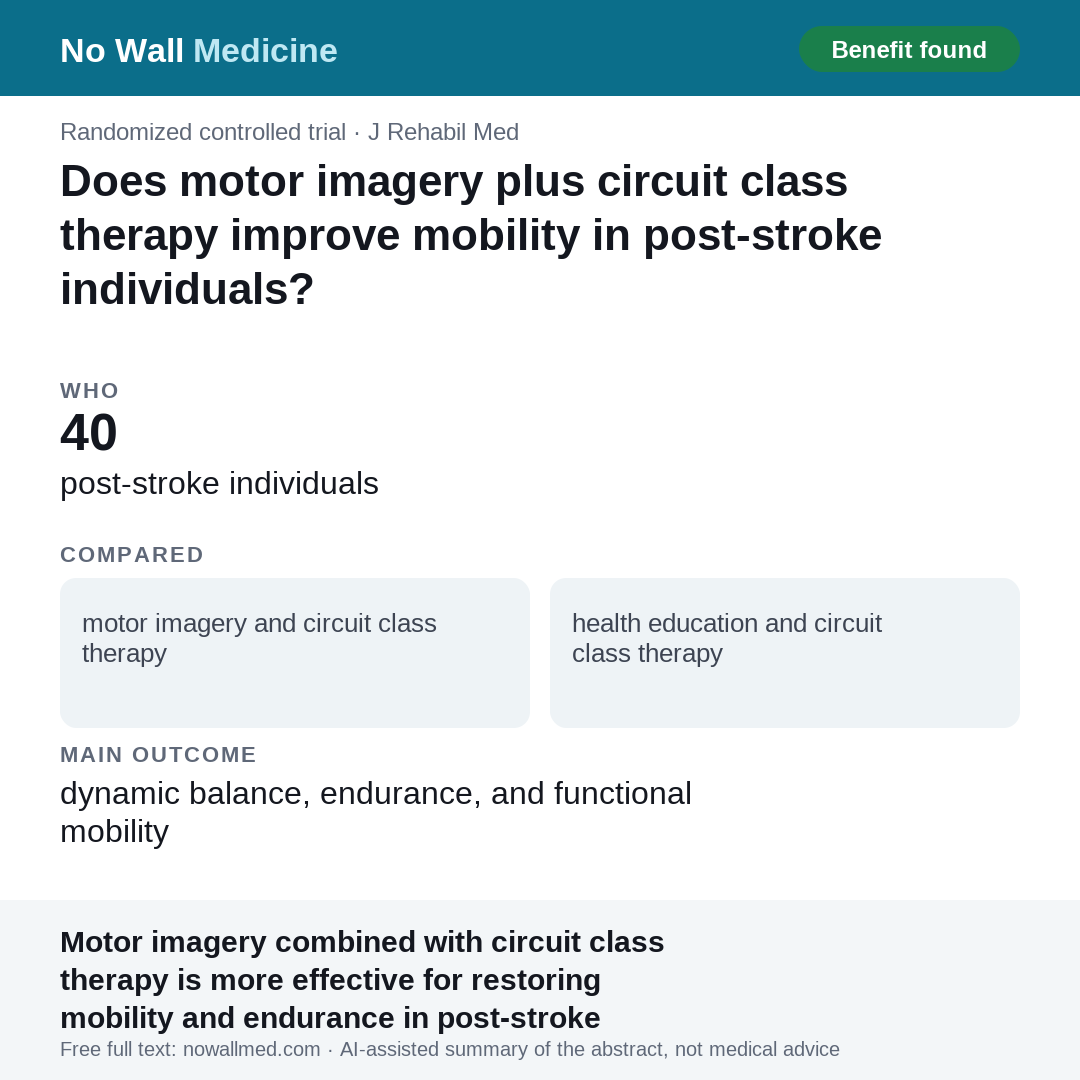
Clinical question: Does motor imagery plus circuit class therapy improve mobility in post-stroke individuals?
Why it matters: It was unknown if adding motor imagery, which involves mental practice of movements, to circuit training improves balance, endurance, and mobility after a stroke.
Key points
- Researchers studied 40 post-stroke individuals who were randomly assigned to receive either motor imagery with circuit training or health education with circuit training.
- At 4 weeks, the motor imagery group showed significant differences in the step test for both limbs and the Timed Up and Go test, which measures functional mobility.
- The motor imagery group also showed significant differences in the 6-Minute Walk Test, which measures endurance, compared to the control group.
Headline and key points written with AI from the paper’s abstract, with every number checked against it. Read the paper before relying on them.
Was this summary helpful?
Subject terms
Cite this article
Aung N, Hiengkaew V, Tretriluxana J, Bryant MS, Bovonsunthonchai S. Effectiveness of Motor Imagery Combined with Structured Progressive Circuit Class Training on Functional Mobility in Post-Stroke Individuals: A Randomized Controlled Trial. J Rehabil Med. 2022. doi:10.2340/jrm.v54.1390
Spotted a mistake? Suggest a correction
Top studies every Monday
The week’s key trials and guidelines in your specialties, plus any topics you follow. By email, free.
Get the weekly digest