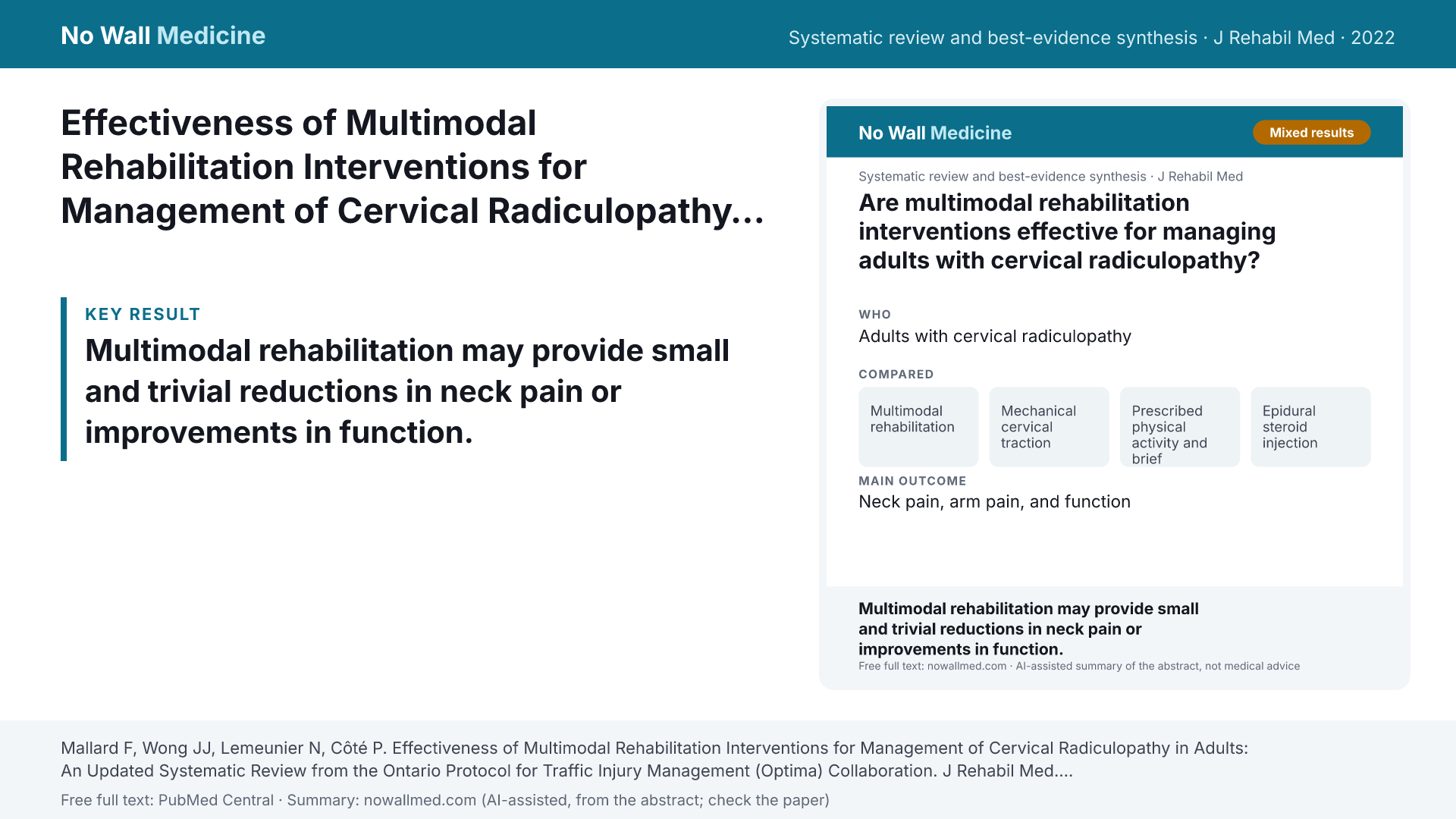
Effectiveness of Multimodal Rehabilitation Interventions for Management of Cervical Radiculopathy in Adults: An Updated Systematic Review from the Ontario Protocol for Traffic Injury Management (Optima) Collaboration
Systematic review and best-evidence synthesisMixed results
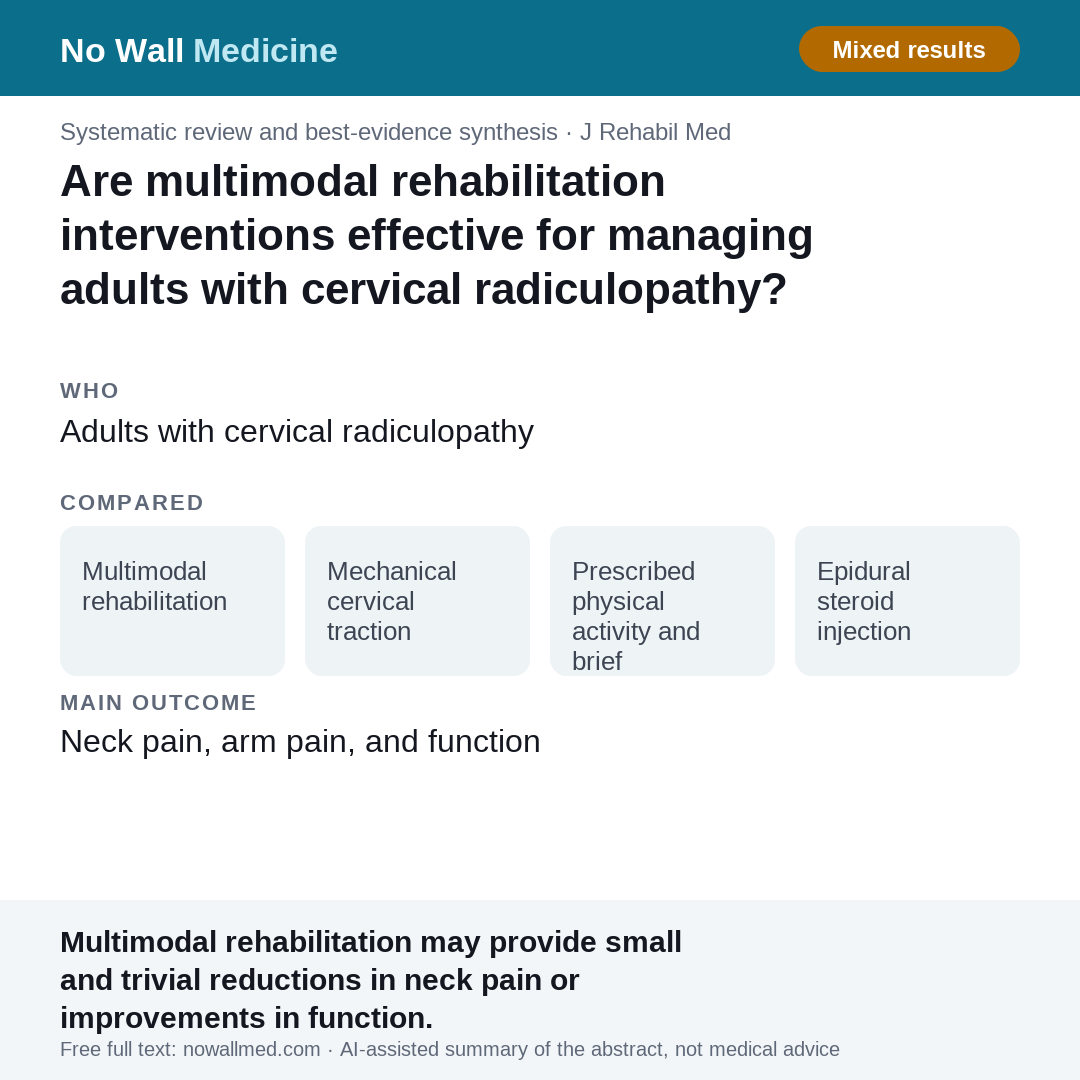
Are multimodal rehabilitation interventions effective for managing adults with cervical radiculopathy?
Who
Adults with cervical radiculopathy
Compared
Multimodal rehabilitation
Mechanical cervical traction
Prescribed physical activity and brief cognitive-behavioural approach
Epidural steroid injection
Main outcome
Neck pain, arm pain, and function
Bottom line: Multimodal rehabilitation may provide small and trivial reductions in neck pain or improvements in function.
Limitation: Low certainty of the evidence across the included studies.
J Rehabil Med · 2022-08-22Download image
Clinical question: Are multimodal rehabilitation interventions effective for managing adults with cervical radiculopathy?
Abstract
Objective
To update the systematic review from the Ontario Protocol for Traffic Injury Management (OPTIMa) Collaboration and to evaluate the effectiveness of multimodal rehabilitation interventions for the management of adults with cervical radiculopathy. Study design
Systematic review and best-evidence synthesis. Methods
Eligible studies (from January 2013 to June 2020) were critically appraised using the Scottish Intercollegiate Guidelines Network and Risk of Bias 2.0 criteria. The certainty of the evidence was assessed according to Grading of Recommendations Assessment, Development, and Evaluation. Results
Four RCTs were deemed acceptable and 1 RCT was considered low quality. In adults with recent-onset cervical radiculopathy, multimodal rehabilitation was associated with a trivial and nonclinically important reduction in neck pain compared with mechanical cervical traction; no differences in disability were reported (1 study, 360 participants, low certainty of the evidence). In adults with cervical radiculopathy of any duration, (i) multimodal rehabilitation may be more effective than prescribed physical activity and brief cognitive-behavioural approach; specifically, a small reduction in arm pain and in function was found (1 study, 144 participants, low certainty of the evidence); (ii) no difference in pain reduction was found between multimodal rehabilitation interventions compared with an epidural steroid injection (1 study, 169 participants, low certainty of the evidence); and (iii) compared with surgery combined with neck exercises, multimodal rehabilitation interventions lead to similar arm pain reduction and improvement in function (1 study, 68 participants, low certainty of the evidence). Conclusion
The evidence suggests that some multimodal rehabilitation care may provide small and trivial reduction in neck pain or improvement in function to patients with cervical radiculopathy.
Subject terms
Cite this article
Mallard F, Wong JJ, Lemeunier N, Côté P. Effectiveness of Multimodal Rehabilitation Interventions for Management of Cervical Radiculopathy in Adults: An Updated Systematic Review from the Ontario Protocol for Traffic Injury Management (Optima) Collaboration. J Rehabil Med. 2022. doi:10.2340/jrm.v54.2799
Spotted a mistake? Suggest a correction