Adding nebulized bronchodilators to sputum induction increases tuberculosis detection rates in Thai patients
Effectiveness of Nebulized Bronchodilator-Enhanced Sputum Induction in Thai Patients With Presumed Pulmonary Tuberculosis: A Randomized Controlled Trial (NeB-TB Trial)
Randomized controlled trialBenefit found
Does adding nebulized bronchodilators improve sputum induction effectiveness for presumed pulmonary tuberculosis?
Who
204
Adults with presumed pulmonary tuberculosis and negative Xpert MTB/RIF Ultra results · King Chulalongkorn Memorial Hospital, Thailand
Compared
17.8%Conventional sputum induction
30.1%Bronchodilator-enhanced induction
Main outcome
Tuberculosis detection rates by Xpert MTB/RIF assay
Result: relative risk 1.68 (95% CI 1.01-2.80)
Bottom line: Bronchodilator-enhanced sputum induction increases tuberculosis detection rates and enables significantly earlier treatment initiation compared to conventional induction.
Clin Infect Dis · 2025-10-23Download image
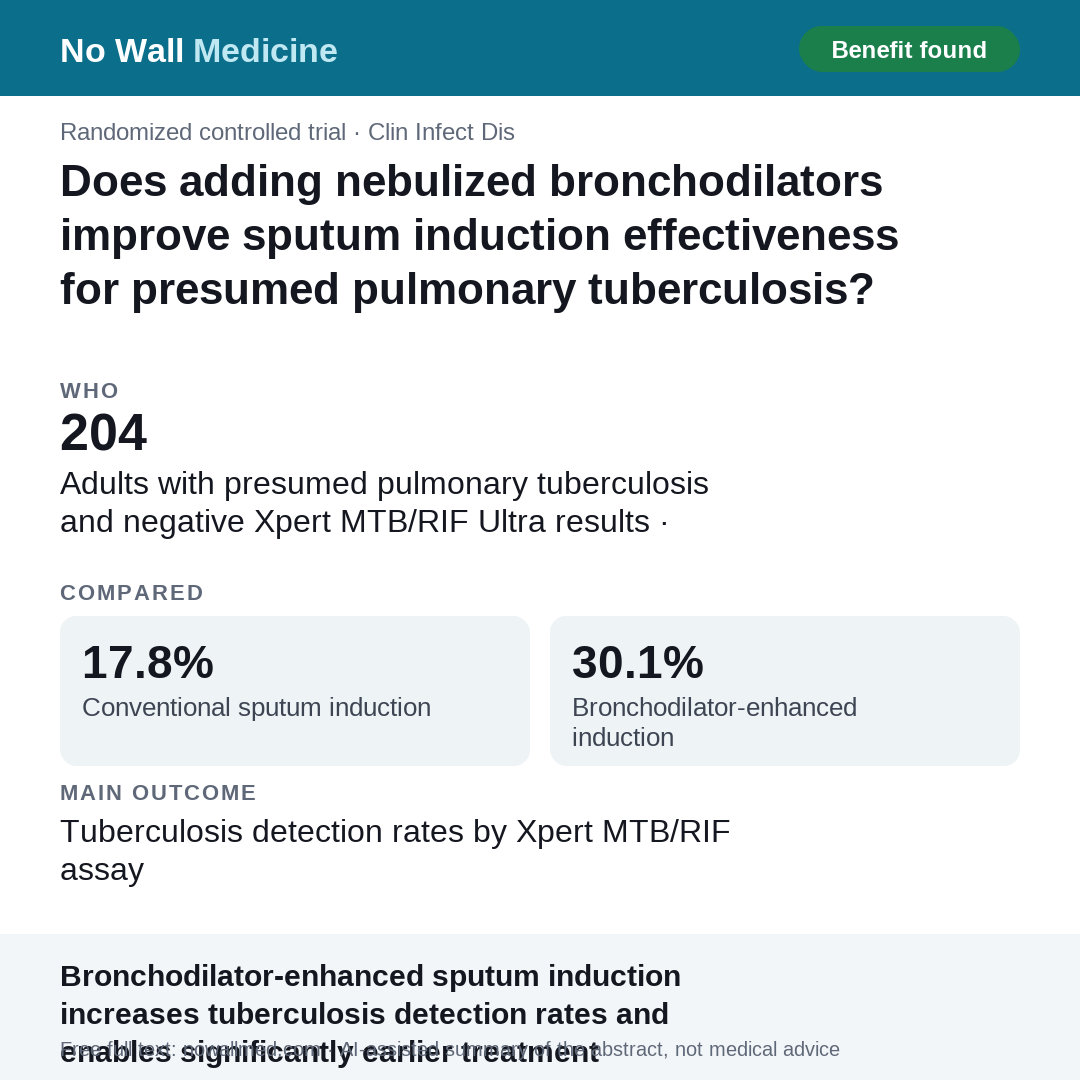
Clinical question: Does adding nebulized bronchodilators improve sputum induction effectiveness for presumed pulmonary tuberculosis?
Why it matters: Delayed diagnosis of pulmonary tuberculosis increases transmission risks and worsens outcomes, especially when bronchoscopy resources are limited.
In absolute numbers
Conventional sputum induction: 17.8% · Bronchodilator-enhanced induction: 30.1% → a difference of 12.3 percentage points, so about 9 people would need the treatment for 1 more to benefit (number needed to treat) over the trial’s follow-up.
Worked out by us from the two group results above, not reported by the authors. Check the paper for the exact outcome and timing.
Key points
- Researchers studied 204 adults with suspected pulmonary tuberculosis by comparing conventional hypertonic saline induction to induction using both hypertonic saline and nebulized bronchodilators.
- The bronchodilator group had a tuberculosis detection rate of 30.1% compared to 17.8% in the conventional group, representing a 12.3% difference.
- Patients receiving bronchodilators reached treatment initiation faster, with a median of 4.5 days compared to 14 days for the conventional group.
Headline and key points written with AI from the paper’s abstract, with every number checked against it. Read the paper before relying on them.
Topics
Cite this article
Mingchay P, Kawkitinarong K, Torvorapanit P, Ohata PJ, Suwanpimolkul G. Effectiveness of Nebulized Bronchodilator-Enhanced Sputum Induction in Thai Patients With Presumed Pulmonary Tuberculosis: A Randomized Controlled Trial (NeB-TB Trial). Clin Infect Dis. 2025. doi:10.1093/cid/ciaf580
Spotted a mistake? Suggest a correction