PLCOm2012 risk prediction model was more effective at detecting lung cancer than NELSON criteria
Effectiveness of NELSON versus PLCOm2012 lung cancer screening eligibility criteria in Germany (HANSE): a prospective cohort study
Prospective cohort studyBenefit found
Is the PLCOm2012 model more effective than NELSON criteria for lung cancer screening?
Who
5191
Current or former smokers aged 55-79 years · Three certified German lung cancer centres
Compared
2.59%PLCOm2012-selected (95% CI 2.13-3.12)
2.17%NELSON-selected (1.74-2.68)
Main outcome
Positive predictive values for lung cancers detected
Result: lower number needed to screen 38.6 (32.1-46.9) vs 46.1 (37.3-57.5)
Bottom line: The PLCOm2012 risk prediction model is more efficient and effective at detecting lung cancer than NELSON criteria.
Funded by: Federal Ministry of Education and Research and AstraZeneca
Lancet Oncol · 2025-11-10Download image
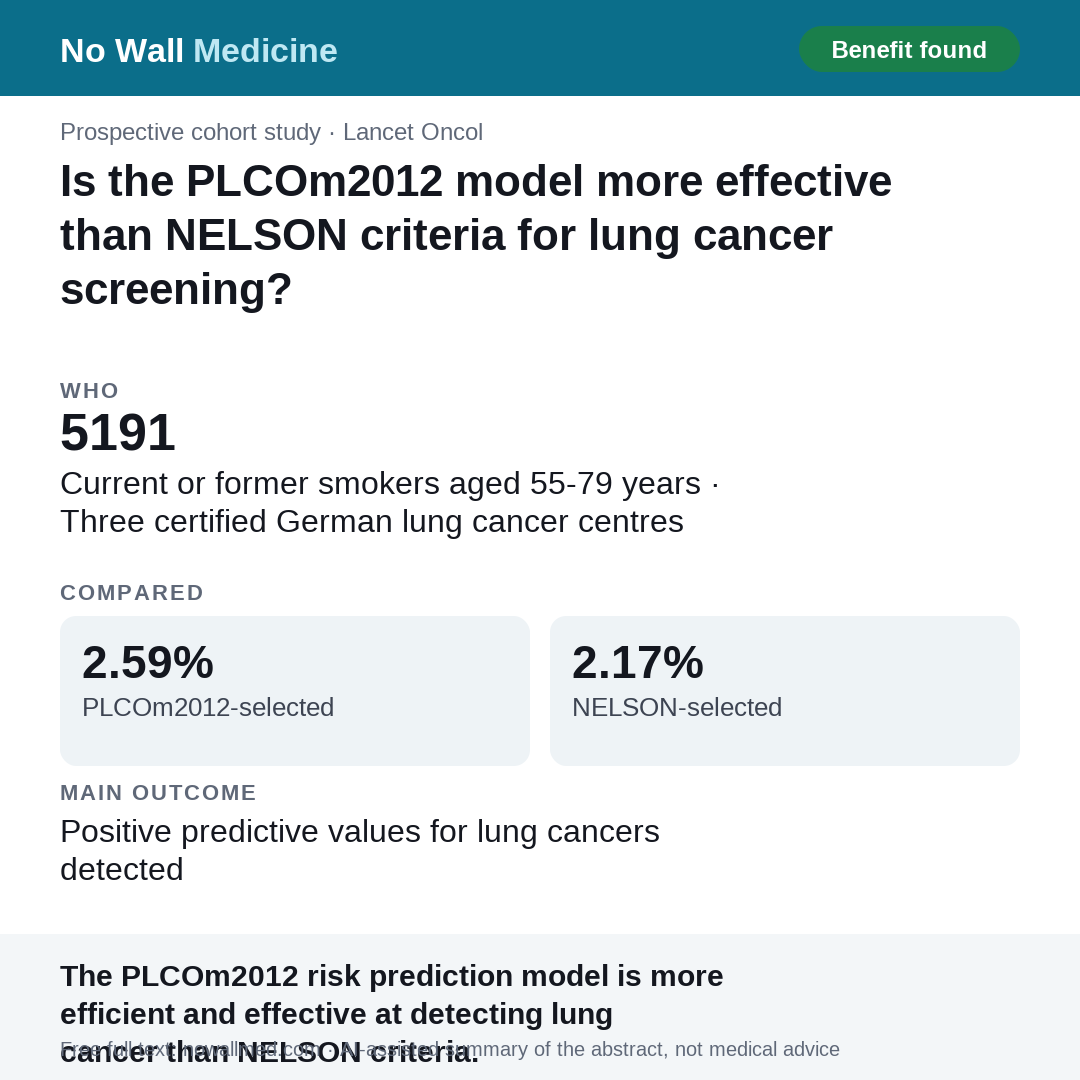
Clinical question: Is the PLCOm2012 model more effective than NELSON criteria for lung cancer screening?
Why it matters: Policy makers have reservations about using risk prediction models instead of categorical age and smoking criteria for selecting lung cancer screening participants.
Key points
- The study followed 5191 current or former smokers aged 55-79 years recruited from three German lung cancer centres.
- The lung cancer detection rate was 2.59% in the PLCOm2012 group compared to 2.17% in the NELSON group.
- The number needed to screen was 38.6 for the PLCOm2012 group versus 46.1 for the NELSON group.
Headline and key points written with AI from the paper’s abstract, with every number checked against it. Read the paper before relying on them.
Was this summary helpful?
Abstract
Background
Low-dose chest CT screening can reduce lung cancer mortality through early diagnosis. Several studies suggest that risk prediction models are more efficient than categorical age and smoking criteria for participant selection, but there are still reservations from policy makers about their implementation. We aimed to compare the effectiveness of a predefined PLCOm2012 model threshold with the categorical NELSON risk criteria. Methods
In this ongoing prospective cohort study, current or former smokers aged 55-79 years who met either NELSON risk criteria or had a PLCOm2012 6-year risk of at least 1·58% were recruited from three certified German lung cancer centres in Großhansdorf, Hannover, and Lübeck, and received low-dose CT at baseline and 1-year follow-up screening rounds, including all downstream follow-up procedures. The PLCOm2012 cutoff point of at least 1·58% was predefined and estimated to result in an equal group size as with the NELSON inclusion criteria. The primary outcome was the comparison of the positive predictive values for lung cancers detected in PLCOm2012-selected versus NELSON-selected groups. Here, we report the final results of the primary analysis. This study is registered with ClinicalTrials.gov, NCT04913155. Findings
Between July 23, 2021, and Aug 19, 2022 (end of recruitment), 5191 participants (2208 [43·5%] female, 2983 [57·5%] male, and 5076 [97·8%] of European White ethnicity) who met either one or both high-risk criteria were enrolled (4167 PLCOm2012-selected vs 3916 NELSON-selected participants) and underwent the baseline low-dose CT scan. In the observation period between the two low-dose CT screening rounds (mean volume CT dose index 1·15 mGy [SD 0·15]) with a median time interval of 1·05 years (IQR 0·95-1·08), 111 lung cancers were detected. The positive predictive value (lung cancer detection rate) in the PLCOm2012-selected group was 108 of 4167 participants (2·59% [95% CI 2·13-3·12]) compared with 85 of 3916 participants (2·17% [1·74-2·68]) in the NELSON-selected group (p=0·0016), resulting in a lower number needed to screen (38·6 [32·1-46·9] vs 46·1 [37·3-57·5]). Interpretation
Participant selection using the PLCOm2012 risk prediction model with a 6-year risk of at least 1·58% cutoff is more efficient and effective in detecting lung cancer than the NELSON criteria and should therefore be implemented in lung cancer screening programmes. Funding
Federal Ministry of Education and Research (German Center for Lung Research) and AstraZeneca.
Abstract reproduced under the article’s CC BY licence.
Subject terms
Cite this article
Vogel-Claussen J, Bollmann BA, May K, Stiebeler S, Dettmer S, Faron A. Effectiveness of NELSON versus PLCOm2012 lung cancer screening eligibility criteria in Germany (HANSE): a prospective cohort study. Lancet Oncol. 2025. doi:10.1016/S1470-2045(25)00490-5
Spotted a mistake? Suggest a correction
Top studies every Monday
The week’s key trials and guidelines in your specialties, plus any topics you follow. By email, free.
Get the weekly digest