Immediate vision therapy improves eye focusing ability faster than delayed treatment after concussion
Effectiveness of office-based vergence/accommodative therapy with movement for accommodative dysfunction in concussion-related convergence insufficiency: a secondary analysis of the CONCUSS randomised clinical trial
Randomized clinical trial secondary analysisBenefit found
Does immediate office-based vergence/accommodative therapy with movement improve accommodative function after concussion?
Who
106
Participants aged 11–25 years with concussion-related convergence insufficiency
Compared
Immediate office-based therapy: significantly greater improvements
Delayed office-based therapy
Main outcome
visual accommodative amplitude and accommodative facility
Bottom line: Immediate office-based vergence/accommodative therapy accelerates recovery of accommodative function compared to delayed treatment.
Br J Sports Med · 2026-10-09Download image
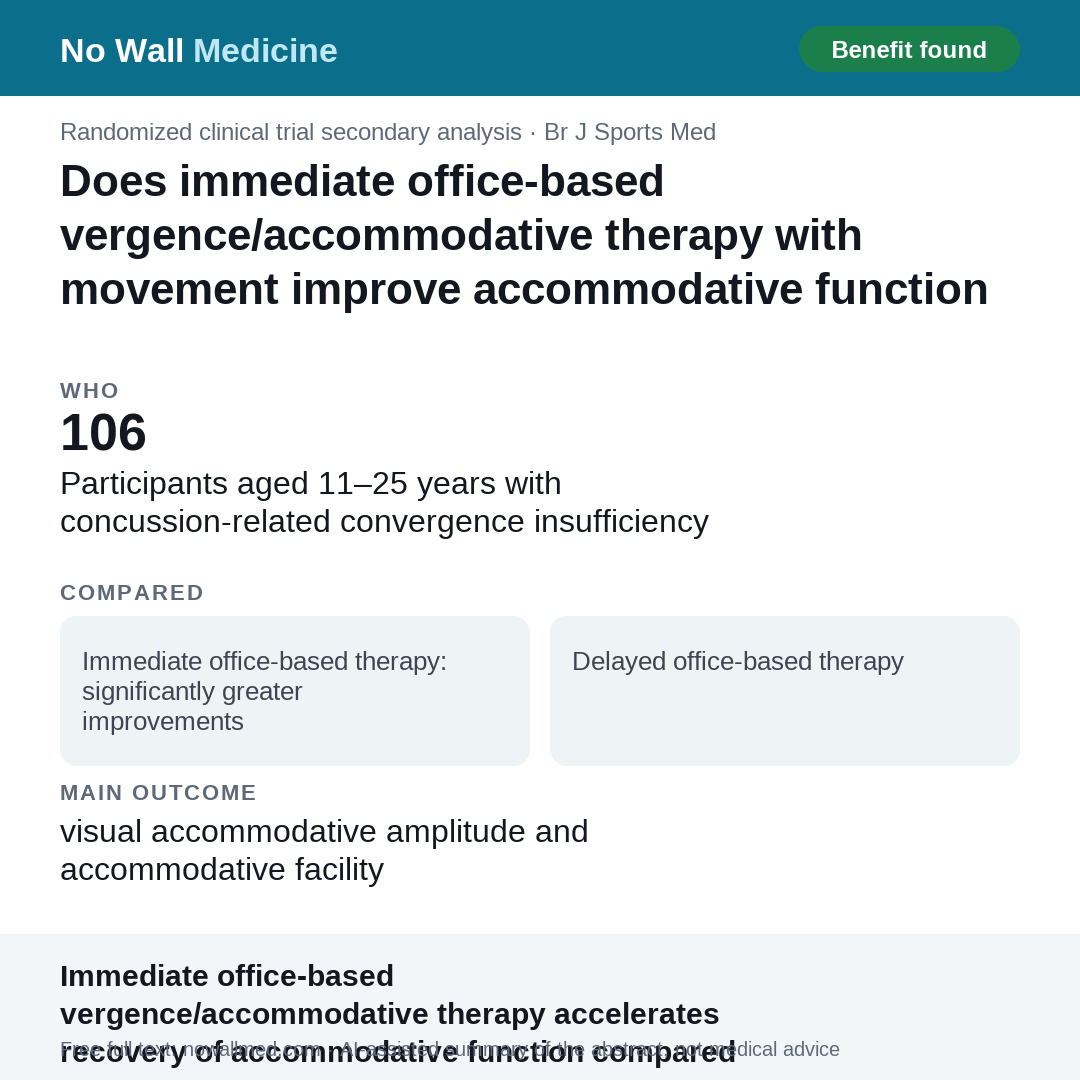
Clinical question: Does immediate office-based vergence/accommodative therapy with movement improve accommodative function after concussion?
Why it matters: Doctors need to know if starting vision therapy immediately or after a period of watchful waiting better helps patients with post-concussion eye focusing issues.
Key points
- Researchers studied 84 participants aged 11–25 years with concussion-related convergence insufficiency and accommodative disorders, comparing immediate versus delayed vision therapy.
- After 12 sessions, the immediate therapy group showed significantly greater improvements in accommodative amplitude and accommodative facility compared to the delayed group.
- While both groups eventually improved, immediate therapy accelerated recovery and helped patients return to activities more quickly.
Headline and key points written with AI from the paper’s abstract, with every number checked against it. Read the paper before relying on them.
Spotted a mistake? Suggest a correction
More in Orthopedics & Sports Medicine
Higher pre-treatment expectations associated with less pain and better function after physiotherapy
Higher pre-treatment expectations are associated with less pain and better physical function and quality of life after physiotherapy for knee osteoarthritis
Patellofemoral osteochondritis dissecans patients have distinct knee anatomy
Is There an Association Between Abnormal Patellofemoral Morphology and Patellofemoral Osteochondritis Dissecans in Pediatric Patients?
Newly Diagnosed Dyslipidemia Linked to Higher Risk of Osteoarthritis
Association Between Newly Diagnosed Dyslipidemia and Joint-Specific Incident Osteoarthritis: A Nationwide Propensity-Score-Matched Cohort Study