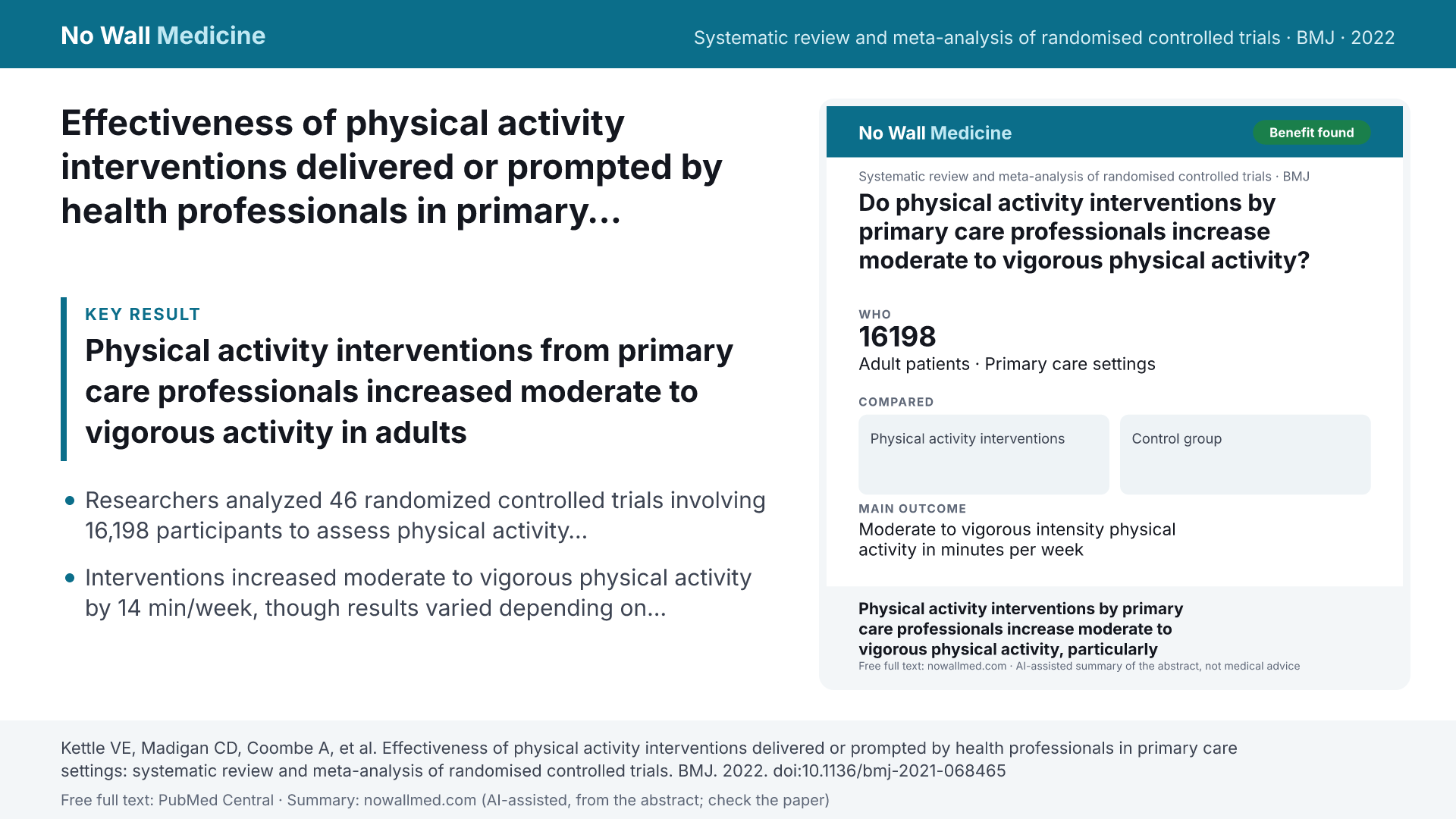
Physical activity interventions from primary care professionals increased moderate to vigorous activity in adults
Effectiveness of physical activity interventions delivered or prompted by health professionals in primary care settings: systematic review and meta-analysis of randomised controlled trials
Systematic review and meta-analysis of randomised controlled trialsBenefit found
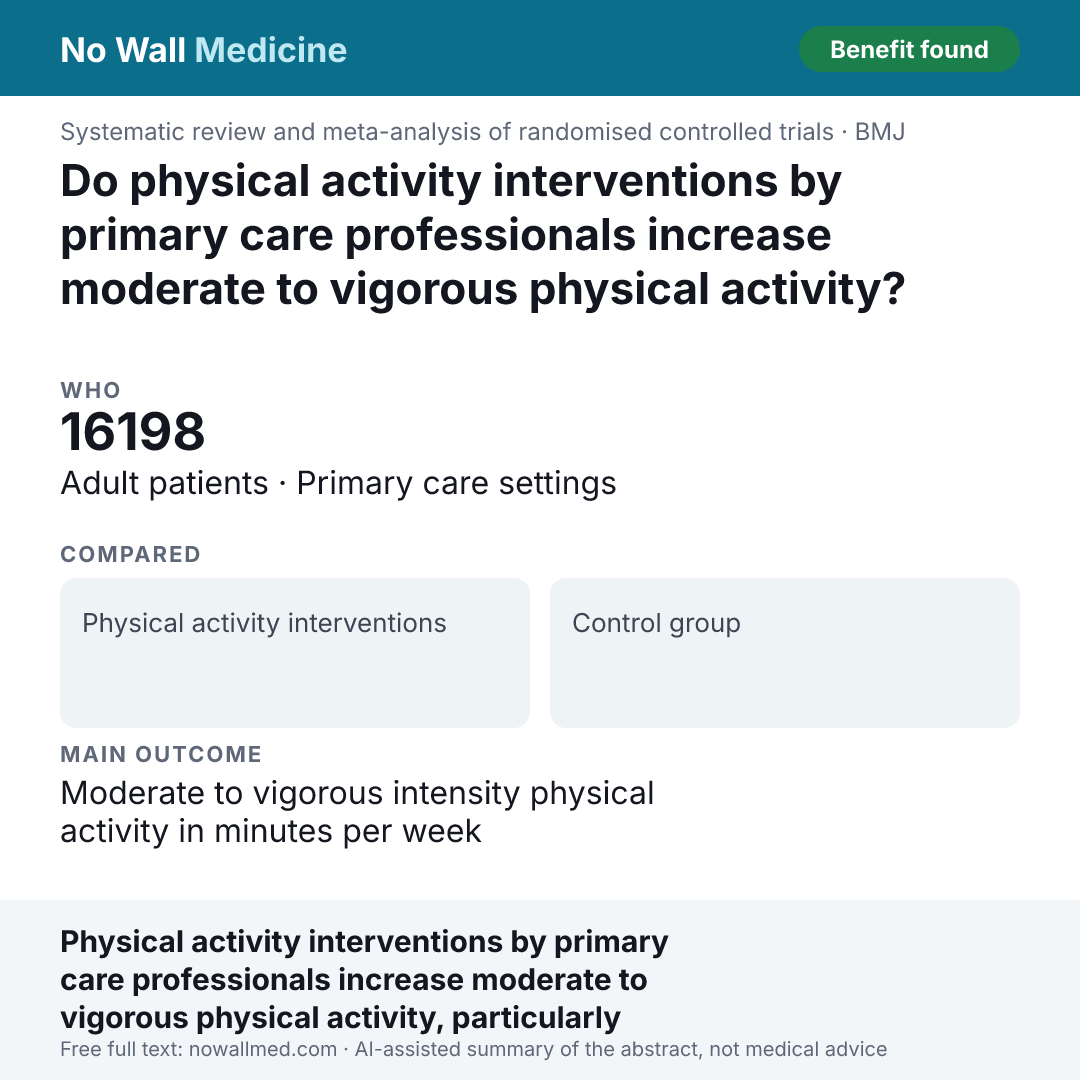
Do physical activity interventions by primary care professionals increase moderate to vigorous physical activity?
Who
16198
Adult patients · Primary care settings
Compared
Physical activity interventions
Control group
Main outcome
Moderate to vigorous intensity physical activity in minutes per week
Result: 14 min/week (95% confidence interval 4.2 to 24.6)
Bottom line: Physical activity interventions by primary care professionals increase moderate to vigorous physical activity, particularly when measured by self-report.
Limitation: Substantial heterogeneity was observed and results differed when using device-measured physical activity.
BMJ · 2022-02-23 · Save PNG
Clinical question: Do physical activity interventions by primary care professionals increase moderate to vigorous physical activity?
Key points
- Researchers analyzed 46 randomized controlled trials involving 16,198 participants to assess physical activity interventions in primary care.
- Interventions increased moderate to vigorous physical activity by 14 min/week, though results varied depending on whether activity was self-reported or measured by a device.
- The interventions increased the odds of patients meeting physical activity guidelines by 33% compared to control groups.
Limitation the authors note: The meta-analysis showed substantial heterogeneity and 14 of the 46 included studies were at high risk of bias.
Headline and key points written with AI from the paper’s abstract, with every number checked against it. Read the paper before relying on them.
Was this summary helpful?
Abstract
Objective
To examine the effectiveness of physical activity interventions delivered or prompted by primary care health professionals for increasing moderate to vigorous intensity physical activity (MVPA) in adult patients. Design
Systematic review and meta-analysis of randomised controlled trials. Data sources
Databases (Medline and Medline in progress, Embase, PsycINFO, CINAHL, SPORTDiscus, Sports Medicine and Education Index, ASSIA, PEDro, Bibliomap, Science Citation Index, Conference Proceedings Citation Index), trial registries (Cochrane Central Register of Controlled Trials, ClinicalTrials.gov, TRoPHI), and grey literature (OpenGrey) sources were searched (from inception to September 2020). Eligibility criteria for selecting studies
Randomised controlled trials of aerobic based physical activity interventions delivered or prompted by health professionals in primary care with a usual care control group or another control group that did not involve physical activity. Study selection and analysis
Two independent reviewers screened the search results, extracted data from eligible trials and assessed the risk of bias using the Cochrane risk of bias tool (version 2). Inverse variance meta-analyses using random effects models examined the primary outcome of difference between the groups in MVPA (min/week) from baseline to final follow-up. The odds of meeting the guidelines for MVPA at follow-up were also analysed. Results
14 566 unique reports were identified and 46 randomised controlled trials with a range of follow-ups (3-60 months) were included in the meta-analysis (n=16 198 participants). Physical activity interventions delivered or prompted by health professionals in primary care increased MVPA by 14 min/week (95% confidence interval 4.2 to 24.6, P=0.006). Heterogeneity was substantial (I2=91%, P<0.001). Limiting analyses to trials that used a device to measure physical activity showed no significant group difference in MVPA (mean difference 4.1 min/week, 95% confidence interval -1.7 to 9.9, P=0.17; I2=56%, P=0.008). Trials that used self-report measures showed that intervention participants achieved 24 min/week more MVPA than controls (95% confidence interval 6.3 to 41.8, P=0.008; I2=72%, P<0.001). Additionally, interventions increased the odds of patients meeting guidelines for MVPA by 33% (95% confidence interval 1.17 to 1.50, P<0.001; I2=25%, P=0.11) versus controls. 14 of 46 studies were at high risk of bias but sensitivity analyses excluding these studies did not alter the results. Conclusions
Physical activity interventions delivered or prompted by health professionals in primary care appear effective at increasing participation in self-reported MVPA. Such interventions should be considered for routine implementation to increase levels of physical activity and improve health outcomes in the population. Systematic review registration
PROSPERO CRD42021209484.
Abstract reproduced under the article’s CC BY licence.
Subject terms
Headline, design, result, key points, caveat and citation as plain text.
Cite this article
Kettle VE, Madigan CD, Coombe A, et al. Effectiveness of physical activity interventions delivered or prompted by health professionals in primary care settings: systematic review and meta-analysis of randomised controlled trials. BMJ. 2022. doi:10.1136/bmj-2021-068465
Spotted a mistake? Suggest a correction