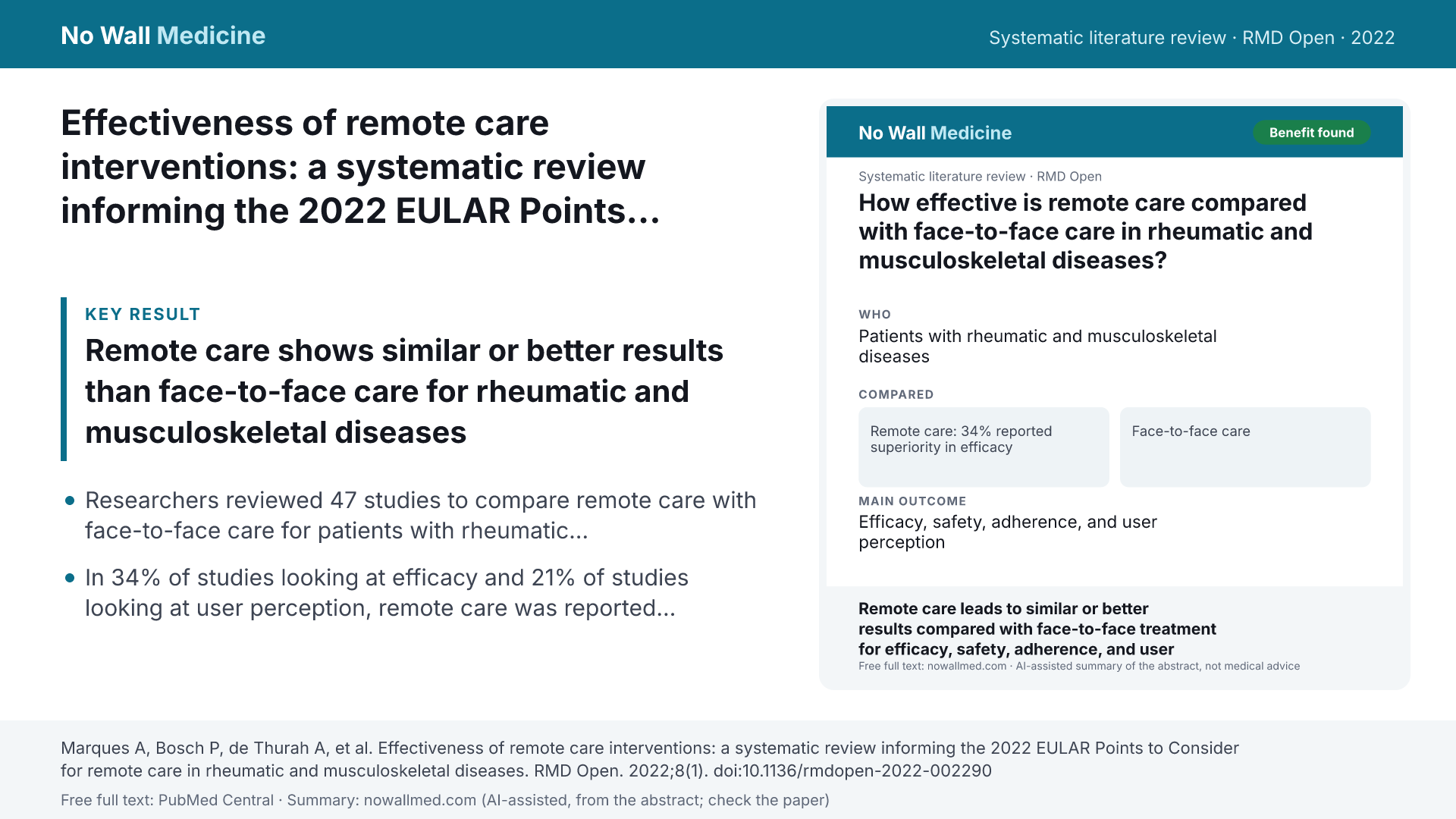
Remote care shows similar or better results than face-to-face care for rheumatic and musculoskeletal diseases
Effectiveness of remote care interventions: a systematic review informing the 2022 EULAR Points to Consider for remote care in rheumatic and musculoskeletal diseases
Systematic literature reviewBenefit found
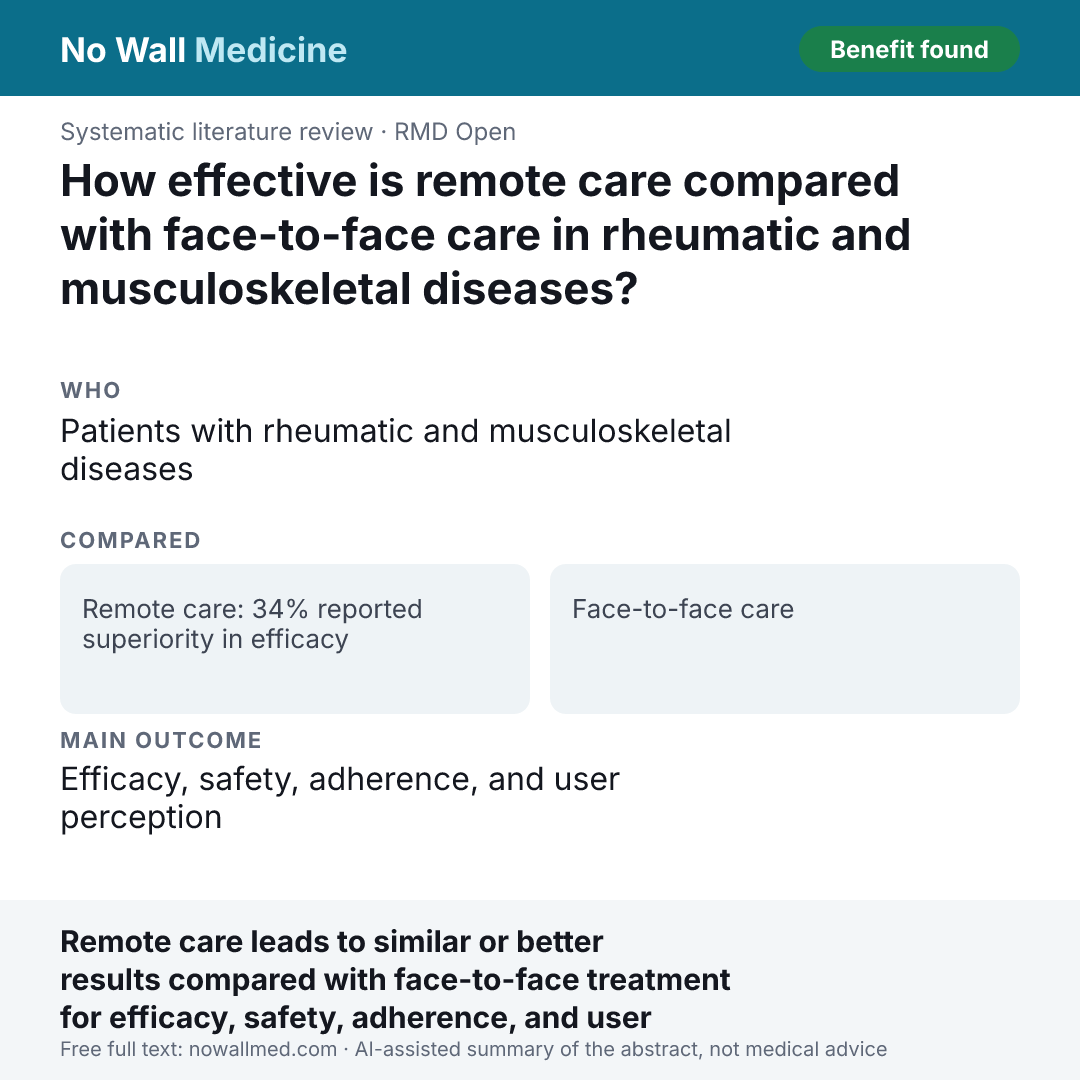
How effective is remote care compared with face-to-face care in rheumatic and musculoskeletal diseases?
Who
Patients with rheumatic and musculoskeletal diseases
Compared
Remote care: 34% reported superiority in efficacy
Face-to-face care
Main outcome
Efficacy, safety, adherence, and user perception
Bottom line: Remote care leads to similar or better results compared with face-to-face treatment for efficacy, safety, adherence, and user perception.
Limitation: Heterogeneity of outcomes and methods, and 50% of studies had high risk of bias.
RMD Open · 2022-05-06 · Save PNG
Clinical question: How effective is remote care compared with face-to-face care in rheumatic and musculoskeletal diseases?
Key points
- Researchers reviewed 47 studies to compare remote care with face-to-face care for patients with rheumatic and musculoskeletal diseases.
- In 34% of studies looking at efficacy and 21% of studies looking at user perception, remote care was reported as superior to face-to-face care.
- Time and cost savings were reported as major benefits, while technical aspects were identified as major drawbacks.
Limitation the authors note: The authors noted a high risk of bias in 50% of the studies and significant heterogeneity in outcomes and methods.
Headline and key points written with AI from the paper’s abstract, with every number checked against it. Read the paper before relying on them.
Was this summary helpful?
Abstract
Objective
To perform a systematic literature review (SLR) on different outcomes of remote care compared with face-to-face (F2F) care, its implementation into clinical practice and to identify drivers and barriers in order to inform a task force formulating the EULAR Points to Consider for remote care in rheumatic and musculoskeletal diseases (RMDs). Methods
A search strategy was developed and run in Medline (PubMed), Embase and Cochrane Library. Two reviewers independently performed standardised data extraction, synthesis and risk of bias (RoB) assessment. Results
A total of 2240 references were identified. Forty-seven of them fulfilled the inclusion criteria. Remote monitoring (n=35) was most frequently studied, with telephone/video calls being the most common mode of delivery (n=30). Of the 34 studies investigating outcomes of remote care, the majority addressed efficacy and user perception; 34% and 21% of them, respectively, reported a superiority of remote care as compared with F2F care. Time and cost savings were reported as major benefits, technical aspects as major drawback in the 13 studies that investigated drivers and barriers of remote care. No study addressed remote care implementation. The main limitation of the studies identified was the heterogeneity of outcomes and methods, as well as a substantial RoB (50% of studies with high RoB). Conclusions
Remote care leads to similar or better results compared with F2F treatment concerning efficacy, safety, adherence and user perception outcomes, with the limitation of heterogeneity and considerable RoB of the available studies.
Abstract reproduced under the article’s CC BY NC licence.
Subject terms
Headline, design, result, key points, caveat and citation as plain text.
Cite this article
Marques A, Bosch P, de Thurah A, et al. Effectiveness of remote care interventions: a systematic review informing the 2022 EULAR Points to Consider for remote care in rheumatic and musculoskeletal diseases. RMD Open. 2022. doi:10.1136/rmdopen-2022-002290
Spotted a mistake? Suggest a correction