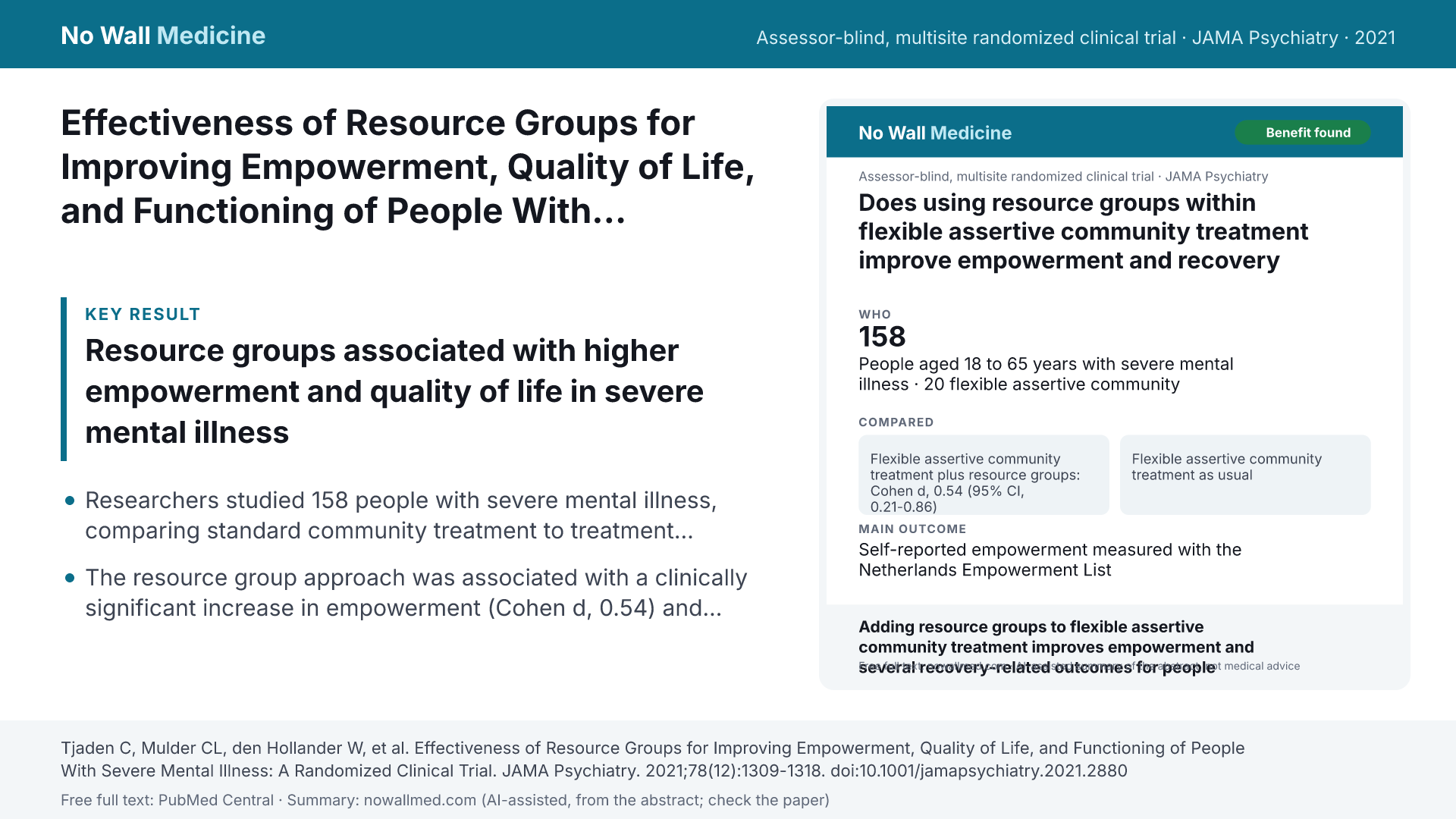
Resource groups associated with higher empowerment and quality of life in severe mental illness
Effectiveness of Resource Groups for Improving Empowerment, Quality of Life, and Functioning of People With Severe Mental Illness: A Randomized Clinical Trial
Assessor-blind, multisite randomized clinical trialBenefit found
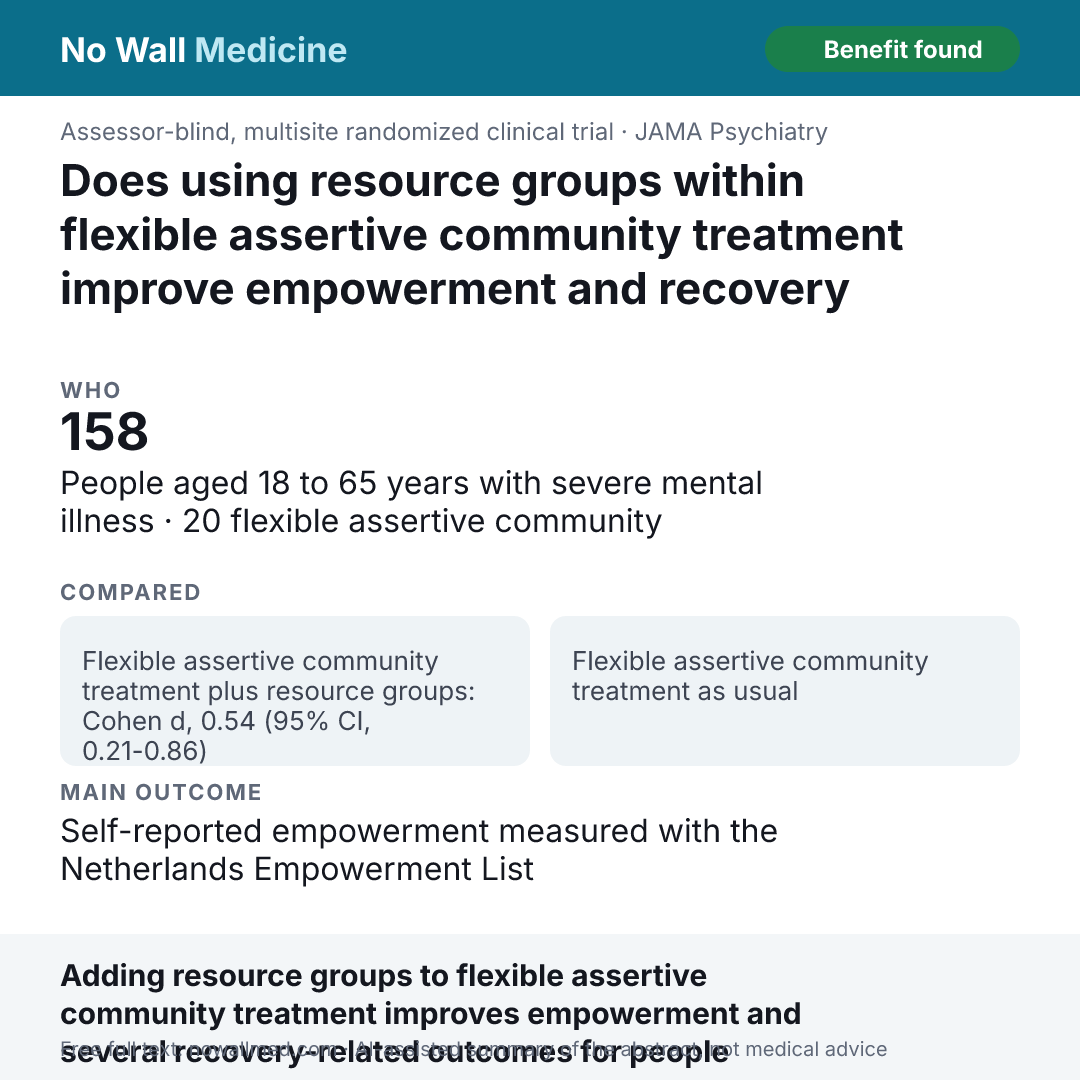
Does using resource groups within flexible assertive community treatment improve empowerment and recovery outcomes?
Who
158
People aged 18 to 65 years with severe mental illness · 20 flexible assertive community treatment teams throughout the Netherlands
Compared
Flexible assertive community treatment plus resource groups: Cohen d, 0.54 (95% CI, 0.21-0.86)
Flexible assertive community treatment as usual
Main outcome
Self-reported empowerment measured with the Netherlands Empowerment List
Result: Cohen d, 0.54 (95% CI, 0.21-0.86)
Bottom line: Adding resource groups to flexible assertive community treatment improves empowerment and several recovery-related outcomes for people with severe mental illness.
JAMA Psychiatry · 2021-10-14 · Save PNG
Clinical question: Does using resource groups within flexible assertive community treatment improve empowerment and recovery outcomes?
Why it matters: Personalization and the involvement of significant others are not adequately implemented in practice for people with severe mental illness.
Key points
- Researchers studied 158 people with severe mental illness, comparing standard community treatment to treatment including resource groups of chosen network members.
- The resource group approach was associated with a clinically significant increase in empowerment (Cohen d, 0.54) and small to medium improvements in quality of life (Cohen d, 0.25).
- No differences between the two groups were found regarding psychopathological symptoms, attachment, frequency of social contact, or employment.
Headline and key points written with AI from the paper’s abstract, with every number checked against it. Read the paper before relying on them.
Was this summary helpful?
Subject terms
Headline, design, result, key points, caveat and citation as plain text.
Cite this article
Tjaden C, Mulder CL, den Hollander W, et al. Effectiveness of Resource Groups for Improving Empowerment, Quality of Life, and Functioning of People With Severe Mental Illness: A Randomized Clinical Trial. JAMA Psychiatry. 2021;78(12):1309-1318. doi:10.1001/jamapsychiatry.2021.2880
Spotted a mistake? Suggest a correction