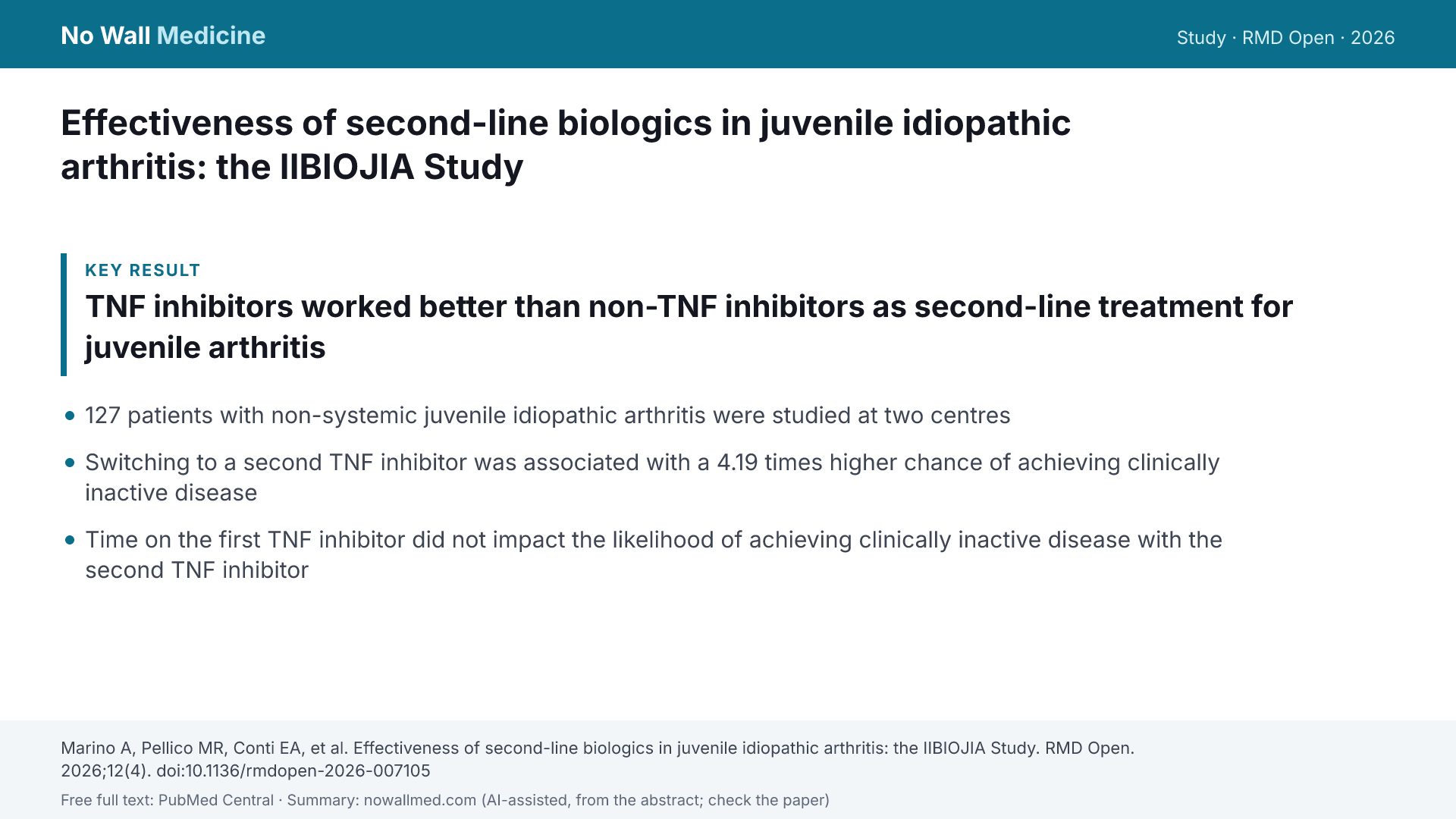
TNF inhibitors worked better than non-TNF inhibitors as second-line treatment for juvenile arthritis
Effectiveness of second-line biologics in juvenile idiopathic arthritis: the IIBIOJIA Study
Why it matters: Doctors have had limited evidence on the effectiveness of second-line biologics in juvenile idiopathic arthritis
Key points
- 127 patients with non-systemic juvenile idiopathic arthritis were studied at two centres.
- Switching to a second TNF inhibitor was associated with a 4.19 times higher chance of achieving clinically inactive disease.
- Time on the first TNF inhibitor did not impact the likelihood of achieving clinically inactive disease with the second TNF inhibitor.
Limitation the authors note: This was a retrospective cohort study at two paediatric rheumatology tertiary centres
Study type: Observational study: it can show a link, but not prove that one thing causes another.
Headline and key points written with AI from the paper’s abstract, with every number checked against it. Read the paper before relying on them.
Was this summary helpful?
Headline, design, result, key points, caveat and citation as plain text.
Cite this article
Marino A, Pellico MR, Conti EA, et al. Effectiveness of second-line biologics in juvenile idiopathic arthritis: the IIBIOJIA Study. RMD Open. 2026. doi:10.1136/rmdopen-2026-007105
Spotted a mistake? Suggest a correction