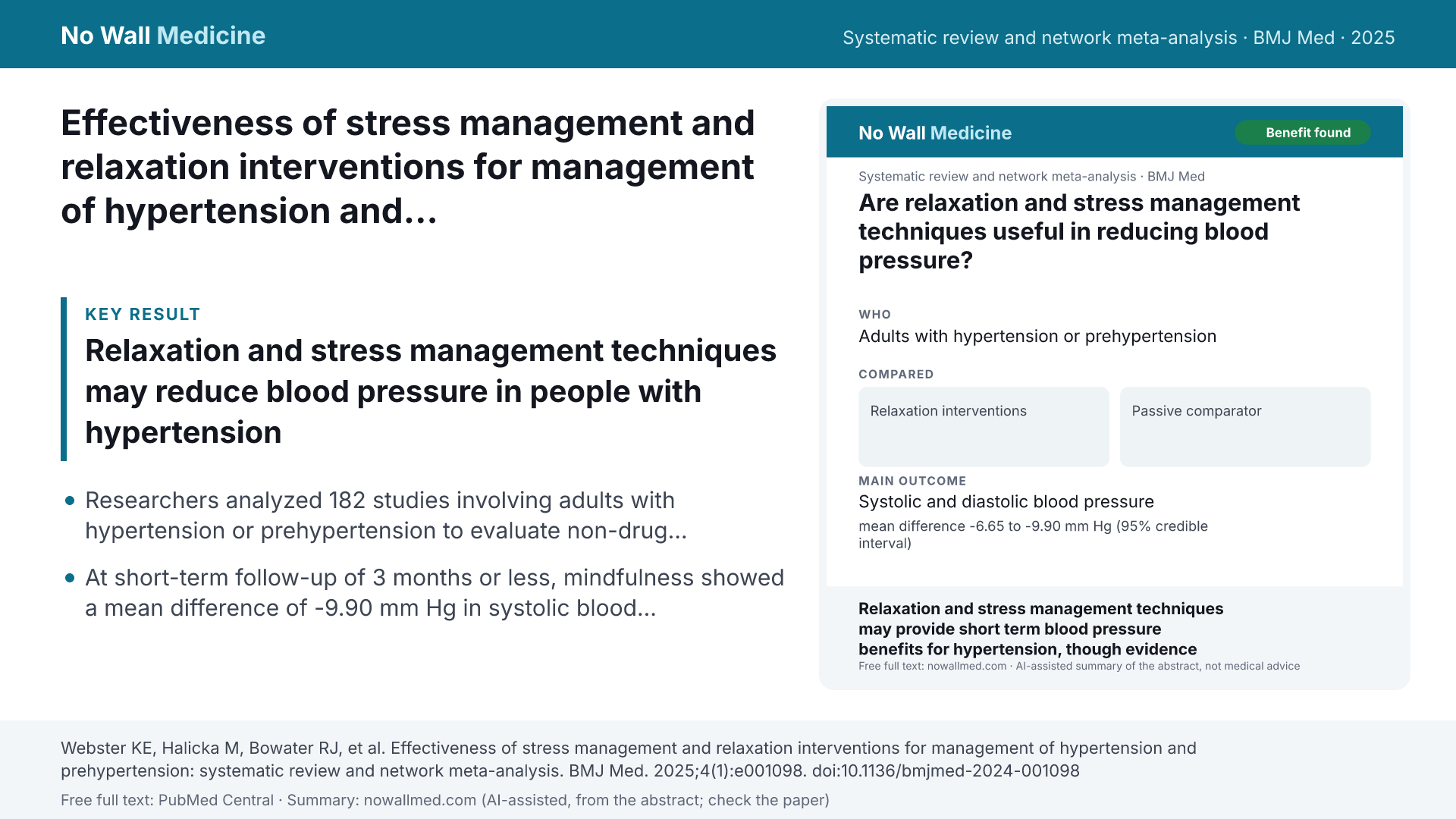
Relaxation and stress management techniques may reduce blood pressure in people with hypertension
Effectiveness of stress management and relaxation interventions for management of hypertension and prehypertension: systematic review and network meta-analysis
Systematic review and network meta-analysisBenefit found
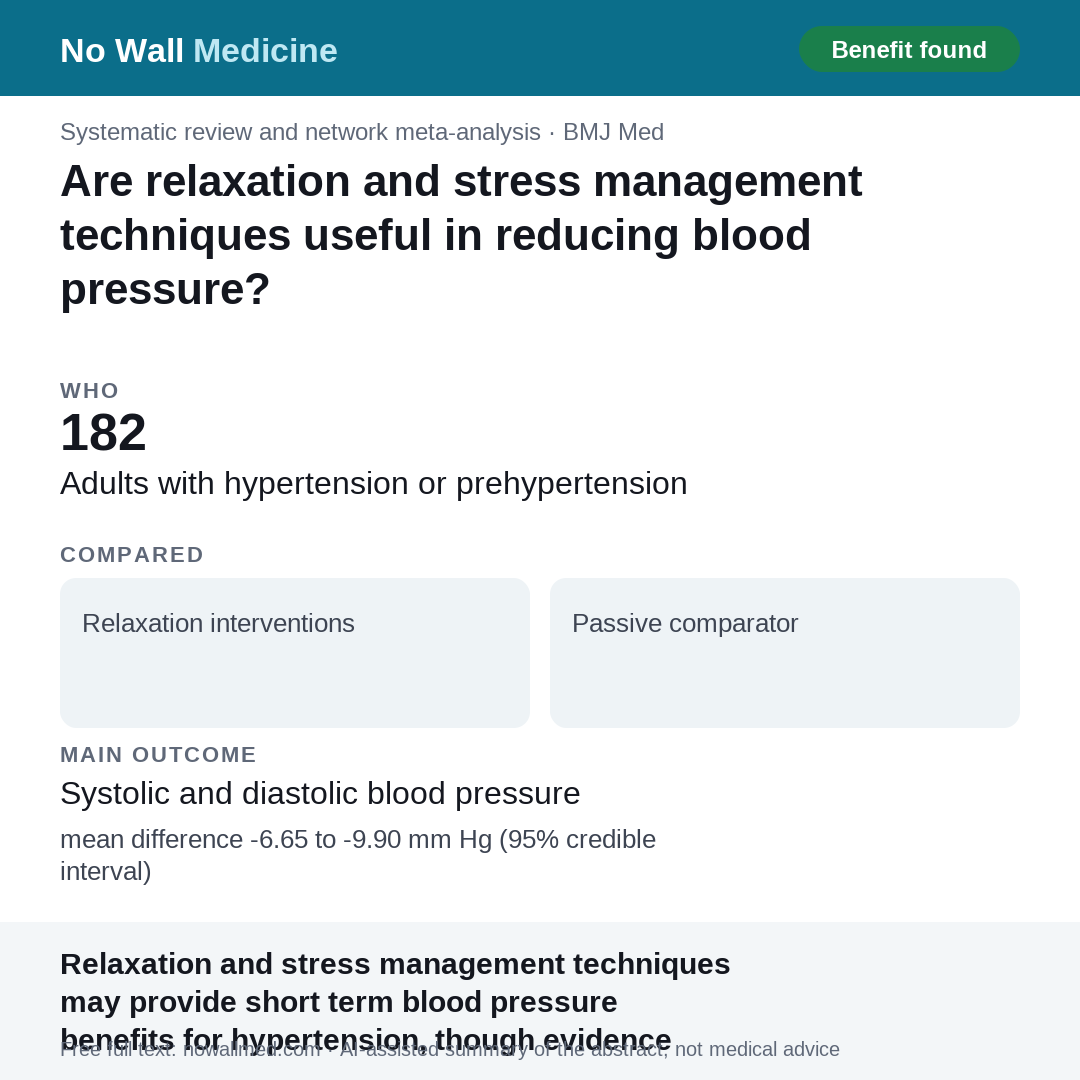
Are relaxation and stress management techniques useful in reducing blood pressure?
Who
182
Adults with hypertension or prehypertension
Compared
Relaxation interventions
Passive comparator
Main outcome
Systolic and diastolic blood pressure
Result: mean difference -6.65 to -9.90 mm Hg (95% credible interval)
Bottom line: Relaxation and stress management techniques may provide short term blood pressure benefits for hypertension, though evidence certainty is very low.
Limitation: Very low certainty due to risk of bias, potential publication bias, and imprecision.
BMJ Med · 2025-04-08Download image
Clinical question: Are relaxation and stress management techniques useful in reducing blood pressure?
Why it matters: It is unclear which relaxation or stress management techniques are effective for managing blood pressure in individuals with hypertension or prehypertension.
Key points
- Researchers analyzed 182 studies involving adults with hypertension or prehypertension to evaluate non-drug relaxation and stress management techniques.
- At short-term follow-up of 3 months or less, mindfulness showed a mean difference of -9.90 mm Hg in systolic blood pressure compared to passive controls.
- For prehypertension, meditative movement showed a mean difference of -3.84 mm Hg in systolic blood pressure, while multicomponent interventions showed a mean difference of -0.53 mm Hg.
Limitation the authors note: The certainty of the evidence was considered very low due to risk of bias in primary studies, potential publication bias, and imprecision in effect estimates.
Headline and key points written with AI from the paper’s abstract, with every number checked against it. Read the paper before relying on them.
Was this summary helpful?
Abstract
Objective
To assess whether relaxation and stress management techniques are useful in reducing blood pressure in individuals with hypertension and prehypertension. Design
Systematic review and network meta-analysis. Data sources
Medline, PsycInfo, and CENTRAL (Cochrane Central Register of Controlled Trials) from inception to 23 February 2024, and CINAHL (Cumulative Index to Nursing and Allied Health Literature) from inception to 27 February 2024. Eligibility criteria for selecting studies
Studies published in English of adults with hypertension (blood pressure ≥140/90 mm Hg) or prehypertension (blood pressure ≥120/80 mm Hg but <140/90 mm Hg). Studies that compared non-pharmacological interventions used to promote relaxation or reduce stress with each other, or with a control group (eg, no intervention, waiting list, or standard care). Where possible, network meta-analysis was used to compare the efficacy of the different interventions. Studies were assessed with the risk of bias 2 tool (RoB2), and those at high risk of bias were excluded from the primary analysis. The certainty of the evidence was assessed with CINeMA (Confidence in Network Meta-Analysis) and GRADE (Grading of Recommendations Assessment, Development, and Evaluation). Results
182 studies were included (166 for hypertension and 16 for prehypertension). Results from a random effects network meta-analysis showed that, at short term follow-up (≤3 months), most relaxation interventions appeared to have a beneficial effect on systolic and diastolic blood pressure for individuals with hypertension. Between study heterogeneity was moderate (τ=2.62-4.73). Compared with a passive comparator (ie, no intervention, waiting list, or usual care), moderate reductions in systolic blood pressure were found for breathing control (mean difference -6.65 mm Hg, 95% credible interval -10.39 to -2.93), meditation (mean difference -7.71 mm Hg, -14.07 to -1.29), meditative movement (including tai chi and yoga, mean difference -9.58 mm Hg, -12.95 to -6.17), mindfulness (mean difference -9.90 mm Hg, -16.44 to -3.53), music (mean difference -6.61 mm Hg, -11.62 to -1.56), progressive muscle relaxation (mean difference -7.46 mm Hg, -12.15 to -2.96), psychotherapy (mean difference -9.83 mm Hg, -16.24 to -3.43), and multicomponent interventions (mean difference -6.78 mm Hg, -11.59 to -1.99). Reductions were also seen in diastolic blood pressure. Few studies conducted follow-up for more than three months, but effects on blood pressure seemed to lessen over time. Limited data were available for prehypertension; only two studies compared short term follow-up of relaxation therapies with a passive comparator, and the effects on systolic blood pressure were small (mean difference -3.84 mm Hg, 95% credible interval -6.25 to -1.43 for meditative movement; mean difference -0.53 mm Hg, -2.03 to 0.97 for multicomponent intervention). The certainty of the evidence was considered to be very low based on the CINeMA framework, owing to the risk of bias in the primary studies, potential publication bias, and imprecision in the effect estimates. Conclusions
The results of the study indicated that relaxation and stress management techniques might have beneficial short term effects on blood pressure for people with hypertension, but the effectiveness of these interventions is still uncertain. Future studies should ensure rigorous methods are used to minimise the risk of bias, and a longer duration of follow-up to establish whether these effects persist. Systematic review registration
PROSPERO CRD42023469128.
Abstract reproduced under the article’s CC BY licence.
Cite this article
Webster KE, Halicka M, Bowater RJ, et al. Effectiveness of stress management and relaxation interventions for management of hypertension and prehypertension: systematic review and network meta-analysis. BMJ Med. 2025. doi:10.1136/bmjmed-2024-001098
Spotted a mistake? Suggest a correction