Effectiveness of the SAFE eHealth Intervention for Women Experiencing Intimate Partner Violence and Abuse: Randomized Controlled Trial, Quantitative Process Evaluation, and Open Feasibility Study
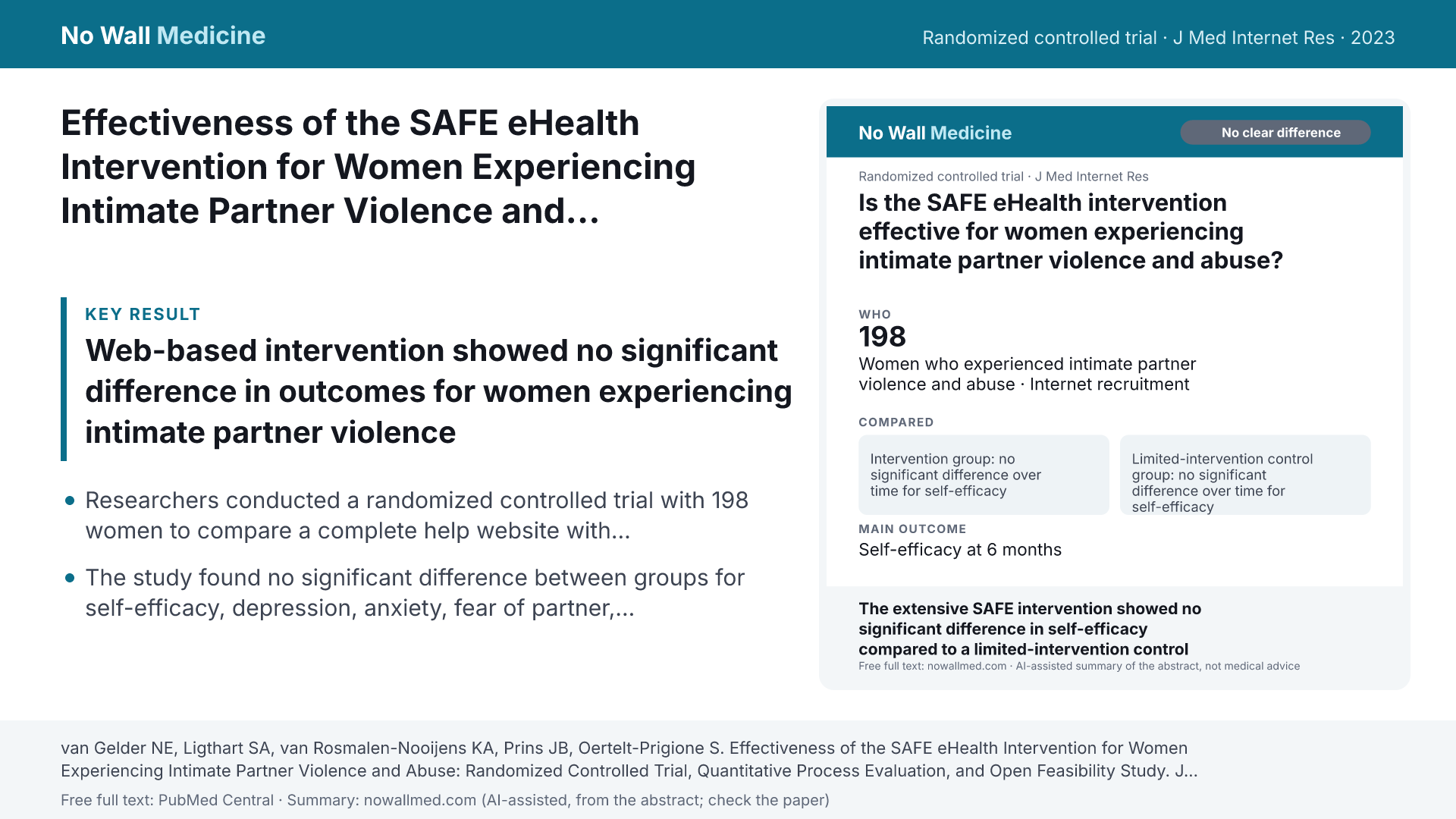
Key result: Web-based intervention showed no significant difference in outcomes for women experiencing intimate partner violence
Key points
- Researchers conducted a randomized controlled trial with 198 women to compare a complete help website with interactive components against a limited-intervention control group.
- The study found no significant difference between groups for self-efficacy, depression, anxiety, fear of partner, awareness, or perceived support at 6 months.
- Participants in the intervention group reported significantly higher scores for suitability and feeling helped compared to the control group.
Limitation the authors note: The researchers encountered high attrition for the follow-up surveys.
Discussion prompts
- Would these patients look like yours? Who was left out?
- Is the main outcome one that matters to patients?
- Is the difference large enough to change what you do?
Cite: van Gelder NE, Ligthart SA, van Rosmalen-Nooijens KA, Prins JB, Oertelt-Prigione S. Effectiveness of the SAFE eHealth Intervention for Women Experiencing Intimate Partner Violence and Abuse: Randomized Controlled Trial, Quantitative Process Evaluation, and Open Feasibility Study. J Med Internet Res. 2023;25:e42641. doi:10.2196/42641
Free full text: PubMed Central · Summary and visual abstract: nowallmed.com/a/effectiveness-of-the-safe-ehealth-intervention-for-women-experiencing-a77d6s/ (AI-assisted from the abstract; check the paper before relying on it).