Transcutaneous spinal cord stimulation may improve motor function and walking speed after spinal cord injury
Effectiveness of transcutaneous spinal cord stimulation for lower limb rehabilitation in spinal cord injury: a systematic review
Systematic review of 14 studiesBenefit found
Is transcutaneous spinal cord stimulation effective for lower limb rehabilitation in spinal cord injury?
Who
183
Adults with spinal cord injury
Compared
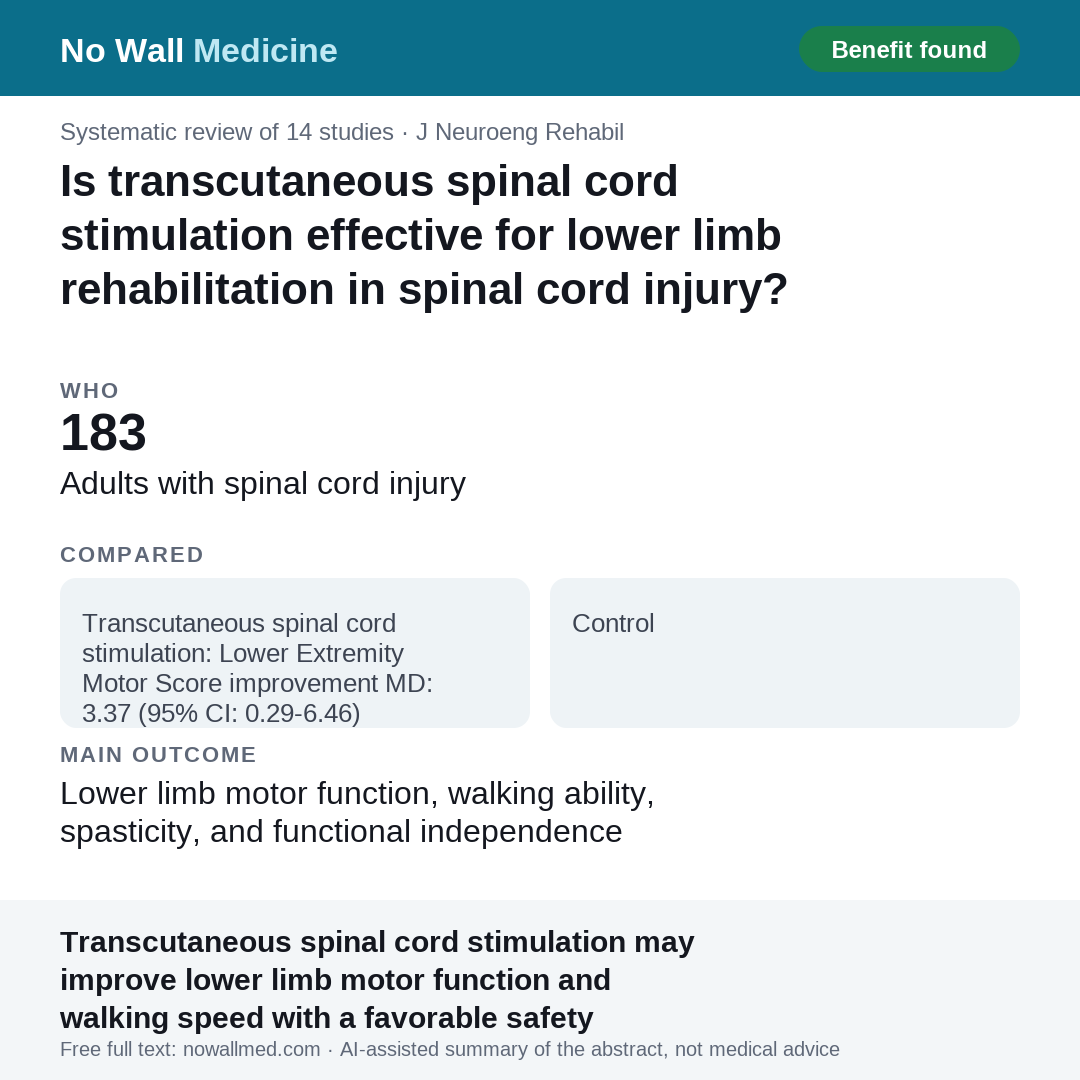
Transcutaneous spinal cord stimulation: Lower Extremity Motor Score improvement MD: 3.37 (95% CI: 0.29-6.46)
Control
Main outcome
Lower limb motor function, walking ability, spasticity, and functional independence
Result: MD: 3.37 (95% CI: 0.29-6.46) for Lower Extremity Motor Score
Bottom line: Transcutaneous spinal cord stimulation may improve lower limb motor function and walking speed with a favorable safety profile.
Limitation: Small sample sizes, heterogeneous protocols, and methodological concerns with very low certainty of evidence.
J Neuroeng Rehabil · 2025-12-30Download image
Clinical question: Is transcutaneous spinal cord stimulation effective for lower limb rehabilitation in spinal cord injury?
Why it matters: The effectiveness of transcutaneous spinal cord stimulation for improving lower limb motor function, walking ability, spasticity, and functional independence in individuals with spinal cord injury remains unclear.
Key points
- Researchers reviewed 14 studies involving 183 participants to evaluate transcutaneous spinal cord stimulation, a non-invasive technique using electrical currents, for lower limb rehabilitation.
- One high-quality randomized controlled trial showed improvements in the Lower Extremity Motor Score and 10-meter walk test speed, but no significant effects on spasticity or the 6-minute walk test.
- Most studies reported only mild adverse events such as skin irritation or tingling sensations.
Limitation the authors note: The authors state the evidence base is limited by small sample sizes, heterogeneous protocols, and methodological concerns.
Headline and key points written with AI from the paper’s abstract, with every number checked against it. Read the paper before relying on them.
Topics
Cite this article
Shankar R, Wen KSW, Goh Z, Tan B, Chandran G. Effectiveness of transcutaneous spinal cord stimulation for lower limb rehabilitation in spinal cord injury: a systematic review. J Neuroeng Rehabil. 2025. doi:10.1186/s12984-025-01775-w
Spotted a mistake? Suggest a correction