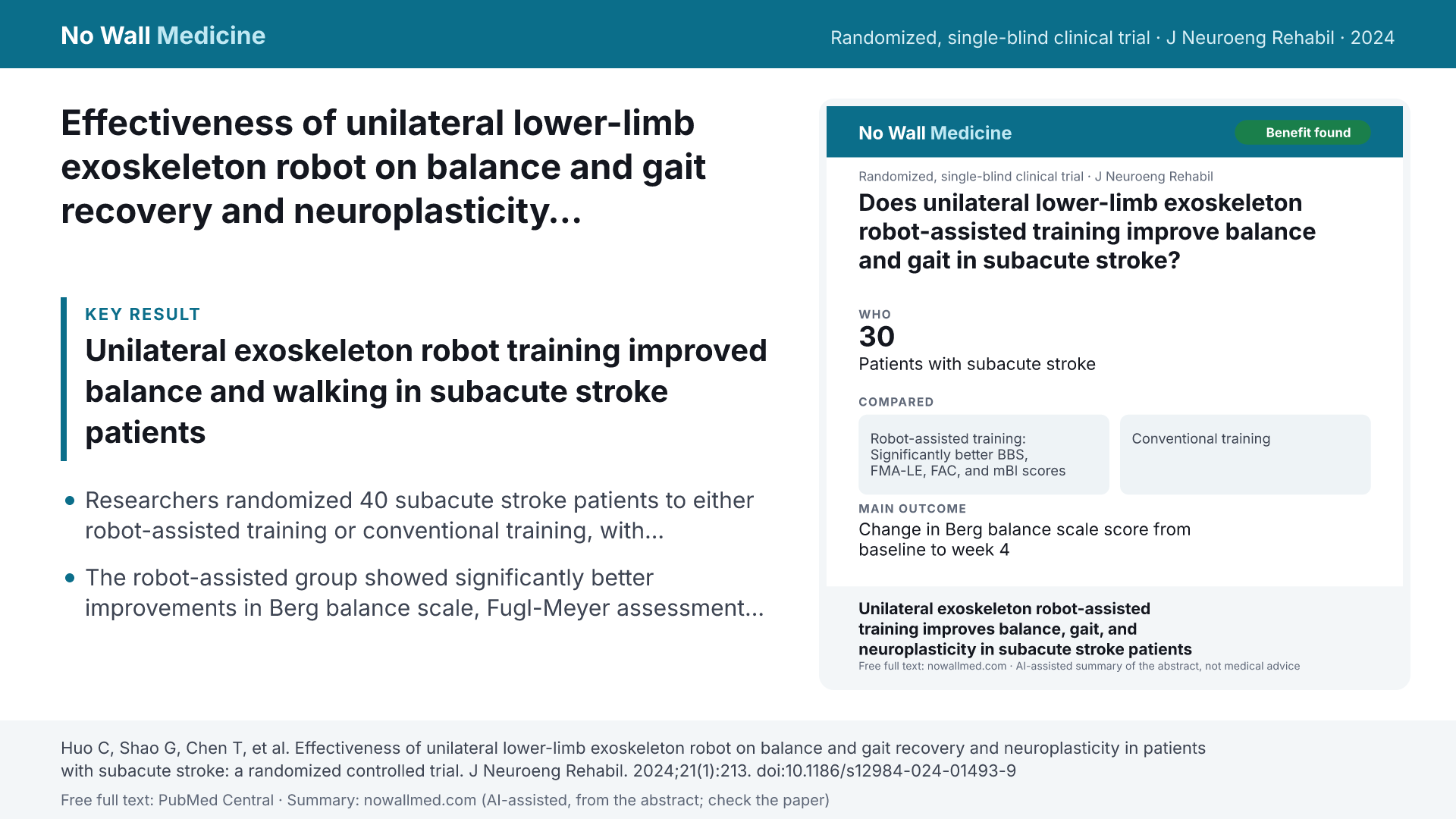
Unilateral exoskeleton robot training improved balance and walking in subacute stroke patients
Effectiveness of unilateral lower-limb exoskeleton robot on balance and gait recovery and neuroplasticity in patients with subacute stroke: a randomized controlled trial
Randomized, single-blind clinical trialBenefit found
Does unilateral lower-limb exoskeleton robot-assisted training improve balance and gait in subacute stroke?
Who
30
Patients with subacute stroke
Compared
Robot-assisted training: Significantly better BBS, FMA-LE, FAC, and mBI scores
Conventional training
Main outcome
Change in Berg balance scale score from baseline to week 4
Bottom line: Unilateral exoskeleton robot-assisted training improves balance, gait, and neuroplasticity in subacute stroke patients compared to conventional training.
J Neuroeng Rehabil · 2024-12-05 · Save PNG

Clinical question: Does unilateral lower-limb exoskeleton robot-assisted training improve balance and gait in subacute stroke?
Key points
- Researchers randomized 40 subacute stroke patients to either robot-assisted training or conventional training, with 30 patients completing the full study.
- The robot-assisted group showed significantly better improvements in Berg balance scale, Fugl-Meyer assessment of the lower limb, functional ambulation category, and modified Barthel index scores.
- Robot-assisted training was associated with increased stride length, support phase, and toe-off angle on the affected side, alongside increased neural activity in specific brain regions.
Headline and key points written with AI from the paper’s abstract, with every number checked against it. Read the paper before relying on them.
Was this summary helpful?
Subject terms
Headline, design, result, key points, caveat and citation as plain text.
Cite this article
Huo C, Shao G, Chen T, et al. Effectiveness of unilateral lower-limb exoskeleton robot on balance and gait recovery and neuroplasticity in patients with subacute stroke: a randomized controlled trial. J Neuroeng Rehabil. 2024;21(1):213. doi:10.1186/s12984-024-01493-9
Spotted a mistake? Suggest a correction