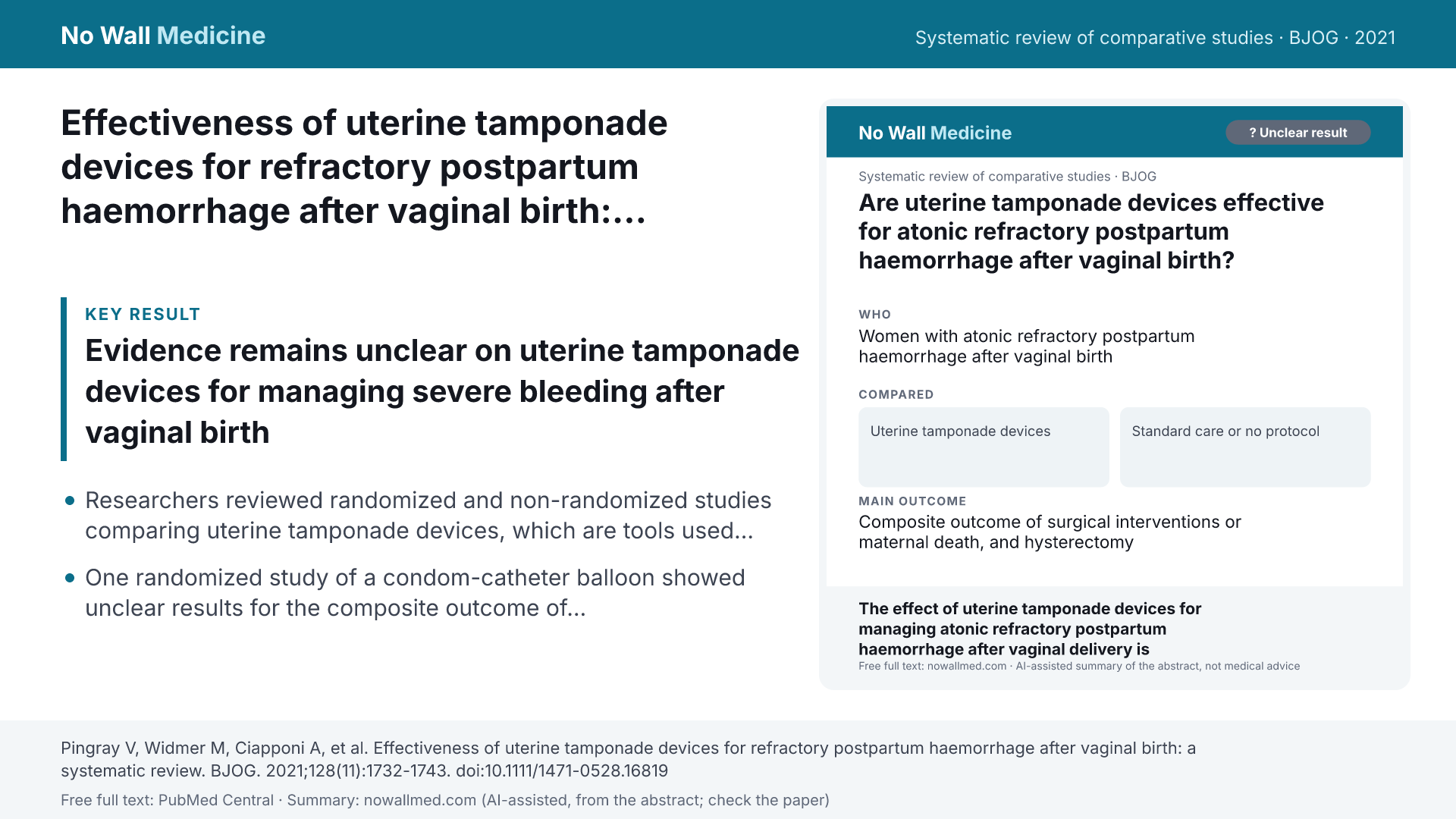
Evidence remains unclear on uterine tamponade devices for managing severe bleeding after vaginal birth
Effectiveness of uterine tamponade devices for refractory postpartum haemorrhage after vaginal birth: a systematic review
Systematic review of comparative studiesUnclear result
Are uterine tamponade devices effective for atonic refractory postpartum haemorrhage after vaginal birth?
Who
Women with atonic refractory postpartum haemorrhage after vaginal birth
Compared
Uterine tamponade devices
Standard care or no protocol
Main outcome
Composite outcome of surgical interventions or maternal death, and hysterectomy
Bottom line: The effect of uterine tamponade devices for managing atonic refractory postpartum haemorrhage after vaginal delivery is unclear.
Limitation: All included studies were at high risk of bias with very low to low certainty.
BJOG · 2021-07-19Download image
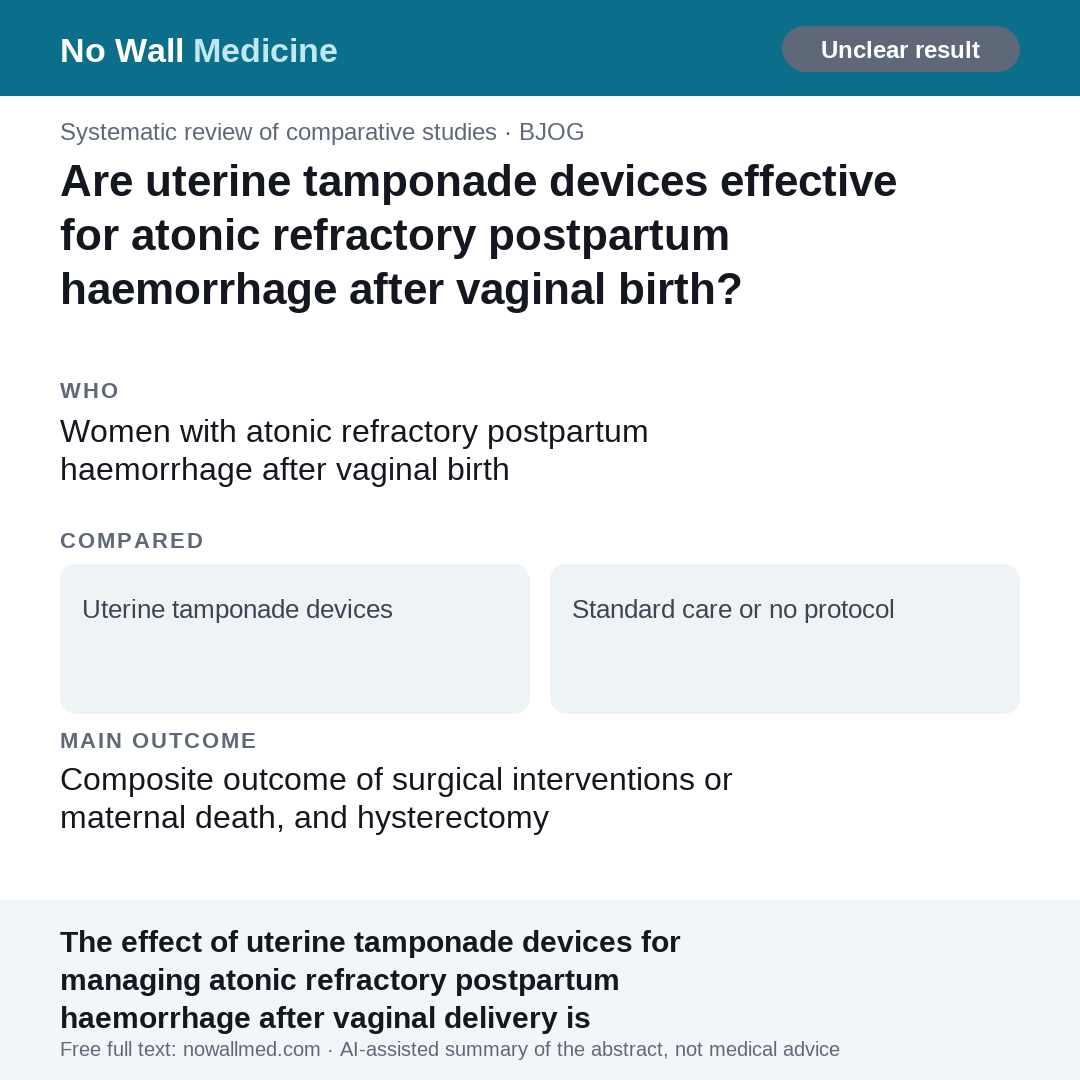
Clinical question: Are uterine tamponade devices effective for atonic refractory postpartum haemorrhage after vaginal birth?
Why it matters: It is unknown how effective uterine tamponade devices are for treating severe bleeding after vaginal birth or how including them in hospital protocols affects outcomes.
Key points
- Researchers reviewed randomized and non-randomized studies comparing uterine tamponade devices, which are tools used to stop bleeding by applying pressure inside the uterus, against standard care.
- One randomized study of a condom-catheter balloon showed unclear results for the composite outcome of surgical intervention or death (RR 2.33, 95% CI 0.76-7.14) and hysterectomy (RR 4.14, 95% CI 0.48-35.93).
- A stepped wedge cluster randomized trial suggested an increase in the composite outcome (RR 4.08, 95% CI 1.07-15.58) when using a condom-catheter or surgical glove balloon.
Limitation the authors note: All included studies were at high risk of bias and the certainty of the evidence was rated as very low to low.
Headline and key points written with AI from the paper’s abstract, with every number checked against it. Read the paper before relying on them.
Was this summary helpful?
Subject terms
Cite this article
Pingray V, Widmer M, Ciapponi A, et al. Effectiveness of uterine tamponade devices for refractory postpartum haemorrhage after vaginal birth: a systematic review. BJOG. 2021. doi:10.1111/1471-0528.16819
Spotted a mistake? Suggest a correction