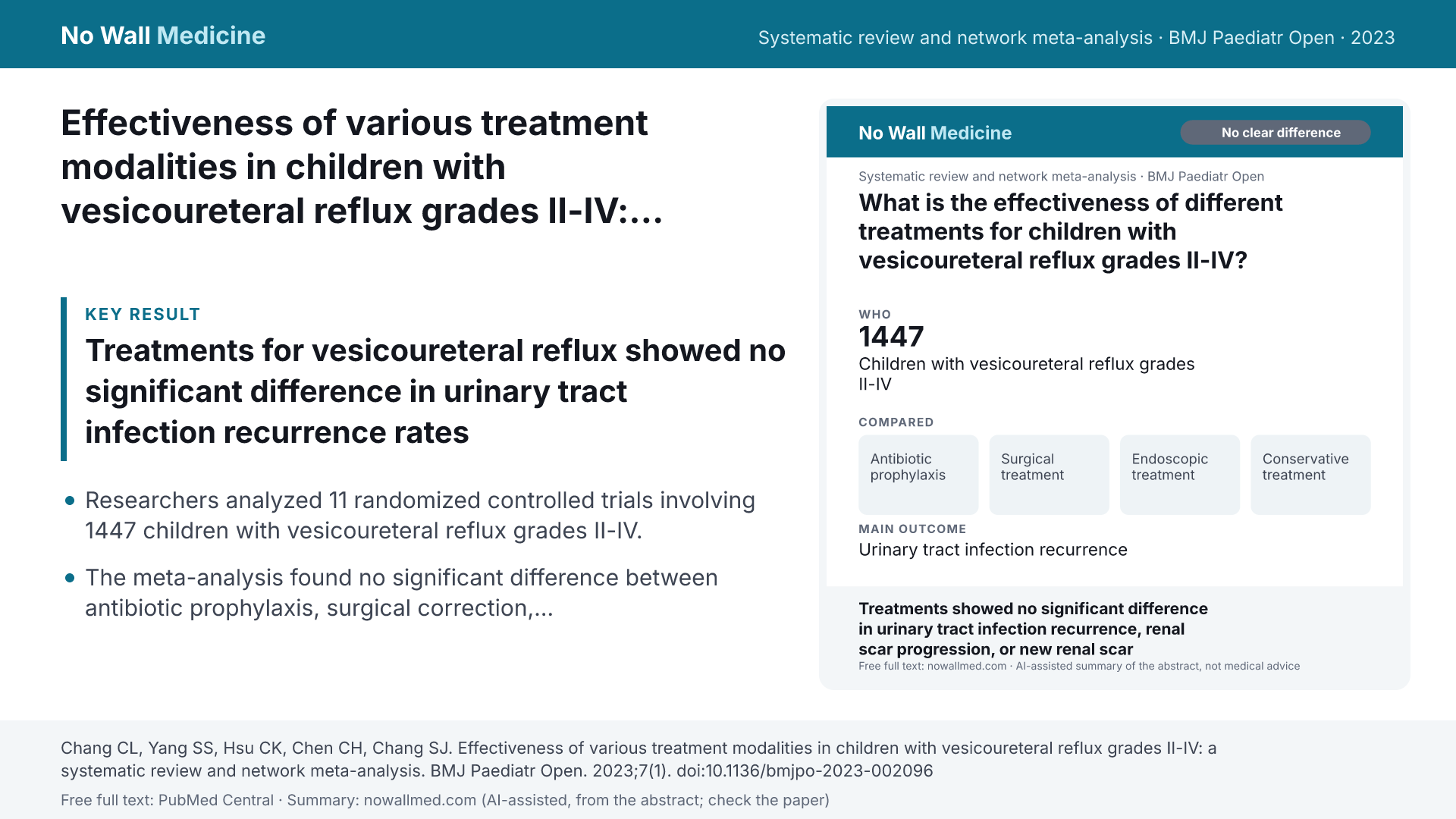
Treatments for vesicoureteral reflux showed no significant difference in urinary tract infection recurrence rates
Effectiveness of various treatment modalities in children with vesicoureteral reflux grades II-IV: a systematic review and network meta-analysis
Systematic review and network meta-analysisNo clear difference
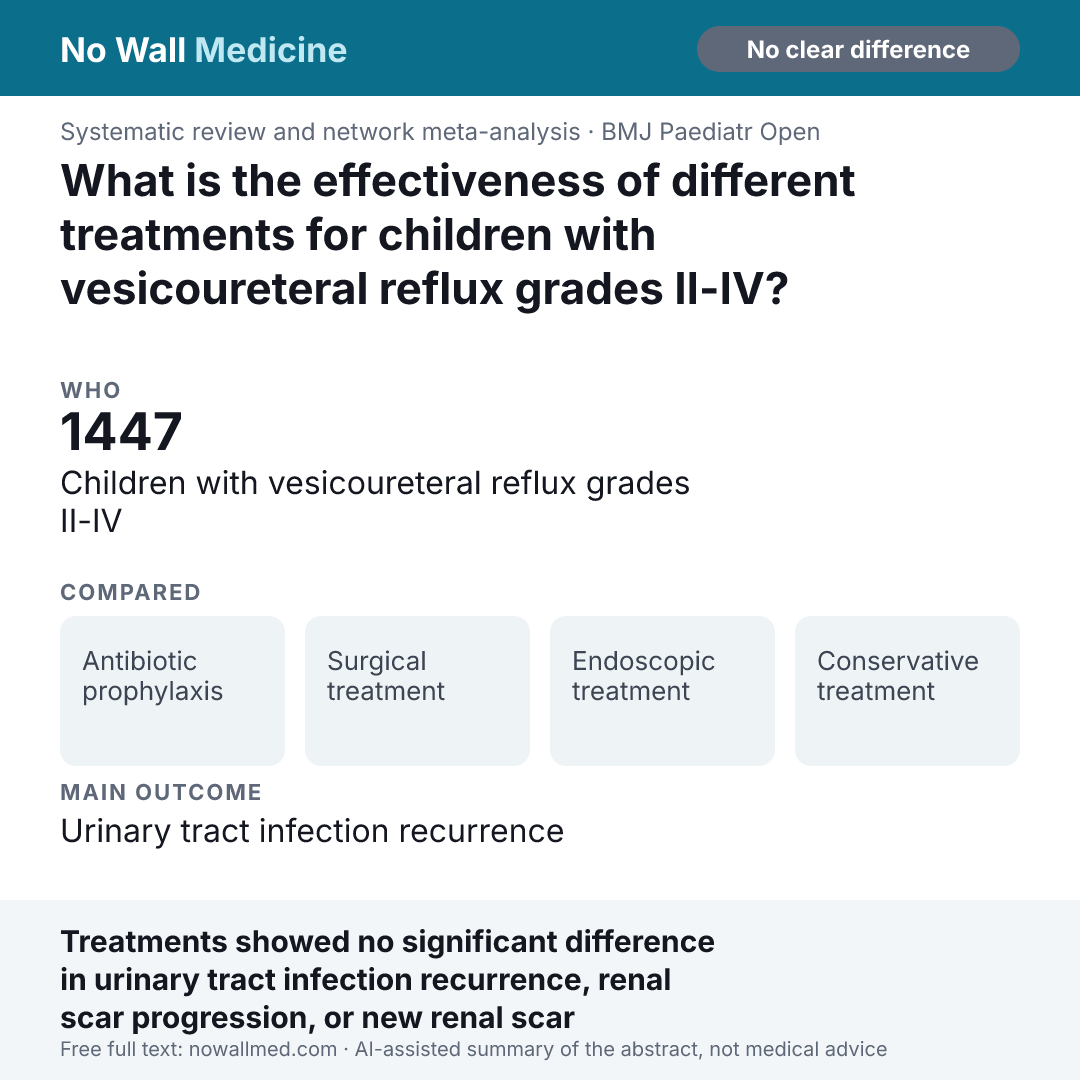
What is the effectiveness of different treatments for children with vesicoureteral reflux grades II-IV?
Who
1447
Children with vesicoureteral reflux grades II-IV
Compared
Antibiotic prophylaxis
Surgical treatment
Endoscopic treatment
Conservative treatment
Main outcome
Urinary tract infection recurrence
Result: Log OR -0.26 (95% CI -0.54 to 0.02)
Bottom line: Treatments showed no significant difference in urinary tract infection recurrence, renal scar progression, or new renal scar formation.
BMJ Paediatr Open · 2023-11-22 · Save PNG
Clinical question: What is the effectiveness of different treatments for children with vesicoureteral reflux grades II-IV?
Key points
- Researchers analyzed 11 randomized controlled trials involving 1447 children with vesicoureteral reflux grades II-IV.
- The meta-analysis found no significant difference between antibiotic prophylaxis, surgical correction, endoscopic treatment, or conservative treatment regarding urinary tract infection recurrence.
- The treatments also showed no significant difference in the progression of existing renal scars or the formation of new renal scars.
Headline and key points written with AI from the paper’s abstract, with every number checked against it. Read the paper before relying on them.
Was this summary helpful?
Abstract
Background
Vesicoureteral reflux (VUR) is one of the most common risk factors of urinary tract infection (UTI) among children. Various treatment modalities including antibiotic prophylaxis, surgical or endoscopic corrections and conservative treatment were used depending on the severity of VUR. The aim of this study is to compare the effectiveness of these treatment modalities in children with VUR grades II-IV by conducting a systematic review and network meta-analysis. Methods
A systematic search from different databases was performed from their earliest records to December 2022 without any language restriction. Only randomised controlled trials were included in this study. Effectiveness of treatment modalities was mainly compared by UTI. Other outcomes for renal scarring and resolution by renal units were also measured between treatments. Results
A total of 11 studies with 1447 children were included in this study. While comparing with antibiotic prophylaxis in network meta-analysis for UTI recurrence, surgical treatment probably lowers the rate of UTI recurrence (Log OR -0.26, 95% CI -0.54 to 0.02, high quality). However, endoscopic treatment (Log OR 0.2, 95% CI -1.41 to 1.81, high quality) and conservative treatment (Log OR 0.15, 95% CI -0.45 to 0.75, high quality) revealed probably inferior to antibiotic treatment. Conclusion
Both pairwise and network meta-analytic results probably showed no difference between the treatments in terms of their impact on UTI recurrence, progression of previous renal scars, or formation of new renal scars in children with VUR grades II-IV. These findings may offer a better understanding of each treatment and evidence-based suggestions for the choice of treatment, which should be individualised and based on the patient's risk factors.
Abstract reproduced under the article’s CC BY NC licence.
Subject terms
Headline, design, result, key points, caveat and citation as plain text.
Cite this article
Chang CL, Yang SS, Hsu CK, Chen CH, Chang SJ. Effectiveness of various treatment modalities in children with vesicoureteral reflux grades II-IV: a systematic review and network meta-analysis. BMJ Paediatr Open. 2023;7(1). doi:10.1136/bmjpo-2023-002096
Spotted a mistake? Suggest a correction