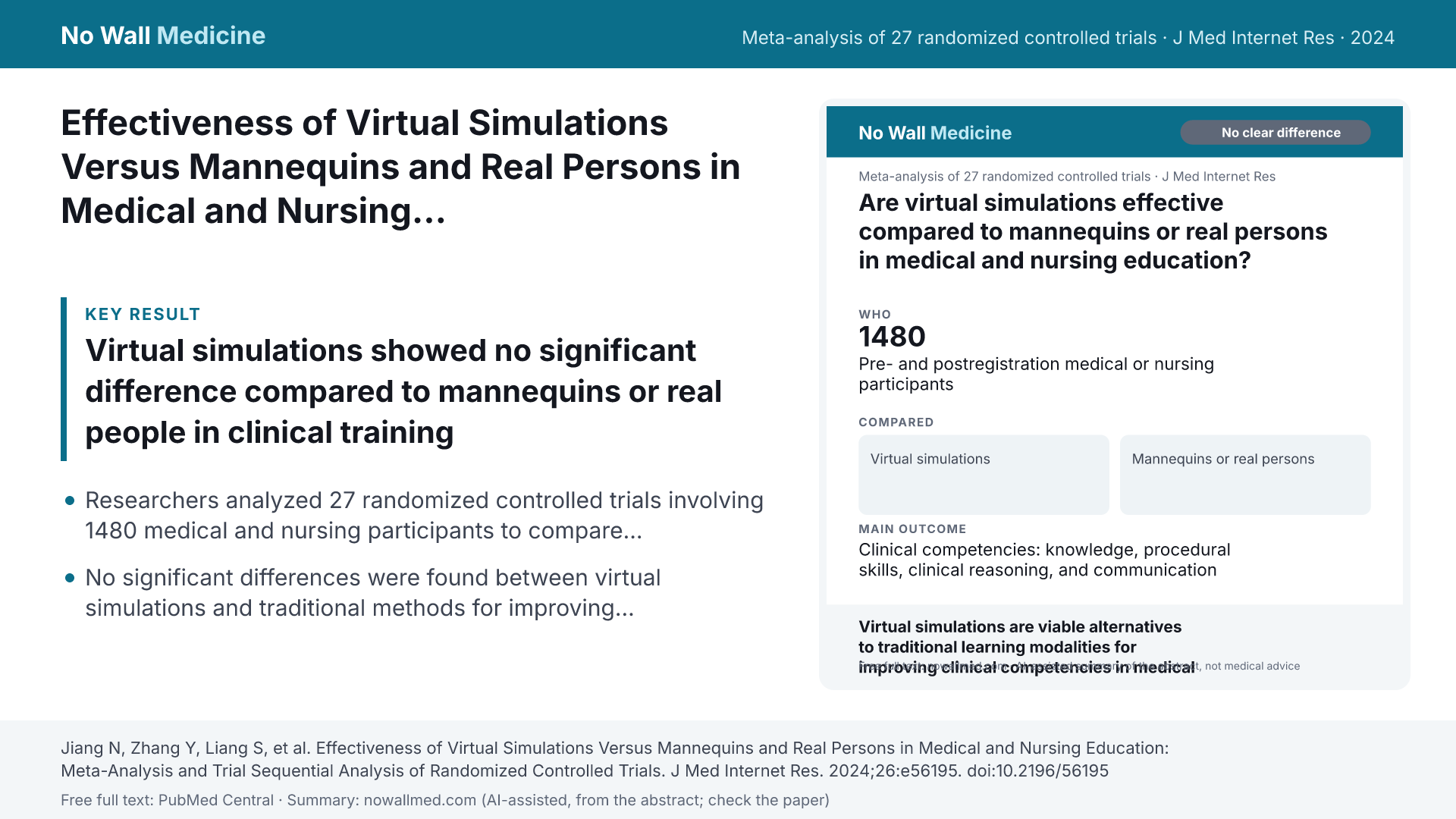
Virtual simulations showed no significant difference compared to mannequins or real people in clinical training
Effectiveness of Virtual Simulations Versus Mannequins and Real Persons in Medical and Nursing Education: Meta-Analysis and Trial Sequential Analysis of Randomized Controlled Trials
Meta-analysis of 27 randomized controlled trialsNo clear difference
Are virtual simulations effective compared to mannequins or real persons in medical and nursing education?
Who
1480
Pre- and postregistration medical or nursing participants
Compared
Virtual simulations
Mannequins or real persons
Main outcome
Clinical competencies: knowledge, procedural skills, clinical reasoning, and communication skills
Result: knowledge SMD=0.08 (95% CI -0.30 to 0.47); procedural skills SMD=-0.12 (95% CI -0.47 to 0.23); clinical reasoning SMD=0.29 (95% CI -0.26 to 0.85); communication skills SMD=-0.02 (95% CI -0.62 to 0.58)
Bottom line: Virtual simulations are viable alternatives to traditional learning modalities for improving clinical competencies in medical and nursing education.
Limitation: Trial sequential analysis indicated an insufficient sample size for a definitive judgment on clinical reasoning.
J Med Internet Res · 2024-12-05Download image
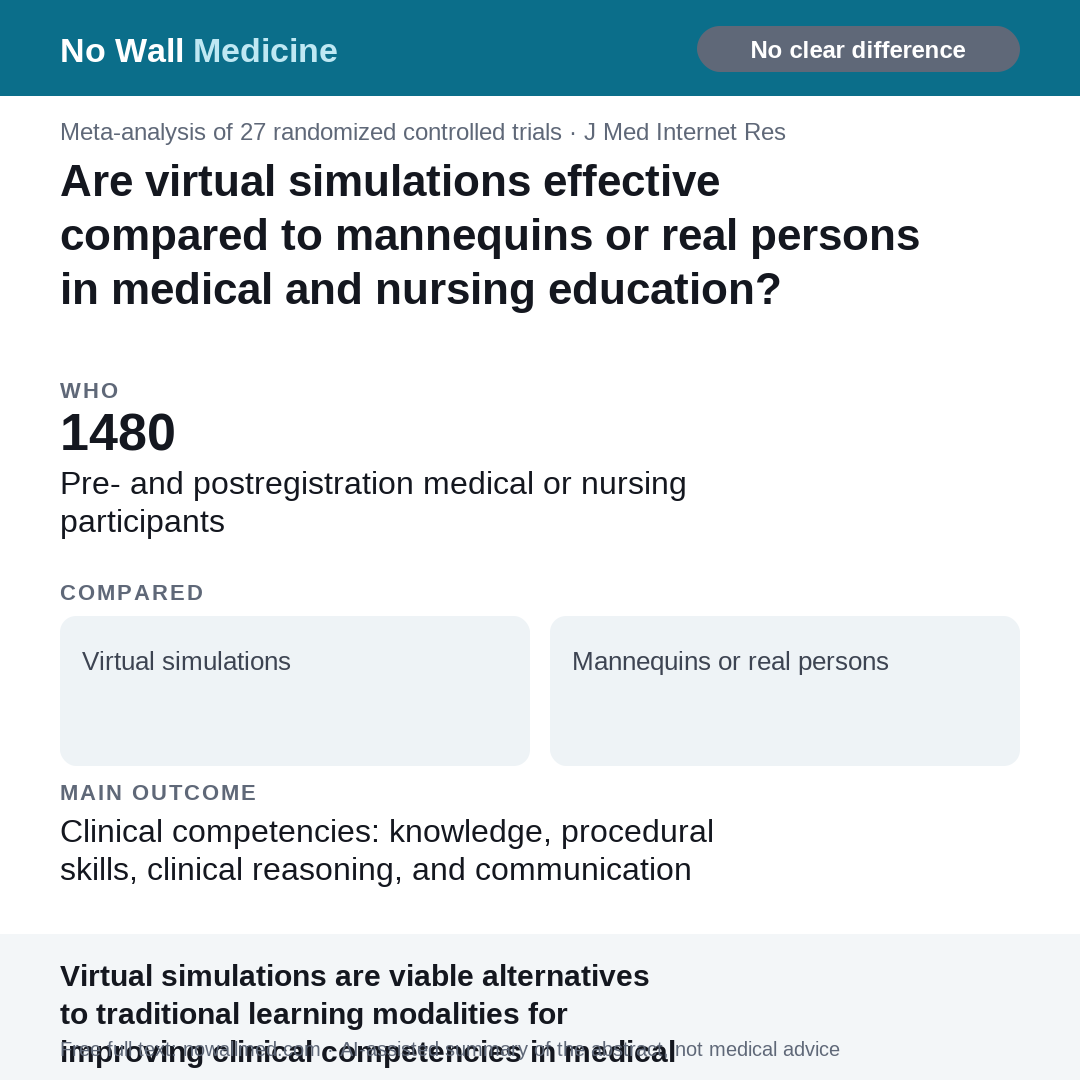
Clinical question: Are virtual simulations effective compared to mannequins or real persons in medical and nursing education?
Key points
- Researchers analyzed 27 randomized controlled trials involving 1480 medical and nursing participants to compare virtual simulations against mannequins and real people.
- No significant differences were found between virtual simulations and traditional methods for improving knowledge, procedural skills, clinical reasoning, or communication skills.
- Subgroup analysis showed virtual simulations were less effective for procedural skills among nursing participants with a standard mean difference of -0.55.
Limitation the authors note: Trial sequential analysis for clinical reasoning indicated an insufficient sample size for a definitive judgment.
Headline and key points written with AI from the paper’s abstract, with every number checked against it. Read the paper before relying on them.
Was this summary helpful?
Subject terms
Cite this article
Jiang N, Zhang Y, Liang S, et al. Effectiveness of Virtual Simulations Versus Mannequins and Real Persons in Medical and Nursing Education: Meta-Analysis and Trial Sequential Analysis of Randomized Controlled Trials. J Med Internet Res. 2024. doi:10.2196/56195
Spotted a mistake? Suggest a correction