WeChat health education was associated with higher exclusive breastfeeding rates in the first month postpartum
Effectiveness of WeChat for Improving Exclusive Breastfeeding in Huzhu County China: Randomized Controlled Trial
2-arm randomized controlled trialBenefit found
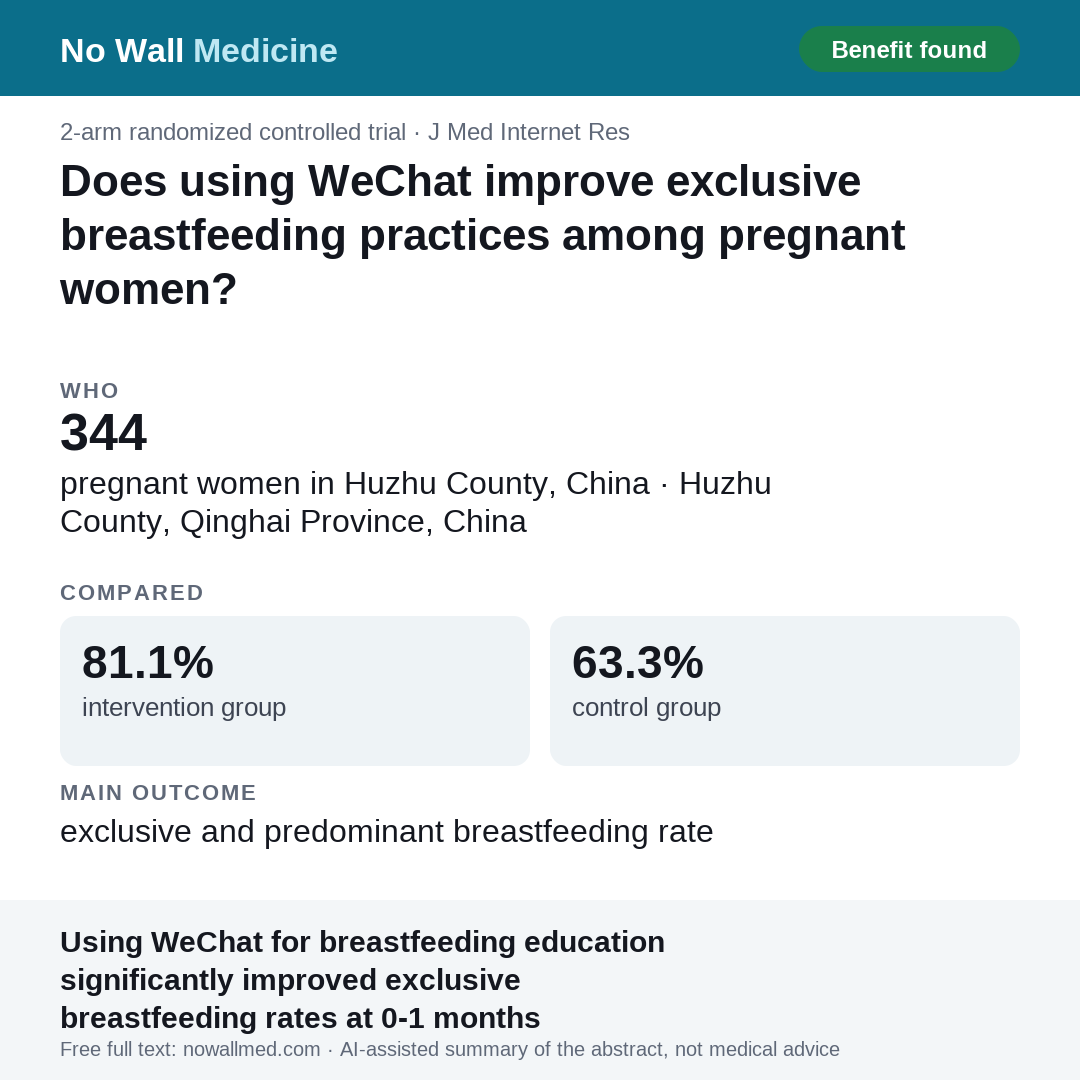
Does using WeChat improve exclusive breastfeeding practices among pregnant women?
Who
344
pregnant women in Huzhu County, China · Huzhu County, Qinghai Province, China
Compared
81.1%intervention group (0-1 month postpartum)
63.3%control group (0-1 month postpartum)
Main outcome
exclusive and predominant breastfeeding rate
Result: odds ratio 2.75 (95% CI 1.58-4.78)
Bottom line: Using WeChat for breastfeeding education significantly improved exclusive breastfeeding rates at 0-1 months postpartum.
J Med Internet Res · 2020-12-03Download image
Clinical question: Does using WeChat improve exclusive breastfeeding practices among pregnant women?
Why it matters: Exclusive breastfeeding rates in China are low and decreasing, and it is unknown if mobile communication apps like WeChat can improve these health behaviors.
In absolute numbers
intervention group: 81.1% · control group: 63.3% → a difference of 17.8 percentage points, so about 6 people would need the treatment for 1 more to benefit (number needed to treat) over the trial’s follow-up.
Worked out by us from the two group results above, not reported by the authors. Check the paper for the exact outcome and timing.
Key points
- Researchers conducted a randomized controlled trial with 344 pregnant women in Huzhu County, China, comparing a WeChat intervention group to a control group.
- At 0-1 months postpartum, the exclusive breastfeeding rate was 81.1% in the intervention group compared to 63.3% in the control group.
- No statistically significant differences were found in exclusive breastfeeding rates at 2-3 months postpartum or 4-5 months postpartum.
Headline and key points written with AI from the paper’s abstract, with every number checked against it. Read the paper before relying on them.
Was this summary helpful?
Subject terms
Cite this article
Wu Q, Huang Y, Liao Z, van Velthoven MH, Wang W, Zhang Y. Effectiveness of WeChat for Improving Exclusive Breastfeeding in Huzhu County China: Randomized Controlled Trial. J Med Internet Res. 2020. doi:10.2196/23273
Spotted a mistake? Suggest a correction
Top studies every Monday
The week’s key trials and guidelines in your specialties, plus any topics you follow. By email, free.
Get the weekly digest