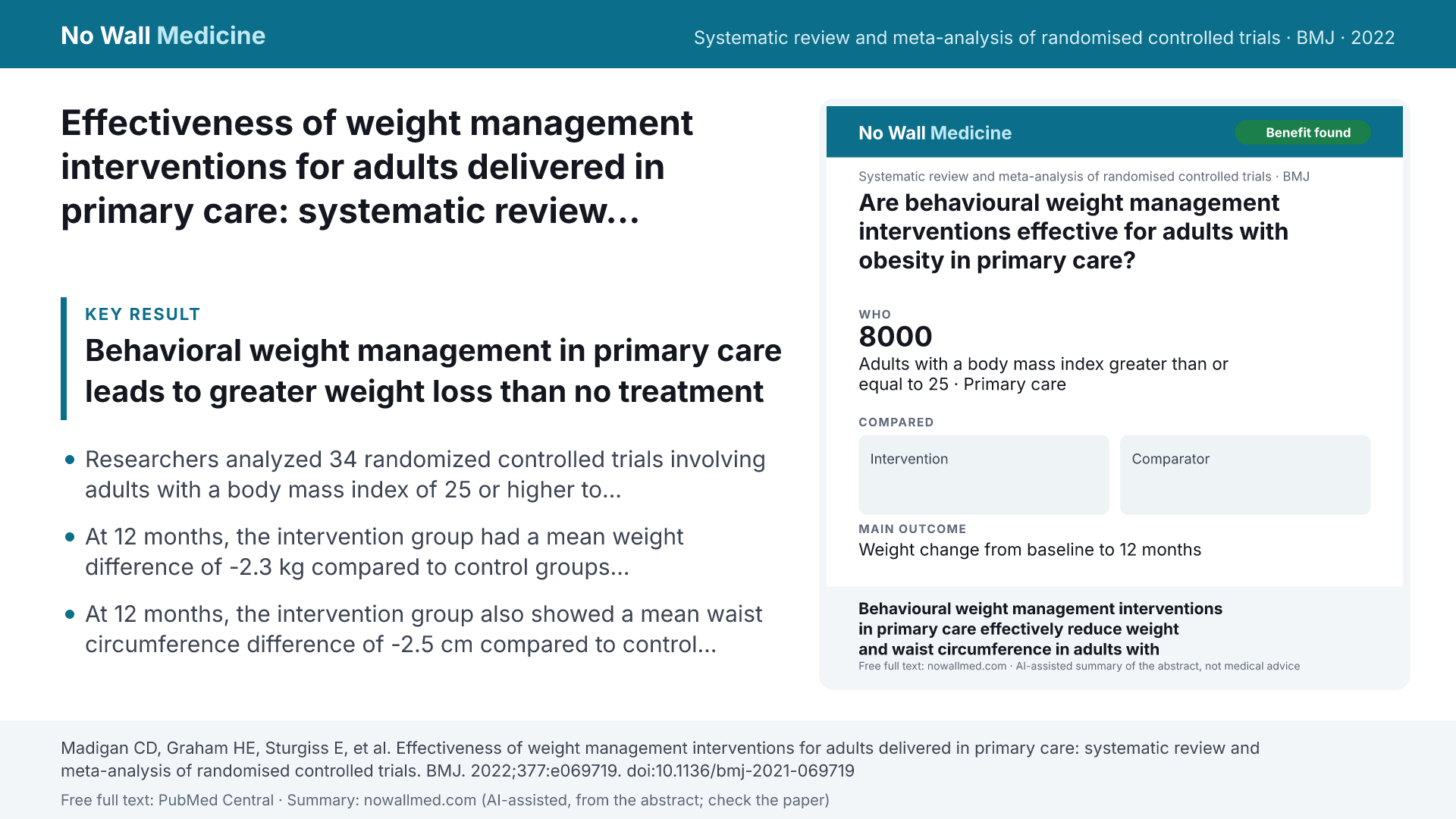
Behavioral weight management in primary care leads to greater weight loss than no treatment
Effectiveness of weight management interventions for adults delivered in primary care: systematic review and meta-analysis of randomised controlled trials
Systematic review and meta-analysis of randomised controlled trialsBenefit found
Are behavioural weight management interventions effective for adults with obesity in primary care?
Who
8000
Adults with a body mass index greater than or equal to 25 · Primary care
Compared
Intervention
Comparator
Main outcome
Weight change from baseline to 12 months
Result: mean difference -2.3 kg (95% confidence interval -3.0 to -1.6 kg)
Bottom line: Behavioural weight management interventions in primary care effectively reduce weight and waist circumference in adults with obesity.
BMJ · 2022-05-30 · Save PNG
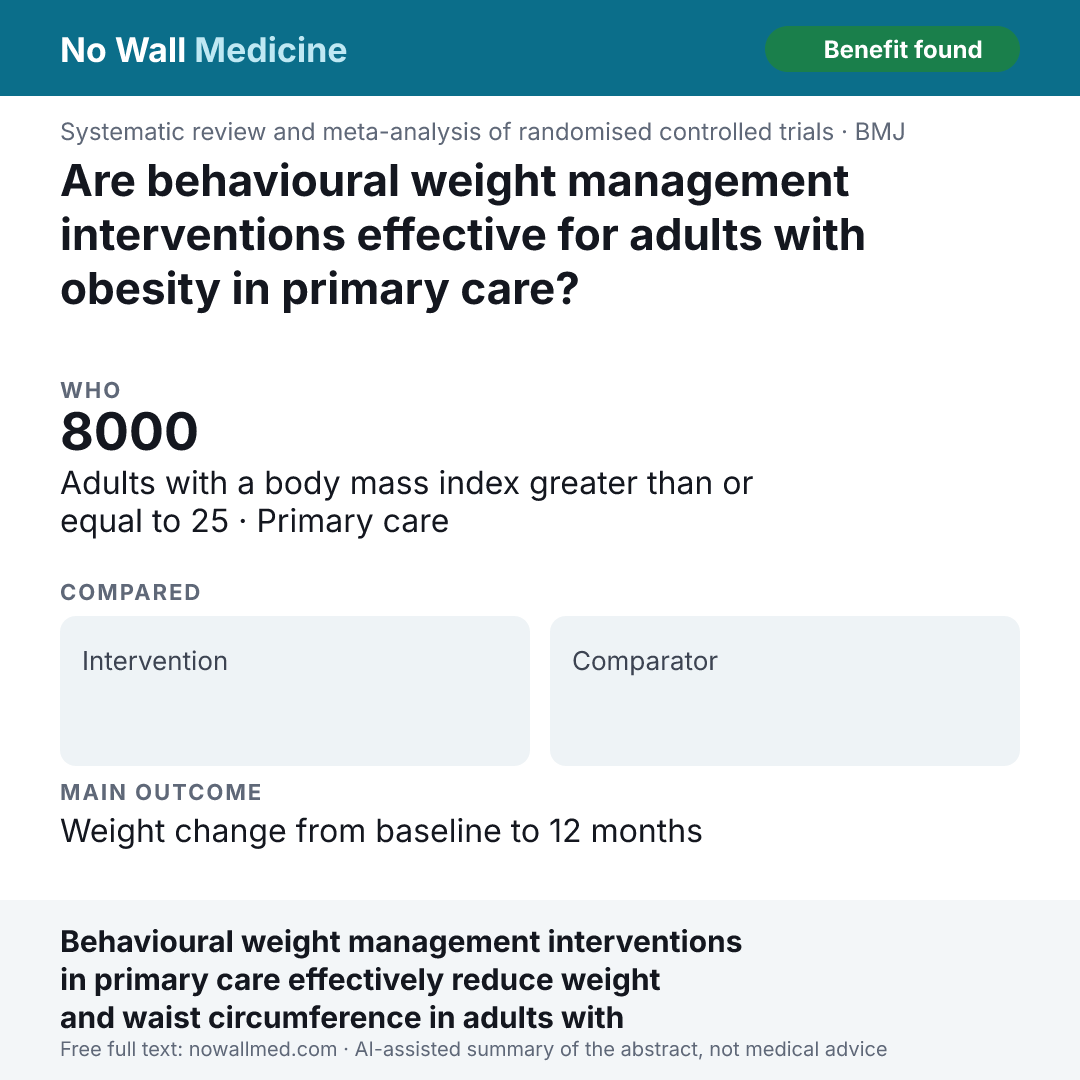
Clinical question: Are behavioural weight management interventions effective for adults with obesity in primary care?
Key points
- Researchers analyzed 34 randomized controlled trials involving adults with a body mass index of 25 or higher to assess behavioral weight management interventions.
- At 12 months, the intervention group had a mean weight difference of -2.3 kg compared to control groups (95% confidence interval -3.0 to -1.6 kg).
- At 12 months, the intervention group also showed a mean waist circumference difference of -2.5 cm compared to control groups (-3.2 to -1.8 cm).
Headline and key points written with AI from the paper’s abstract, with every number checked against it. Read the paper before relying on them.
Was this summary helpful?
Abstract
Objective
To examine the effectiveness of behavioural weight management interventions for adults with obesity delivered in primary care. Design
Systematic review and meta-analysis of randomised controlled trials. Eligibility criteria for selection of studies
Randomised controlled trials of behavioural weight management interventions for adults with a body mass index ≥25 delivered in primary care compared with no treatment, attention control, or minimal intervention and weight change at ≥12 months follow-up. Data sources
Trials from a previous systematic review were extracted and the search completed using the Cochrane Central Register of Controlled Trials, Medline, PubMed, and PsychINFO from 1 January 2018 to 19 August 2021. Data extraction and synthesis
Two reviewers independently identified eligible studies, extracted data, and assessed risk of bias using the Cochrane risk of bias tool. Meta-analyses were conducted with random effects models, and a pooled mean difference for both weight (kg) and waist circumference (cm) were calculated. Main outcome measures
Primary outcome was weight change from baseline to 12 months. Secondary outcome was weight change from baseline to ≥24 months. Change in waist circumference was assessed at 12 months. Results
34 trials were included: 14 were additional, from a previous review. 27 trials (n=8000) were included in the primary outcome of weight change at 12 month follow-up. The mean difference between the intervention and comparator groups at 12 months was -2.3 kg (95% confidence interval -3.0 to -1.6 kg, I2=88%, P<0.001), favouring the intervention group. At ≥24 months (13 trials, n=5011) the mean difference in weight change was -1.8 kg (-2.8 to -0.8 kg, I2=88%, P<0.001) favouring the intervention. The mean difference in waist circumference (18 trials, n=5288) was -2.5 cm (-3.2 to -1.8 cm, I2=69%, P<0.001) in favour of the intervention at 12 months. Conclusions
Behavioural weight management interventions for adults with obesity delivered in primary care are effective for weight loss and could be offered to members of the public. Systematic review registration
PROSPERO CRD42021275529.
Abstract reproduced under the article’s CC BY licence.
Subject terms
Headline, design, result, key points, caveat and citation as plain text.
Cite this article
Madigan CD, Graham HE, Sturgiss E, et al. Effectiveness of weight management interventions for adults delivered in primary care: systematic review and meta-analysis of randomised controlled trials. BMJ. 2022;377:e069719. doi:10.1136/bmj-2021-069719
Spotted a mistake? Suggest a correction