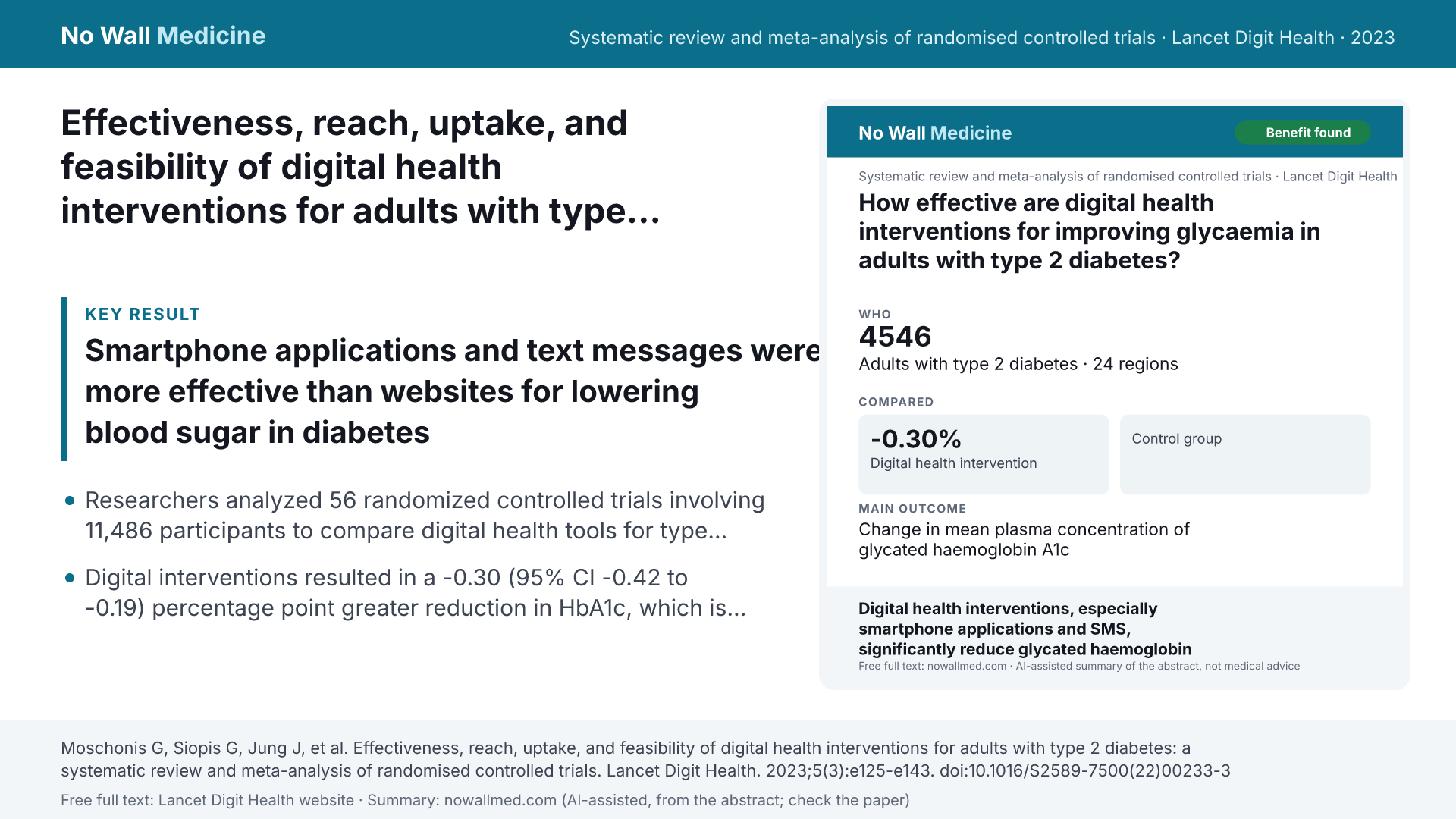
Smartphone applications and text messages were more effective than websites for lowering blood sugar in diabetes
Effectiveness, reach, uptake, and feasibility of digital health interventions for adults with type 2 diabetes: a systematic review and meta-analysis of randomised controlled trials
Systematic review and meta-analysis of randomised controlled trialsBenefit found
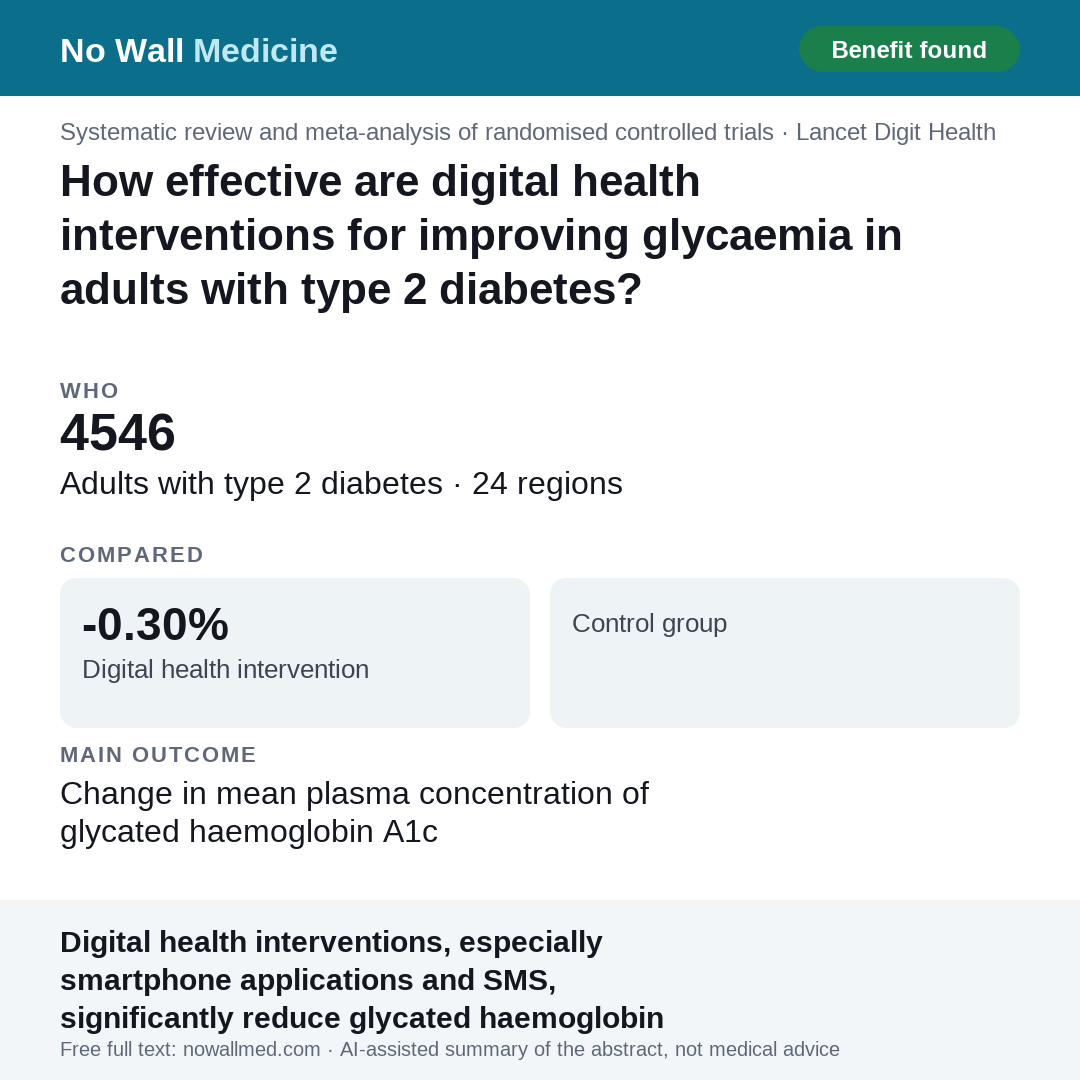
How effective are digital health interventions for improving glycaemia in adults with type 2 diabetes?
Who
4546
Adults with type 2 diabetes · 24 regions
Compared
-0.30%Digital health intervention (95% CI -0.42 to -0.19)
Control group
Main outcome
Change in mean plasma concentration of glycated haemoglobin A1c
Result: -0.30 (95% CI -0.42 to -0.19) percentage point greater reduction
Bottom line: Digital health interventions, especially smartphone applications and SMS, significantly reduce glycated haemoglobin A1c in adults with type 2 diabetes.
Limitation: Considerable heterogeneity between included studies
Lancet Digit Health · 2023-02-24Download image
Clinical question: How effective are digital health interventions for improving glycaemia in adults with type 2 diabetes?
Key points
- Researchers analyzed 56 randomized controlled trials involving 11,486 participants to compare digital health tools for type 2 diabetes management.
- Digital interventions resulted in a -0.30 (95% CI -0.42 to -0.19) percentage point greater reduction in HbA1c, which is a measure of long-term blood sugar, compared to control groups.
- Statistically significant HbA1c reductions were found with smartphone applications (-0.42% [-0.63 to -0.20]) and SMS (-0.37% [-0.57 to -0.17]), but not with websites (-0.09% [-0.64 to 0.46]).
Limitation the authors note: The level of evidence was moderate overall due to considerable heterogeneity between the included studies.
Headline and key points written with AI from the paper’s abstract, with every number checked against it. Read the paper before relying on them.
Was this summary helpful?
Abstract
Background
Digital health interventions have shown promising results for the management of type 2 diabetes, but a comparison of the effectiveness and implementation of the different modes is not currently available. Therefore, this study aimed to compare the effectiveness of SMS, smartphone application, and website-based interventions on improving glycaemia in adults with type 2 diabetes and report on their reach, uptake, and feasibility. Methods
In this systematic review and meta-analysis, we searched CINAHL, Cochrane Central, Embase, MEDLINE, and PsycInfo on May 25, 2022, for randomised controlled trials (RCTs) that examined the effectiveness of digital health interventions in reducing glycated haemoglobin A1c (HbA1c) in adults with type 2 diabetes, published in English from Jan 1, 2009. Screening was carried out using Covidence, and data were extracted following Cochrane's guidelines. The primary endpoint assessed was the change in the mean (and 95% CI) plasma concentration of HbA1c at 3 months or more. Cochrane risk of bias 2 was used to assess risk of bias. Data on reach, uptake, and feasibility were summarised narratively and data on HbA1c reduction were synthesised in a meta-analysis. Grading of Recommendations, Assessment, Development, and Evaluation criteria was used to evaluate the level of evidence. The study was registered with PROSPERO, CRD42021247845. Findings
Of the 3236 records identified, 56 RCTs from 24 regions (n=11 486 participants), were included in the narrative synthesis, and 26 studies (n=4546 participants) in the meta-analysis. 20 studies used SMS as the primary mode of delivery of the digital health intervention, 25 used smartphone applications, and 11 implemented interventions via websites. Smartphone application interventions reported higher reach compared with SMS and website-based interventions, but website-based interventions reported higher uptake compared with SMS and smartphone application interventions. Effective interventions, in general, included people with greater severity of their condition at baseline (ie, higher HbA1c) and administration of a higher dose intensity of the intervention, such as more frequent use of smartphone applications. Overall, digital health intervention group participants had a -0·30 (95% CI -0·42 to -0·19) percentage point greater reduction in HbA1c, compared with control group participants. The difference in HbA1c reduction between groups was statistically significant when interventions were delivered through smartphone applications (-0·42% [-0·63 to -0·20]) and via SMS (-0·37% [-0·57 to -0·17]), but not when delivered via websites (-0·09% [-0·64 to 0·46]). Due to the considerable heterogeneity between included studies, the level of evidence was moderate overall. Interpretation
Smartphone application and SMS interventions, but not website-based interventions, were associated with better glycaemic control. However, the studies' heterogeneity should be recognised. Considering that both smartphone application and SMS interventions are effective for diabetes management, clinicians should consider factors such as reach, uptake, patient preference, and context of the intervention when deciding on the mode of delivery of the intervention. Nine in ten people worldwide own a feature phone and can receive SMS and four in five people have access to a smartphone, with numerous smartphone applications being available for diabetes management. Clinicians should familiarise themselves with this modality of programme delivery and encourage people with type 2 diabetes to use evidence-based applications for improving their self-management of diabetes. Future research needs to describe in detail the mediators and moderators of the effectiveness and implementation of SMS and smartphone application interventions, such as the optimal dose, frequency, timing, user interface, and communication mode to both further improve their effectiveness and to increase their reach, uptake, and feasibility. Funding
EU's Horizon 2020 Research and Innovation Programme.
Abstract reproduced under the article’s CC BY licence.
Subject terms
Headline, design, result, key points, caveat and citation as plain text.
Cite this article
Moschonis G, Siopis G, Jung J, et al. Effectiveness, reach, uptake, and feasibility of digital health interventions for adults with type 2 diabetes: a systematic review and meta-analysis of randomised controlled trials. Lancet Digit Health. 2023. doi:10.1016/S2589-7500(22)00233-3
Spotted a mistake? Suggest a correction