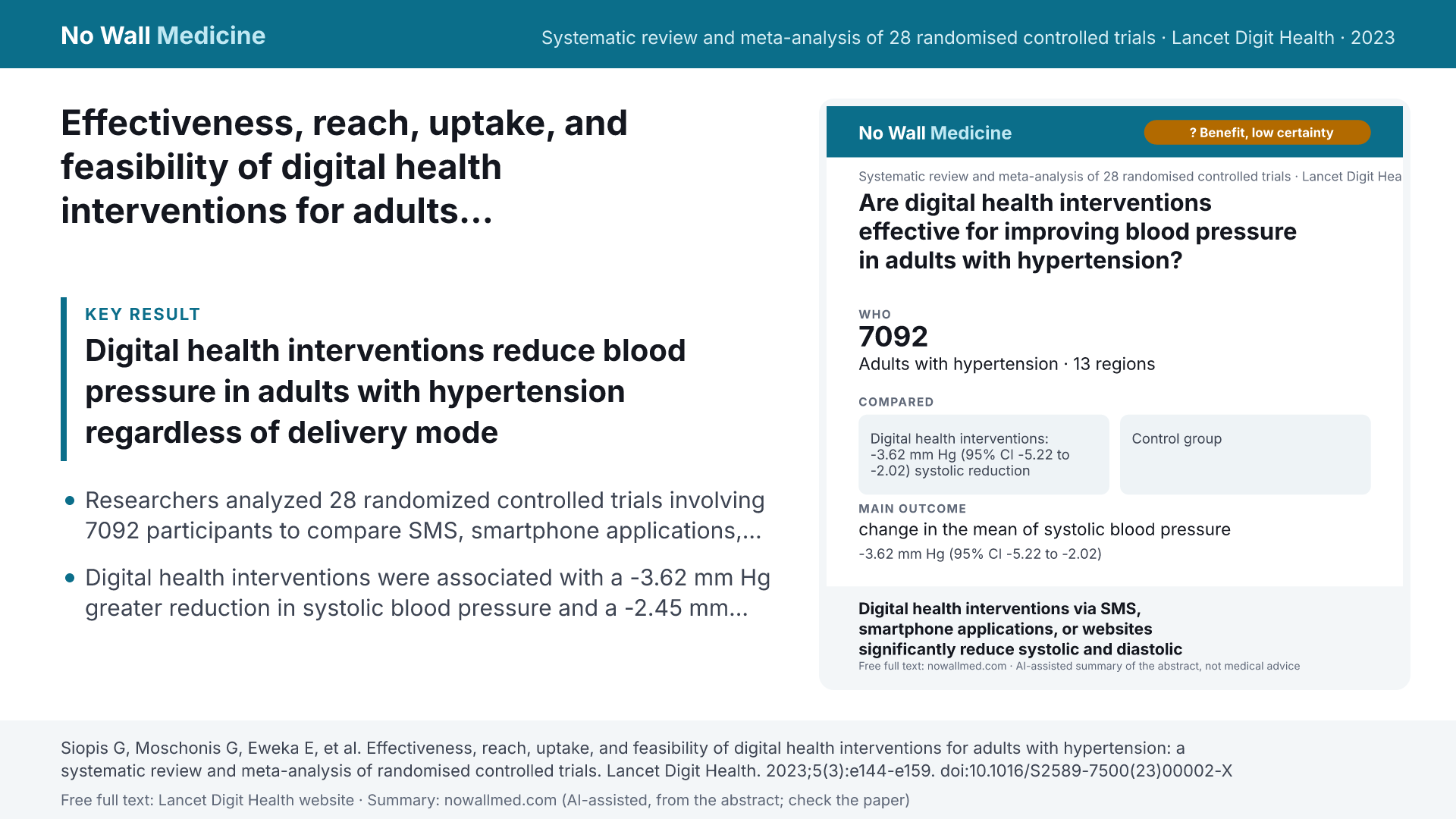
Digital health interventions reduce blood pressure in adults with hypertension regardless of delivery mode
Effectiveness, reach, uptake, and feasibility of digital health interventions for adults with hypertension: a systematic review and meta-analysis of randomised controlled trials
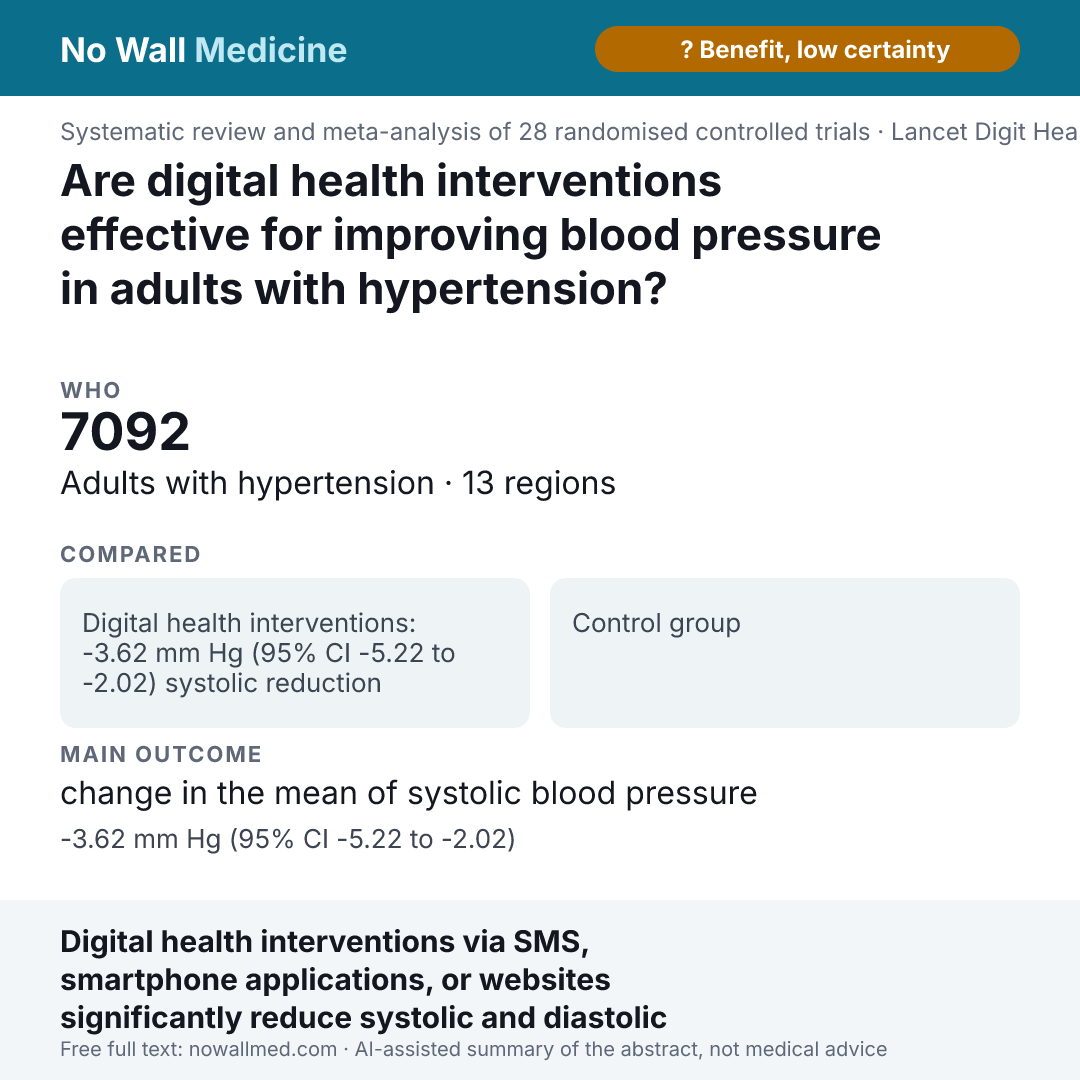
Systematic review and meta-analysis of 28 randomised controlled trialsBenefit, low certainty
Are digital health interventions effective for improving blood pressure in adults with hypertension?
Who
7092
Adults with hypertension · 13 regions
Compared
Digital health interventions: -3.62 mm Hg (95% CI -5.22 to -2.02) systolic reduction
Control group
Main outcome
change in the mean of systolic blood pressure
Result: -3.62 mm Hg (95% CI -5.22 to -2.02)
Bottom line: Digital health interventions via SMS, smartphone applications, or websites significantly reduce systolic and diastolic blood pressure compared to usual care.
Limitation: Considerable heterogeneity between included studies and high risk of bias in most studies.
Funded by: European Union's Horizon 2020 Research and Innovation Programme
Lancet Digit Health · 2023-02-24 · Save PNG
Clinical question: Are digital health interventions effective for improving blood pressure in adults with hypertension?
Why it matters: A comparison of the effectiveness and implementation of different digital health modes for hypertension self-management was not currently available.
Key points
- Researchers analyzed 28 randomized controlled trials involving 7092 participants to compare SMS, smartphone applications, and website interventions for hypertension management.
- Digital health interventions were associated with a -3.62 mm Hg greater reduction in systolic blood pressure and a -2.45 mm Hg greater reduction in diastolic blood pressure compared to control groups.
- No statistically significant differences were found between the three delivery modes for systolic blood pressure (p=0.73) or diastolic blood pressure (p=0.80).
Limitation the authors note: The authors assigned a low overall level of evidence due to considerable heterogeneity between included studies and a high risk of bias in some.
Headline and key points written with AI from the paper’s abstract, with every number checked against it. Read the paper before relying on them.
Was this summary helpful?
Abstract
Background
Digital health interventions are effective for hypertension self-management, but a comparison of the effectiveness and implementation of the different modes of interventions is not currently available. This study aimed to compare the effectiveness of SMS, smartphone application, and website interventions on improving blood pressure in adults with hypertension, and to report on their reach, uptake, and feasibility. Methods
In this systematic review and meta-analysis we searched CINAHL Complete, Cochrane Central Register of Controlled Trials, Ovid Embase, Ovid MEDLINE, and APA PsycInfo on May 25, 2022, for randomised controlled trials (RCTs) published in English from Jan 1, 2009, that examined the effectiveness of digital health interventions on reducing blood pressure in adults with hypertension. Screening was carried out using Covidence, and data were extracted following Cochrane's guidelines. The primary endpoint was change in the mean of systolic blood pressure. Risk of bias was assessed with Cochrane Risk of Bias 2. Data on systolic and diastolic blood pressure reduction were synthesised in a meta-analysis, and data on reach, uptake and feasibility were summarised narratively. Grading of Recommendations, Assessment, Development, and Evaluation criteria were used to evaluate the level of evidence. The study was registered with PROSPERO CRD42021247845. Findings
Of the 3235 records identified, 29 RCTs from 13 regions (n=7592 participants) were included in the systematic review, and 28 of these RCTs (n=7092 participants) were included in the meta-analysis. 11 studies used SMS as the primary mode of delivery of the digital health intervention, 13 used smartphone applications, and five used websites. Overall, digital health intervention group participants had a -3·62 mm Hg (95% CI -5·22 to -2·02) greater reduction in systolic blood pressure, and a -2·45 mm Hg (-3·83 to -1·07) greater reduction in diastolic blood pressure, compared with control group participants. No statistically significant differences between the three different modes of delivery were observed for both the systolic (p=0·73) and the diastolic blood pressure (p=0·80) outcomes. Smartphone application interventions had a statistically significant reduction in diastolic blood pressure (-2·45 mm Hg [-4·15 to -0·74]); however, there were no statistically significant reductions for SMS interventions (-1·80 mm Hg [-4·60 to 1·00]) or website interventions (-3·43 mm Hg [-7·24 to 0·38]). Due to the considerable heterogeneity between included studies and the high risk of bias in some, the level of evidence was assigned a low overall score. Interventions were more effective among people with greater severity of hypertension at baseline. SMS interventions reported higher reach and smartphone application studies reported higher uptake, but differences were not statistically significant. Interpretation
SMS, smartphone application, and website interventions were associated with statistically and clinically significant systolic and diastolic blood pressure reductions, compared with usual care, regardless of the mode of delivery of the intervention. This conclusion is tempered by the considerable heterogeneity of included studies and the high risk of bias in most. Future studies need to describe in detail the mediators and moderators of the effectiveness and implementation of these interventions, to both further improve their effectiveness as well as increase their reach, uptake, and feasibility. Funding
European Union's Horizon 2020 Research and Innovation Programme.
Abstract reproduced under the article’s CC BY licence.
Subject terms
Headline, design, result, key points, caveat and citation as plain text.
Cite this article
Siopis G, Moschonis G, Eweka E, et al. Effectiveness, reach, uptake, and feasibility of digital health interventions for adults with hypertension: a systematic review and meta-analysis of randomised controlled trials. Lancet Digit Health. 2023;5(3):e144-e159. doi:10.1016/S2589-7500(23)00002-X
Spotted a mistake? Suggest a correction