Smart inhaler programme trial to evaluate medication adherence and asthma control in adults
Effectiveness, usability and acceptability of a smart inhaler programme in patients with asthma: protocol of the multicentre, pragmatic, open-label, cluster randomised controlled ACCEPTANCE trial
Open-label cluster randomised controlled trialUnclear result
Does a smart inhaler programme improve medication adherence and clinical outcomes in adults with uncontrolled asthma?
Who
242
Adults with suboptimal controlled asthma and evidence of non-adherence · Primary care in the Netherlands
Compared
Intervention
Control
Main outcome
Difference in mean medication adherence
Bottom line: This protocol describes a study to investigate if smart inhalers improve asthma medication adherence and clinical outcomes.
BMJ Open Respir Res · 2022-12-15Download image
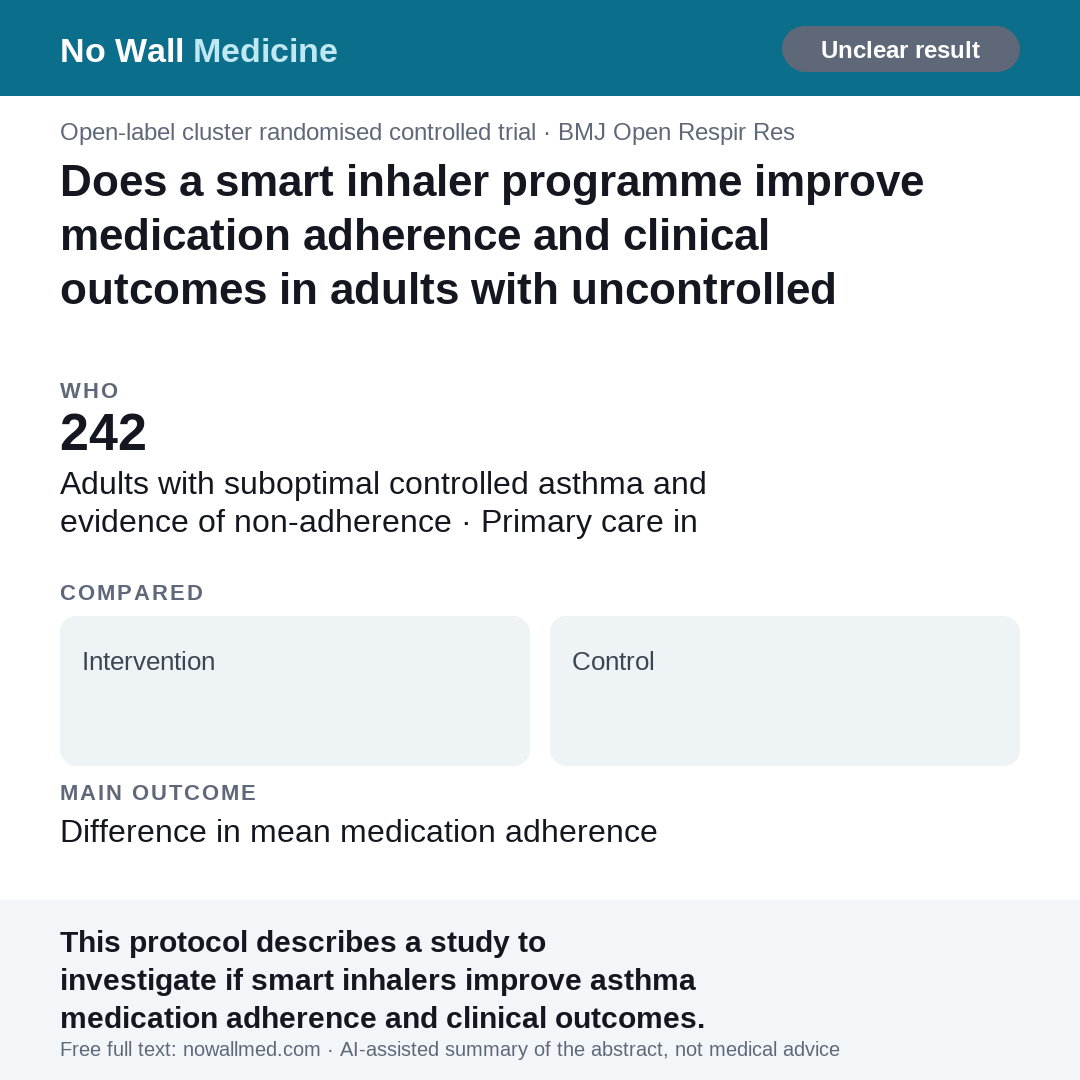
Clinical question: Does a smart inhaler programme improve medication adherence and clinical outcomes in adults with uncontrolled asthma?
Why it matters: Evidence is scarce regarding the long-term benefits and acceptability of using electronic monitoring devices to support asthma self-management.
Key points
- Researchers are conducting a 12-month cluster randomised controlled trial involving 242 adults with uncontrolled asthma in the Netherlands.
- The intervention compares an electronic monitoring device with a smartphone application and healthcare portal against a control group that only uses the device without feedback.
- The study aims to measure differences in mean medication adherence, asthma control, and asthma-related quality of life.
Headline and key points written with AI from the paper’s abstract, with every number checked against it. Read the paper before relying on them.
Abstract
Introduction
Suboptimal asthma control is associated with incorrect inhaler use and poor medication adherence, which could lead to unfavourable clinical and economic outcomes. Smart inhaler programmes using electronic monitoring devices (EMDs) could support self-management and increase medication adherence and asthma control. However, evidence on long-term benefits and acceptability is scarce. This study aims to investigate the effectiveness of a smart inhaler asthma self-management programme on medication adherence and clinical outcomes in adults with uncontrolled asthma, to evaluate its acceptability and to identify subgroups who would benefit most based on patient characteristics. Methods and analysis
This open-label cluster randomised controlled trial of 12 months will be conducted in primary care in the Netherlands. General practices will be randomly assigned to either intervention or control group. We aim to include 242 patients. The intervention consists of (1) an EMD attached to the patient's inhaler that measures medication use; (2) a smartphone application to set medication reminders, receive motivational messages and track asthma symptoms; and (3) a portal for healthcare professionals to view data on medication use. The control group is passively monitored by the EMD but cannot view their inhaler data or receive feedback. Eligible patients are adults with suboptimal controlled asthma (Asthma Control Questionnaire score ≥0.75) with evidence of non-adherence established by the EMD during a 6-week run-in period. Primary outcome is the difference in mean medication adherence between intervention and control group. Secondary outcomes include asthma control, asthma-related quality of life, exacerbations, acceptance, cost-effectiveness and whether the effect of the intervention on medication adherence and asthma control is modified by patient characteristics (eg, self-efficacy, medication beliefs and eHealth literacy).Trial registration numberNL7854.
Abstract reproduced under the article’s CC BY NC licence.
Topics
Cite this article
van de Hei SJ, Poot CC, van den Berg LN, Meijer E, van Boven JFM, Flokstra-de Blok BMJ. Effectiveness, usability and acceptability of a smart inhaler programme in patients with asthma: protocol of the multicentre, pragmatic, open-label, cluster randomised controlled ACCEPTANCE trial. BMJ Open Respir Res. 2022. doi:10.1136/bmjresp-2022-001400
Spotted a mistake? Suggest a correction
Top studies every Monday
The week’s key trials and guidelines in your specialties, plus any topics you follow. By email, free.
Get the weekly digest