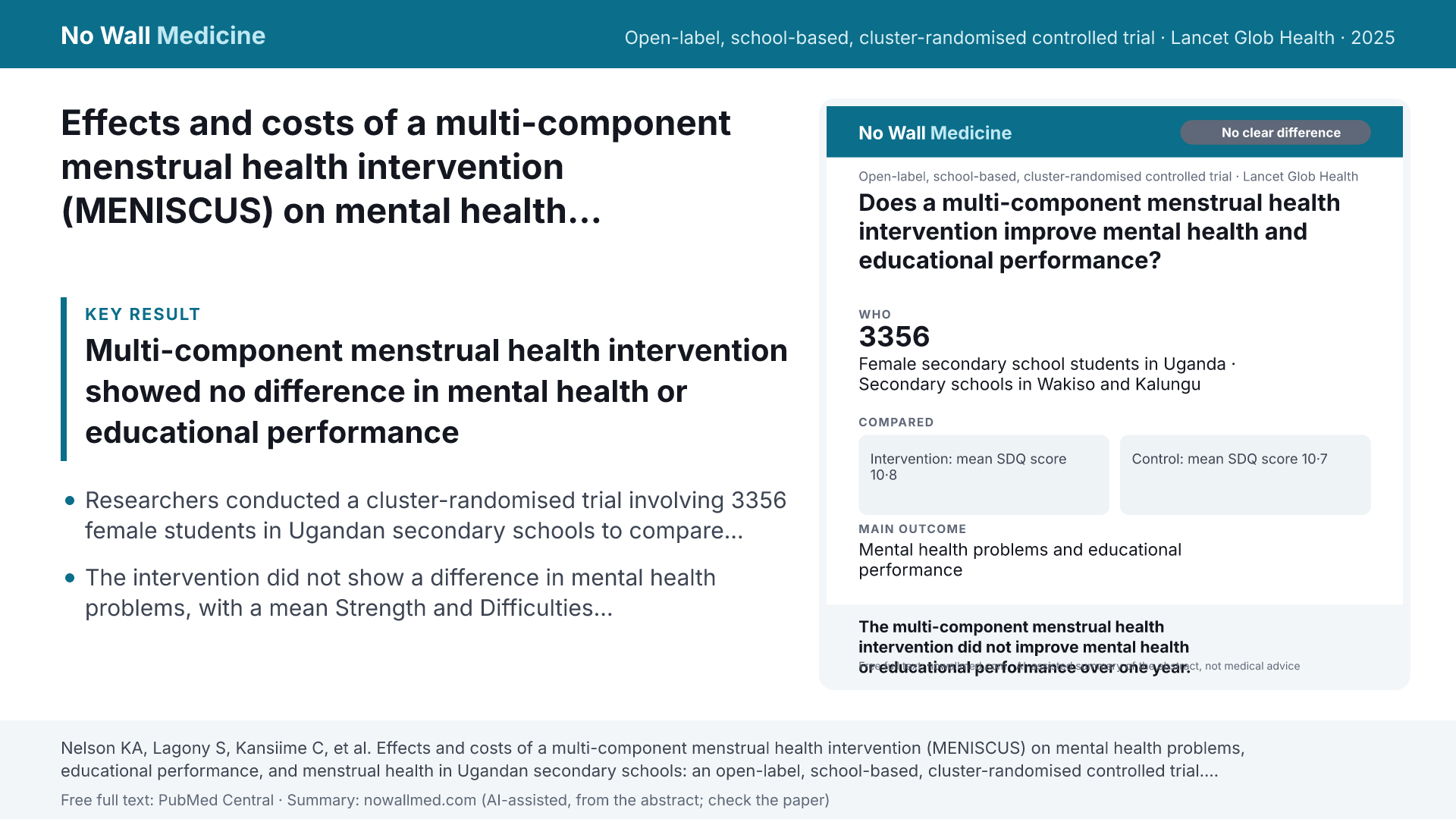
Multi-component menstrual health intervention showed no difference in mental health or educational performance
Effects and costs of a multi-component menstrual health intervention (MENISCUS) on mental health problems, educational performance, and menstrual health in Ugandan secondary schools: an open-label, school-based, cluster-randomised controlled trial
Open-label, school-based, cluster-randomised controlled trialNo clear difference
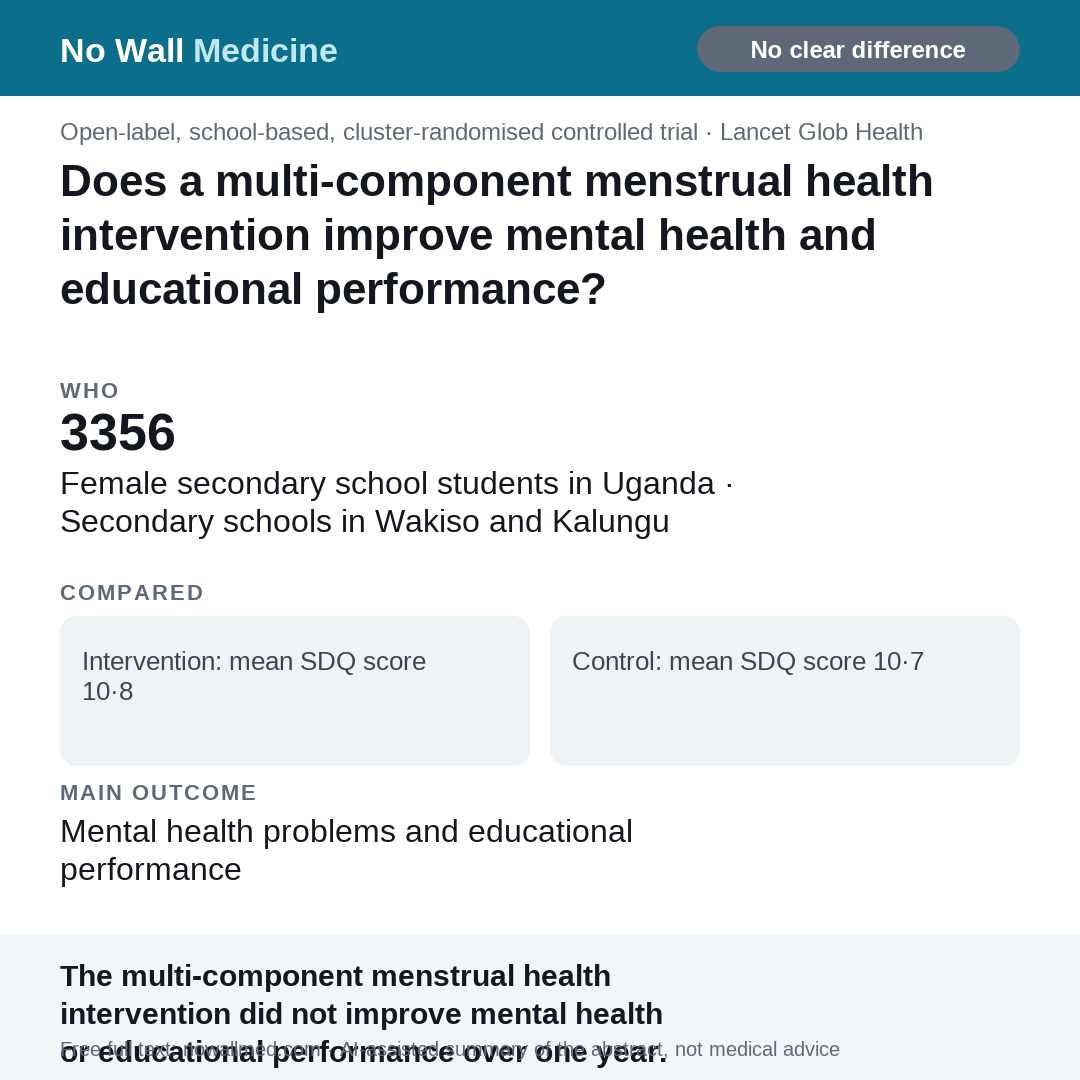
Does a multi-component menstrual health intervention improve mental health and educational performance?
Who
3356
Female secondary school students in Uganda · Secondary schools in Wakiso and Kalungu districts, Uganda
Compared
Intervention: mean SDQ score 10·8
Control: mean SDQ score 10·7
Main outcome
Mental health problems and educational performance
Result: adjusted mean difference 0·05 (95% CI -0·40 to 0·50) for mental health
Bottom line: The multi-component menstrual health intervention did not improve mental health or educational performance over one year.
Funded by: UK Foreign, Commonwealth and Development Office; Medical Research Council; DHSC; Wellcome
Lancet Glob Health · 2025-04-28Download image
Clinical question: Does a multi-component menstrual health intervention improve mental health and educational performance?
Why it matters: It is unclear if improving multiple dimensions of menstrual health in secondary schools can improve mental health or educational performance among adolescents.
Key points
- Researchers conducted a cluster-randomised trial involving 3356 female students in Ugandan secondary schools to compare a multi-component intervention against standard government materials.
- The intervention did not show a difference in mental health problems, with a mean Strength and Difficulties Questionnaire score of 10.8 in the intervention group versus 10.7 in the control group.
- Educational performance also showed no significant difference, with a mean z score of 0.20 in the intervention group compared to 0.12 in the control group.
Headline and key points written with AI from the paper’s abstract, with every number checked against it. Read the paper before relying on them.
Was this summary helpful?
Abstract
Background
Menstrual health is a human rights issue, affecting many aspects of life including mental health, wellbeing, and education. We assessed the effectiveness and costs of a school-based, multi-component menstrual health intervention (MENISCUS) to improve mental health problems and educational performance among in-school adolescents. Methods
We conducted a parallel-arm, cluster-randomised trial in secondary schools in Wakiso and Kalungu districts in Uganda. Schools were eligible for inclusion if they had both male and female students; senior 1-4 classes; day or mixed day and boarding students; at least minimal water, sanitation, and hygiene (WASH) facilities; and enrolments of 50-125 female Senior 1 students in Wakiso district and 40-125 female Senior 1 students in Kalungu district. Schools were randomised (1:1) to the intervention or control condition, stratified by district and baseline mean school examination score. The intervention included creating action groups, strengthening teacher-delivered puberty education, distributing menstrual kits, supporting student-led drama skits, providing pain-management strategies, and improving school water and sanitation facilities. The control condition was provision of printed government menstrual health materials. Schools, participants, and implementors, including the study clinician who monitored adverse events, could not be masked to allocation status. Primary outcomes were mental health problems using the Strength and Difficulties Questionnaire (SDQ) Total Difficulties Score and independently assessed educational performance at individual level, assessed in all female participants at endline. We estimated cluster-intention-to-treat intervention effects using mixed-effects models accounting for school clustering and adjusted for randomisation strata and baseline school-level means of outcomes. The study was registered at the ISRCTN registry, ISRCTN45461276 and is completed. Findings
60 randomly selected schools (44 from Wakiso and 16 from Kalungu) were randomly assigned (30 per group) to the intervention or the control group, and none withdrew. Between March 21 and July 5, 2022, 3841 female students participated in baseline assessments (89·7% of those eligible) and between June 5 and Aug 22, 2023, 3356 participated in endline assessments (1666 in the control group and 1690 in the intervention group). Female participants had a median age of 16 years (IQR 15-16). At endline, there was no evidence of a difference in mental health problems (mean SDQ score, 10·8 in the intervention group vs 10·7 in the control group; adjusted mean difference [aMD] 0·05 [95% CI -0·40 to 0·50]) nor educational performance (mean z score, 0·20 in the intervention group vs 0·12 in the control group; aMD 0·05 [95% CI -0·10 to 0·19]), despite improvements to menstrual health. The annual implementation cost was US$85 per Senior 2 female student. One participant had a serious adverse event (severe anaemia secondary to excess vaginal bleeding), which was deemed to be possibly related to the intervention. Interpretation
Improving multiple dimensions of menstrual health in secondary schools in Uganda is important for health and human rights but is not sufficient to improve mental health or educational performance over 1 year. Funding
UK Foreign, Commonwealth and Development Office; Medical Research Council; Department of Health and Social Care; and Wellcome.
Abstract reproduced under the article’s CC BY licence.
Subject terms
Cite this article
Nelson KA, Lagony S, Kansiime C, et al. Effects and costs of a multi-component menstrual health intervention (MENISCUS) on mental health problems, educational performance, and menstrual health in Ugandan secondary schools: an open-label, school-based, cluster-randomised controlled trial. Lancet Glob Health. 2025. doi:10.1016/S2214-109X(25)00007-5
Spotted a mistake? Suggest a correction