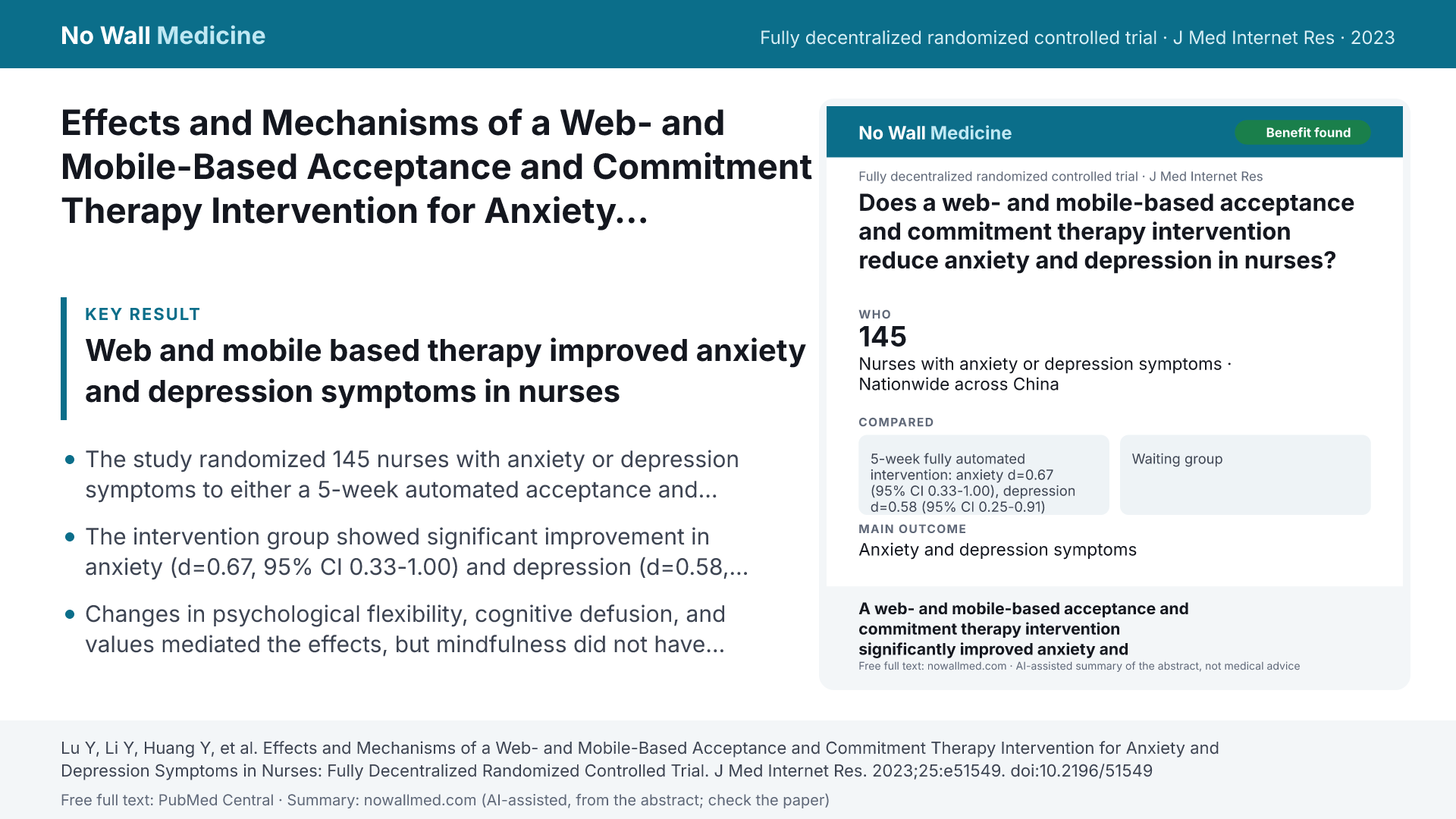
Web and mobile based therapy improved anxiety and depression symptoms in nurses
Effects and Mechanisms of a Web- and Mobile-Based Acceptance and Commitment Therapy Intervention for Anxiety and Depression Symptoms in Nurses: Fully Decentralized Randomized Controlled Trial
Fully decentralized randomized controlled trialBenefit found
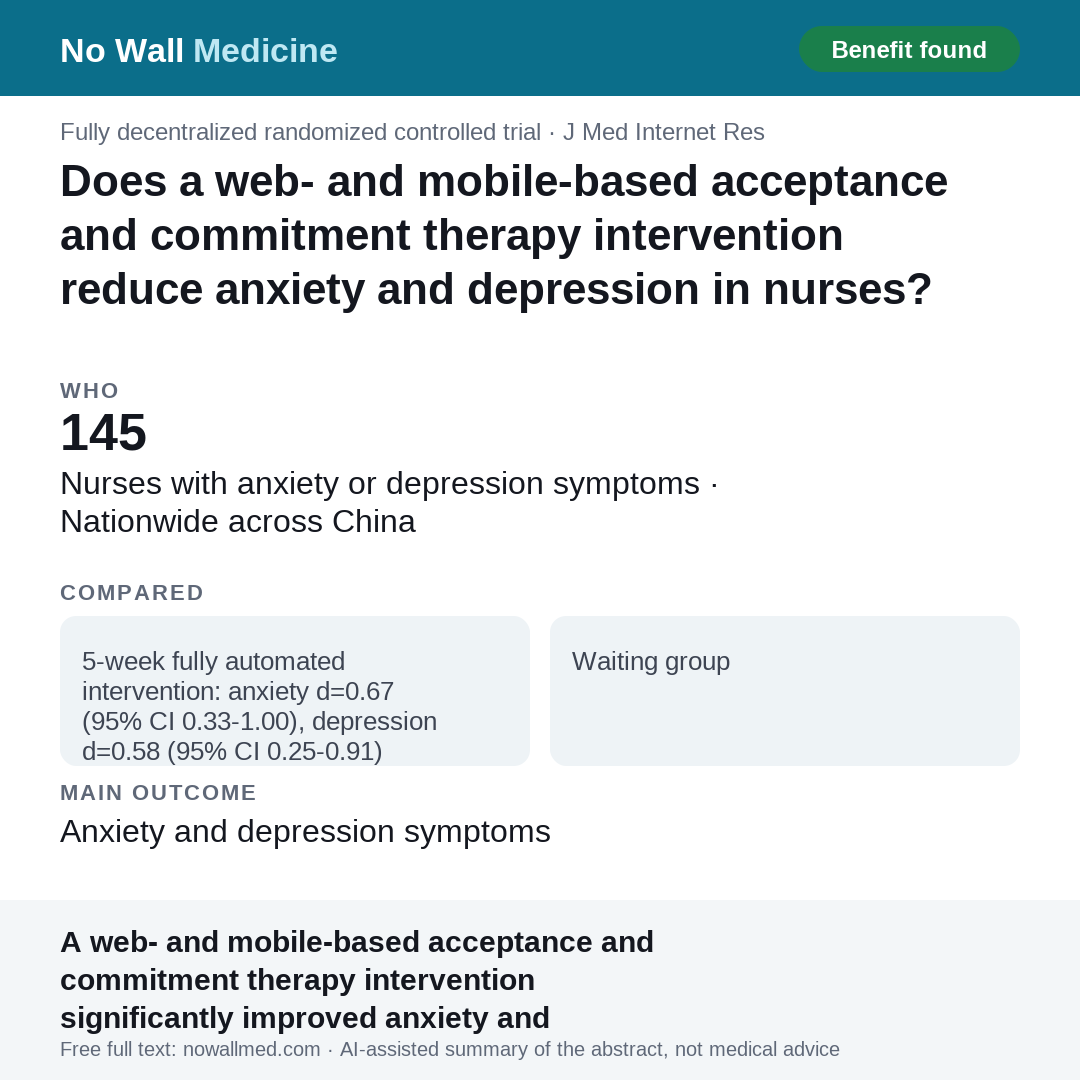
Does a web- and mobile-based acceptance and commitment therapy intervention reduce anxiety and depression in nurses?
Who
145
Nurses with anxiety or depression symptoms · Nationwide across China
Compared
5-week fully automated intervention: anxiety d=0.67 (95% CI 0.33-1.00), depression d=0.58 (95% CI 0.25-0.91)
Waiting group
Main outcome
Anxiety and depression symptoms
Result: anxiety d=0.67 (95% CI 0.33-1.00), depression d=0.58 (95% CI 0.25-0.91)
Bottom line: A web- and mobile-based acceptance and commitment therapy intervention significantly improved anxiety and depression symptoms in nurses.
Limitation: 36 (24.8%) nurses were lost to follow-up
J Med Internet Res · 2023-11-27Download image
Clinical question: Does a web- and mobile-based acceptance and commitment therapy intervention reduce anxiety and depression in nurses?
Why it matters: Evidence is limited regarding the effectiveness of web- and mobile-based acceptance and commitment therapy for reducing anxiety and depression symptoms specifically in nurses.
Key points
- The study randomized 145 nurses with anxiety or depression symptoms to either a 5-week automated acceptance and commitment therapy intervention or a waiting group.
- The intervention group showed significant improvement in anxiety (d=0.67, 95% CI 0.33-1.00) and depression (d=0.58, 95% CI 0.25-0.91) that lasted for 3 months.
- Changes in psychological flexibility, cognitive defusion, and values mediated the effects, but mindfulness did not have a mediating effect.
Limitation the authors note: During the study, 36 (24.8%) nurses were lost to follow-up.
Headline and key points written with AI from the paper’s abstract, with every number checked against it. Read the paper before relying on them.
Was this summary helpful?
Subject terms
Cite this article
Lu Y, Li Y, Huang Y, et al. Effects and Mechanisms of a Web- and Mobile-Based Acceptance and Commitment Therapy Intervention for Anxiety and Depression Symptoms in Nurses: Fully Decentralized Randomized Controlled Trial. J Med Internet Res. 2023. doi:10.2196/51549
Spotted a mistake? Suggest a correction