Effects of a 12-Week Mediterranean-Type Time-Restricted Feeding Protocol in Patients With Metabolic Dysfunction-Associated Steatotic Liver Disease: A Randomised Controlled Trial-The 'CHRONO-NAFLD Project'
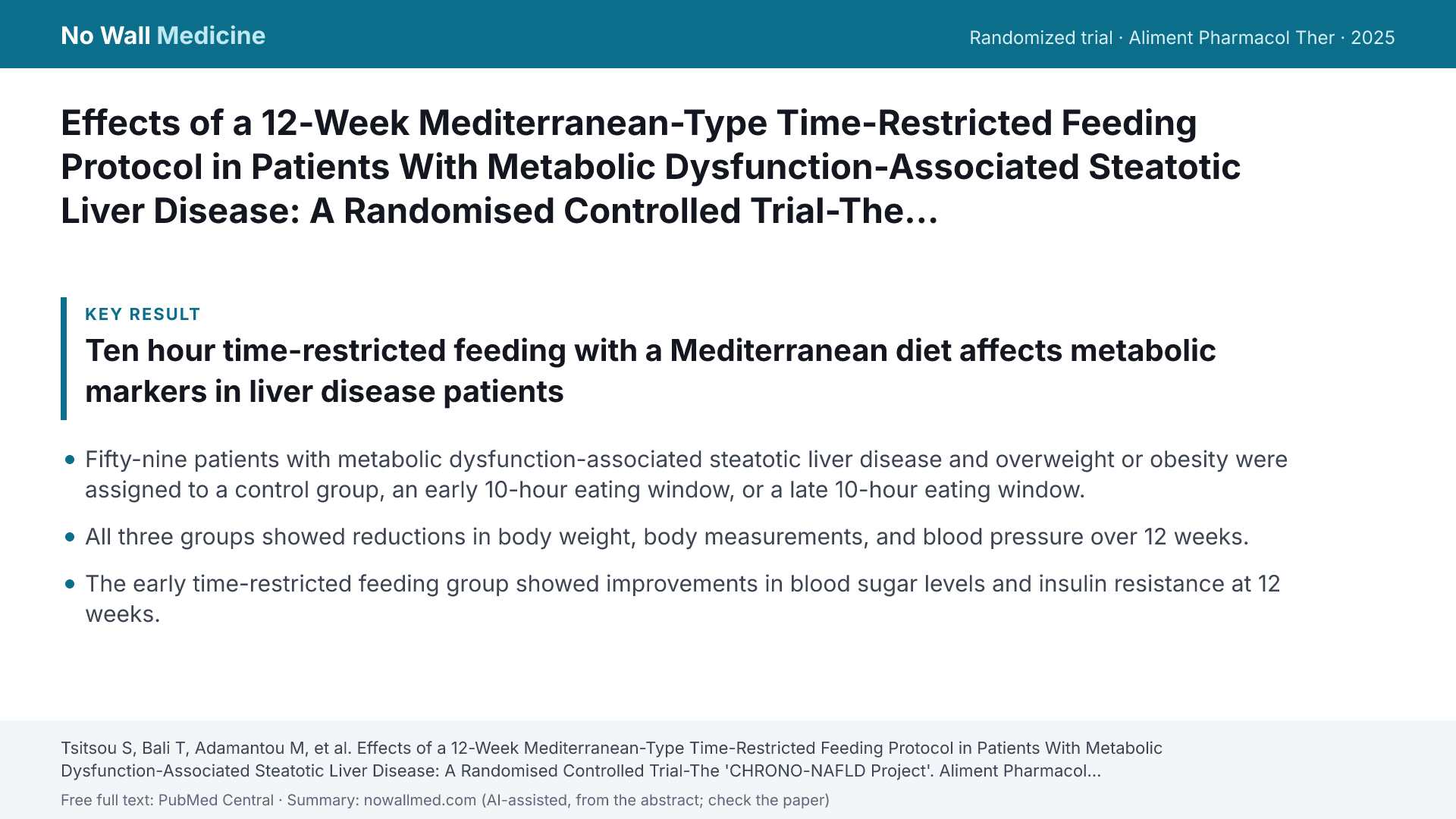
Key result: Ten hour time-restricted feeding with a Mediterranean diet affects metabolic markers in liver disease patients
Key points
- Fifty-nine patients with metabolic dysfunction-associated steatotic liver disease and overweight or obesity were assigned to a control group, an early 10-hour eating window, or a late 10-hour eating window.
- All three groups showed reductions in body weight, body measurements, and blood pressure over 12 weeks.
- The early time-restricted feeding group showed improvements in blood sugar levels and insulin resistance at 12 weeks.
Discussion prompts
- Would these patients look like yours? Who was left out?
- Is the main outcome one that matters to patients?
- Is the difference large enough to change what you do?
Cite: Tsitsou S, Bali T, Adamantou M, et al. Effects of a 12-Week Mediterranean-Type Time-Restricted Feeding Protocol in Patients With Metabolic Dysfunction-Associated Steatotic Liver Disease: A Randomised Controlled Trial-The 'CHRONO-NAFLD Project'. Aliment Pharmacol Ther. 2025. doi:10.1111/apt.70044
Free full text: PubMed Central · Summary and visual abstract: nowallmed.com/a/effects-of-a-12-week-mediterranean-type-time-restricted-feeding-y6kqbx/ (AI-assisted from the abstract; check the paper before relying on it).