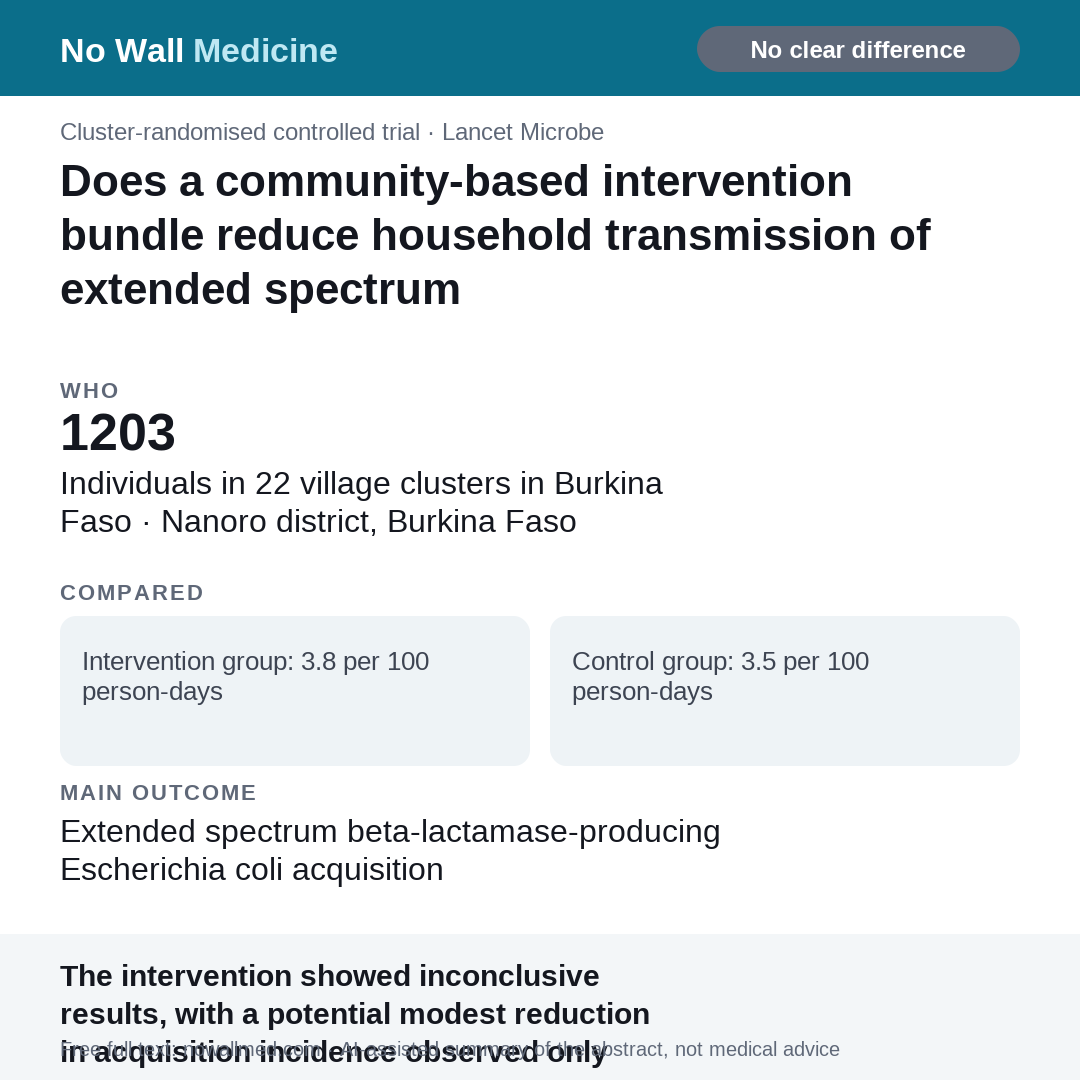
Community intervention bundle did not significantly reduce antibiotic-resistant bacteria acquisition in rural Burkina Faso
Effects of a community-based intervention bundle on household transmission of extended spectrum β-lactamase-producing Escherichia coli in rural Burkina Faso to target community-level drivers of antimicrobial resistance in sub-Saharan Africa: a cluster-randomised trial
Aizouk R, Sibidou Y, Valia D, Ingelbeen B, Campbell L, Kouanda JS, et al
Result: hazard ratio 1.02 (95% CrI 0.78-1.31) for months 1-6
Bottom line: The intervention showed inconclusive results, with a potential modest reduction in acquisition incidence observed only between months 6 and 9.
Funded by: EU Joint Programme Initiative on Antimicrobial Resistance CABU-EICO
Clinical question: Does a community-based intervention bundle reduce household transmission of extended spectrum beta-lactamase-producing Escherichia coli?
Why it matters: Invasive antimicrobial-resistant infections in sub-Saharan Africa often originate from community-level acquisition, but the effect of cluster-level interventions on individual acquisition remains unclear.
Key points
Researchers studied 1203 individuals across 22 village clusters in Burkina Faso to see if a behavioral intervention bundle reduced the acquisition of extended spectrum β-lactamase-producing Escherichia coli.
The intervention did not change the risk of acquiring the bacteria in months 1-6, with a hazard ratio of 1.02, and showed an inconclusive reduction in months 6-9.
Higher rates of bacteria acquisition were associated with rainy seasons and poor sanitation practices.
Headline and key points written with AI from the paper’s abstract, with every number checked against it. Read the paper before relying on them.