Effects of a dual intervention (motor and virtual reality-based cognitive) on cognition in patients with mild cognitive impairment: a single-blind, randomized controlled trial
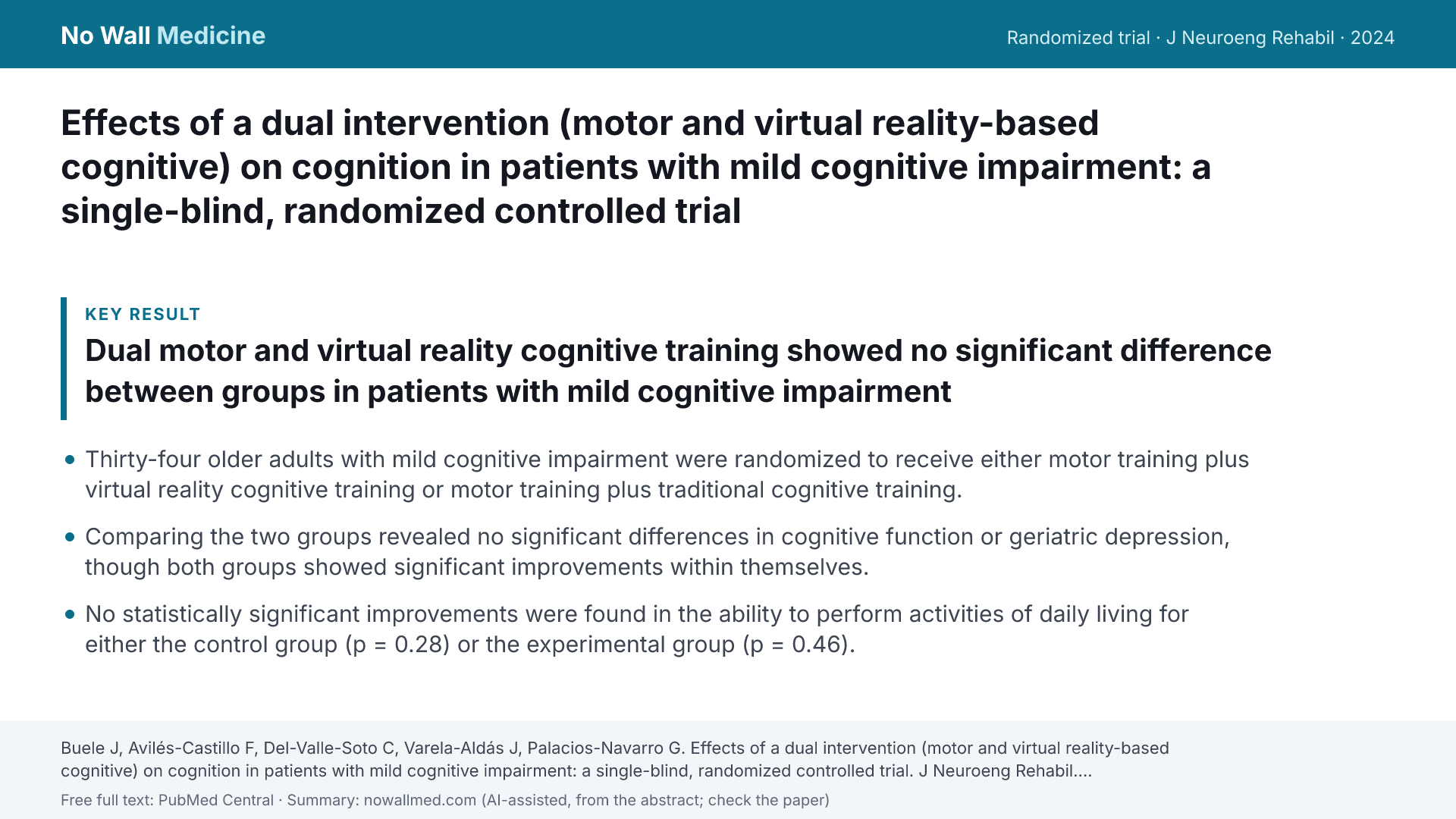
Key result: Dual motor and virtual reality cognitive training showed no significant difference between groups in patients with mild cognitive impairment
Key points
- Thirty-four older adults with mild cognitive impairment were randomized to receive either motor training plus virtual reality cognitive training or motor training plus traditional cognitive training.
- Comparing the two groups revealed no significant differences in cognitive function or geriatric depression, though both groups showed significant improvements within themselves.
- No statistically significant improvements were found in the ability to perform activities of daily living for either the control group (p = 0.28) or the experimental group (p = 0.46).
Why it matters: Current pharmacological options have limited effectiveness in preventing or treating the early stages of cognitive deterioration in patients with mild cognitive impairment.
Discussion prompts
- Would these patients look like yours? Who was left out?
- Is the main outcome one that matters to patients?
- Is the difference large enough to change what you do?
Cite: Buele J, Avilés-Castillo F, Del-Valle-Soto C, Varela-Aldás J, Palacios-Navarro G. Effects of a dual intervention (motor and virtual reality-based cognitive) on cognition in patients with mild cognitive impairment: a single-blind, randomized controlled trial. J Neuroeng Rehabil. 2024;21(1):130. doi:10.1186/s12984-024-01422-w
Free full text: PubMed Central · Summary and visual abstract: nowallmed.com/a/effects-of-a-dual-intervention-motor-and-virtual-reality-based-19jxbyh/ (AI-assisted from the abstract; check the paper before relying on it).