Home-based exercise showed small short-term improvements in walking patterns for older adults with cognitive impairment
Effects of a home-based exercise and physical activity intervention after inpatient rehabilitation on real-world mobility in older adults with cognitive impairment: a secondary analysis of a randomised controlled trial
Single-centre, double-blind, randomised, placebo-controlled trialMixed results
Does a home-based exercise and physical activity programme improve real-world digital mobility?
Who
104
Community-dwelling older adults with cognitive impairment recently discharged from inpatient rehabilitation · Community
Compared
Intervention group: small statistically significant improvements in walking pattern and pace
Control group: no between-group differences for walking amount
Main outcome
real-world digital mobility outcomes related to walking
Bottom line: Home-based exercise showed small, short-term improvements in walking pattern and pace, but effects were not sustained.
Age Ageing · 2026-06-27Download image
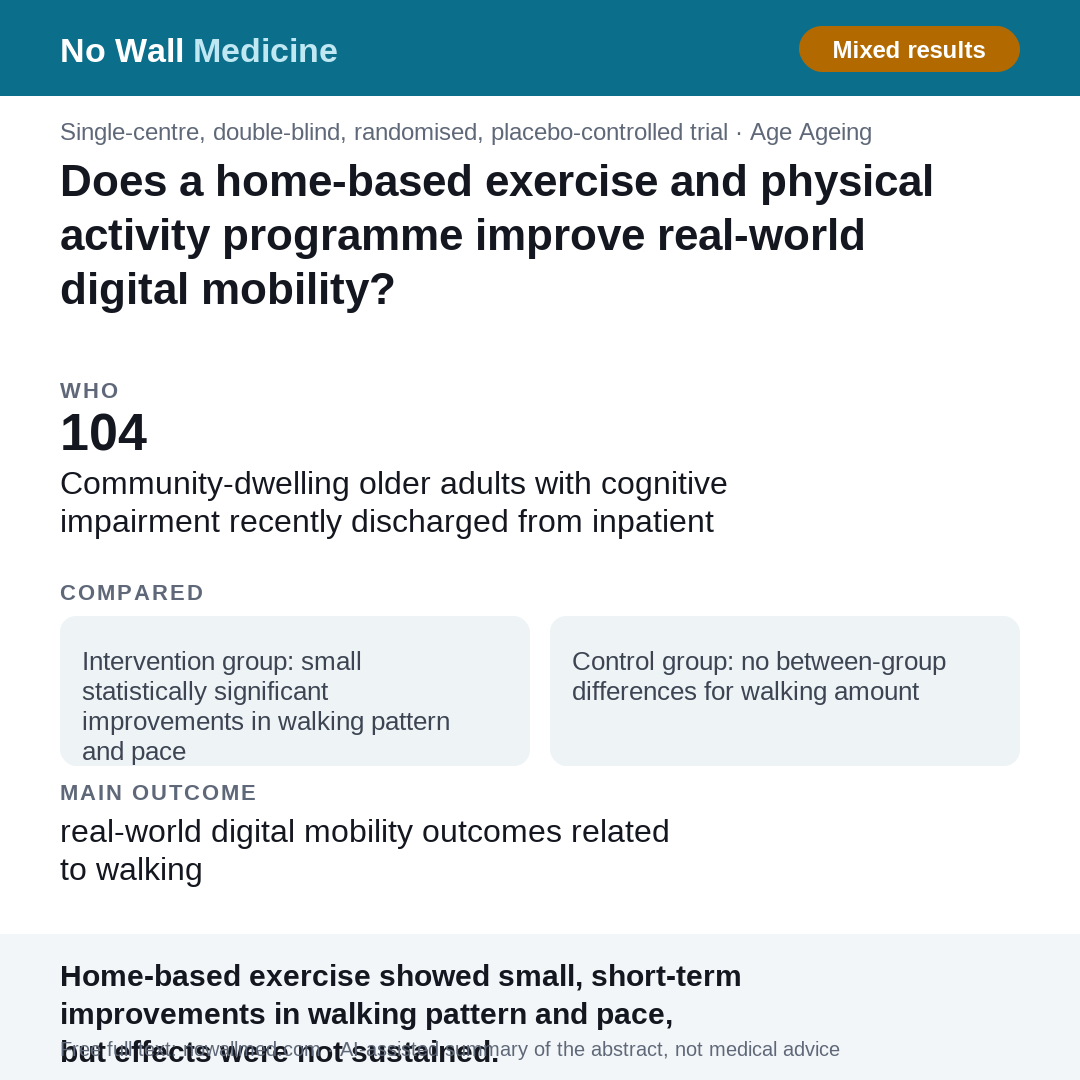
Clinical question: Does a home-based exercise and physical activity programme improve real-world digital mobility?
Why it matters: Evidence is scarce regarding whether home-based exercise interventions improve real-world mobility for older adults with cognitive impairment after inpatient rehabilitation.
Key points
- Researchers studied 104 community-dwelling older adults with cognitive impairment who were recently discharged from geriatric rehabilitation.
- The 12-week exercise program led to small improvements in walking speed and stride length, but these effects were not sustained at the 12-week follow-up.
- No differences were found between the exercise group and the placebo group regarding the total amount of walking performed.
Headline and key points written with AI from the paper’s abstract, with every number checked against it. Read the paper before relying on them.
Topics
Spotted a mistake? Suggest a correction