Narrative-based psychoeducation improved medication adherence and attitudes in people with schizophrenia
Effects of a narrative-based psychoeducational intervention on medication adherence in individuals with schizophrenia: a multicentre, parallel-group randomised controlled trial
Psychiatry & Mental HealthAdult and pediatric
Multicentre, parallel-group randomised controlled trialBenefit found
Does a narrative-based psychoeducational intervention improve medication adherence in individuals with stable schizophrenia?
Who
70
Individuals with stable schizophrenia aged 18-60 years · Seven community rehabilitation centres
Compared
Intervention group: β = 0.75 [95% CI, 0.10-1.40]
Control group
Main outcome
Medication adherence and medication attitude
Result: β = 0.75 [95% CI, 0.10-1.40]
Bottom line: Narrative-based psychoeducational interventions improve medication adherence and attitude in individuals with schizophrenia with sustained effects.
Funded by: Shanghai Municipal Science and Technology Commission and Shanghai Jiao Tong University
eClinicalMedicine · 2025-09-04Download image
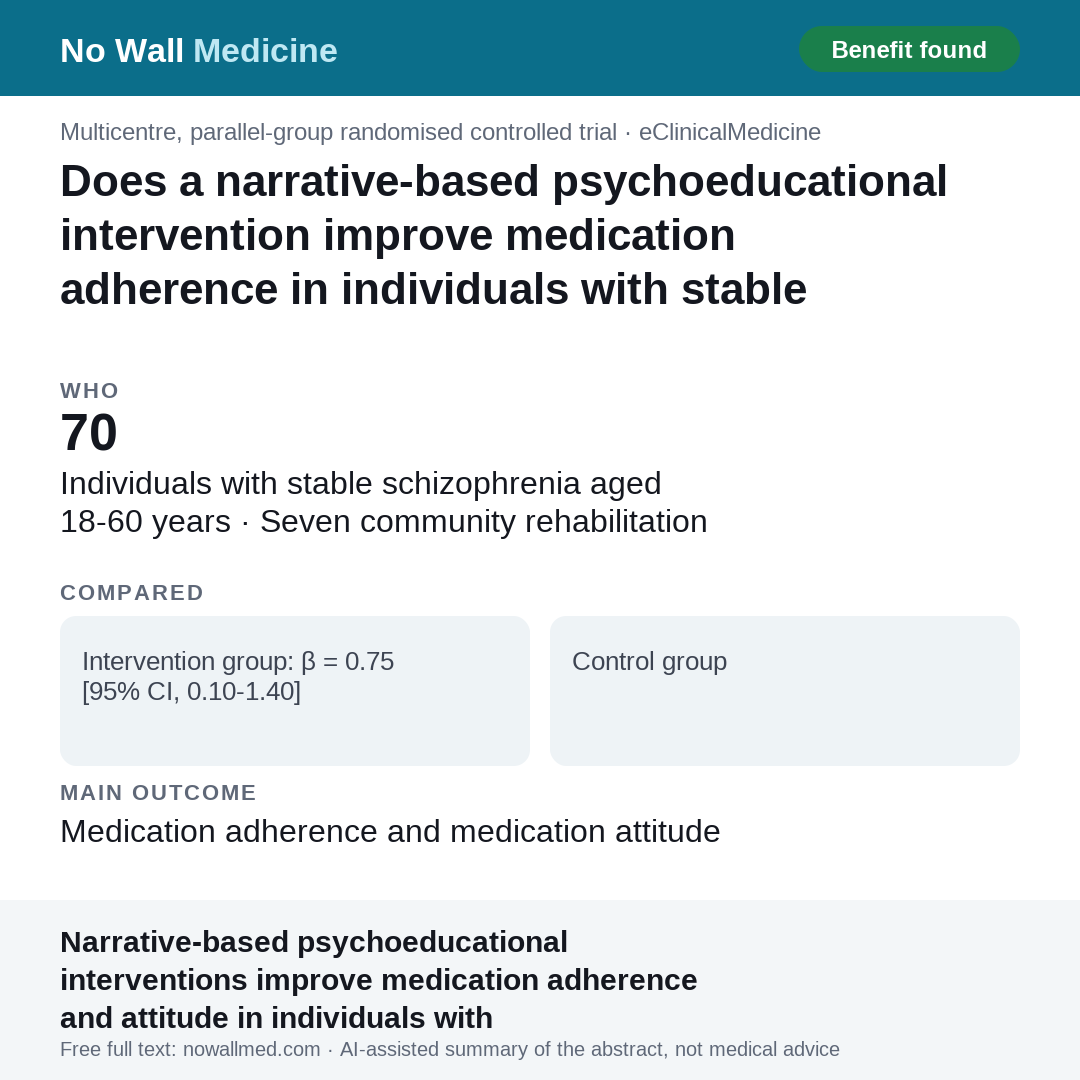
Clinical question: Does a narrative-based psychoeducational intervention improve medication adherence in individuals with stable schizophrenia?
Why it matters: Medication non-adherence is a significant challenge in schizophrenia management, with rates ranging from 30% to 70%.
Key points
- Researchers conducted a randomized controlled trial with 70 participants with stable schizophrenia to compare a narrative-based psychoeducational intervention against standard community rehabilitation.
- The intervention group showed greater positive changes in medication adherence (β = 0.75; P = 0.02) and medication attitude (β = 2.29; P = 0.02) at 3 months.
- These improvements in medication adherence (β = 1.65; P < 0.001) and attitude (β = 3.42; P = 0.001) were sustained at the 6-month follow-up.
Headline and key points written with AI from the paper’s abstract, with every number checked against it. Read the paper before relying on them.
Cite this article
Liu Z, Zhu D, Zhang Z, Liu Y, Yang H, Chang F. Effects of a narrative-based psychoeducational intervention on medication adherence in individuals with schizophrenia: a multicentre, parallel-group randomised controlled trial. eClinicalMedicine. 2025. doi:10.1016/j.eclinm.2025.103483
Spotted a mistake? Suggest a correction
Top studies every Monday
The week’s key trials and guidelines in your specialties, by email. Free.
Get the weekly digest