Effects of a Narrative-Based Psychoeducational Intervention to Prepare Patients for Responding to Acute Myocardial Infarction: A Randomized Clinical Trial
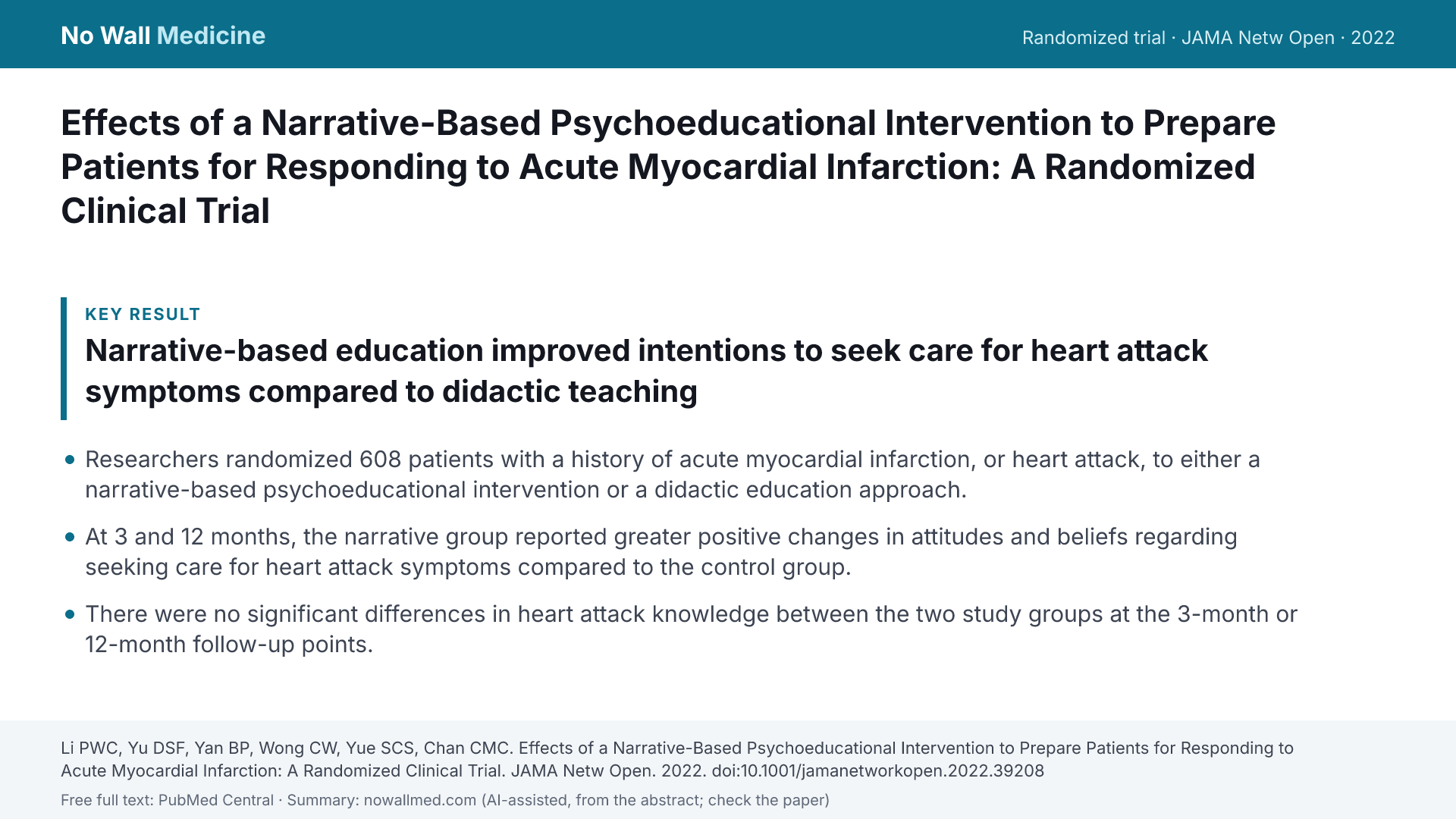
Key result: Narrative-based education improved intentions to seek care for heart attack symptoms compared to didactic teaching
Key points
- Researchers randomized 608 patients with a history of acute myocardial infarction, or heart attack, to either a narrative-based psychoeducational intervention or a didactic education approach.
- At 3 and 12 months, the narrative group reported greater positive changes in attitudes and beliefs regarding seeking care for heart attack symptoms compared to the control group.
- There were no significant differences in heart attack knowledge between the two study groups at the 3-month or 12-month follow-up points.
Why it matters: Patients often experience prolonged delays in seeking care for heart attack symptoms despite existing educational efforts.
Discussion prompts
- Would these patients look like yours? Who was left out?
- Is the main outcome one that matters to patients?
- Is the difference large enough to change what you do?
Cite: Li PWC, Yu DSF, Yan BP, Wong CW, Yue SCS, Chan CMC. Effects of a Narrative-Based Psychoeducational Intervention to Prepare Patients for Responding to Acute Myocardial Infarction: A Randomized Clinical Trial. JAMA Netw Open. 2022. doi:10.1001/jamanetworkopen.2022.39208
Free full text: PubMed Central · Summary and visual abstract: nowallmed.com/a/effects-of-a-narrative-based-psychoeducational-intervention-to-gzx1c0/ (AI-assisted from the abstract; check the paper before relying on it).