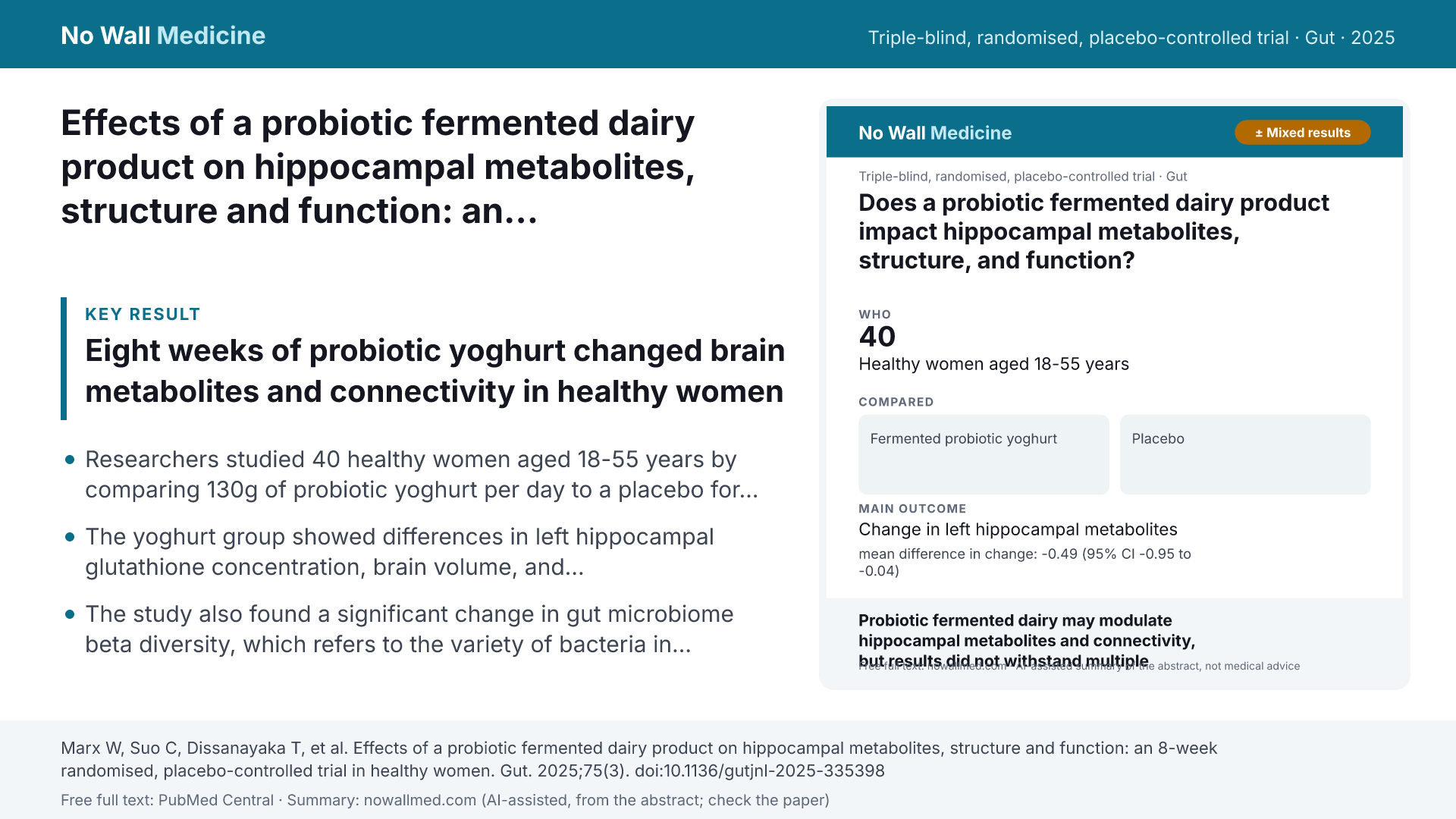
Eight weeks of probiotic yoghurt changed brain metabolites and connectivity in healthy women
Effects of a probiotic fermented dairy product on hippocampal metabolites, structure and function: an 8-week randomised, placebo-controlled trial in healthy women
Triple-blind, randomised, placebo-controlled trialMixed results
Does a probiotic fermented dairy product impact hippocampal metabolites, structure, and function?
Who
40
Healthy women aged 18-55 years
Compared
Fermented probiotic yoghurt
Placebo
Main outcome
Change in left hippocampal metabolites
Result: mean difference in change: -0.49 (95% CI -0.95 to -0.04)
Bottom line: Probiotic fermented dairy may modulate hippocampal metabolites and connectivity, but results did not withstand multiple comparison corrections.
Gut · 2025-12-18 · Save PNG
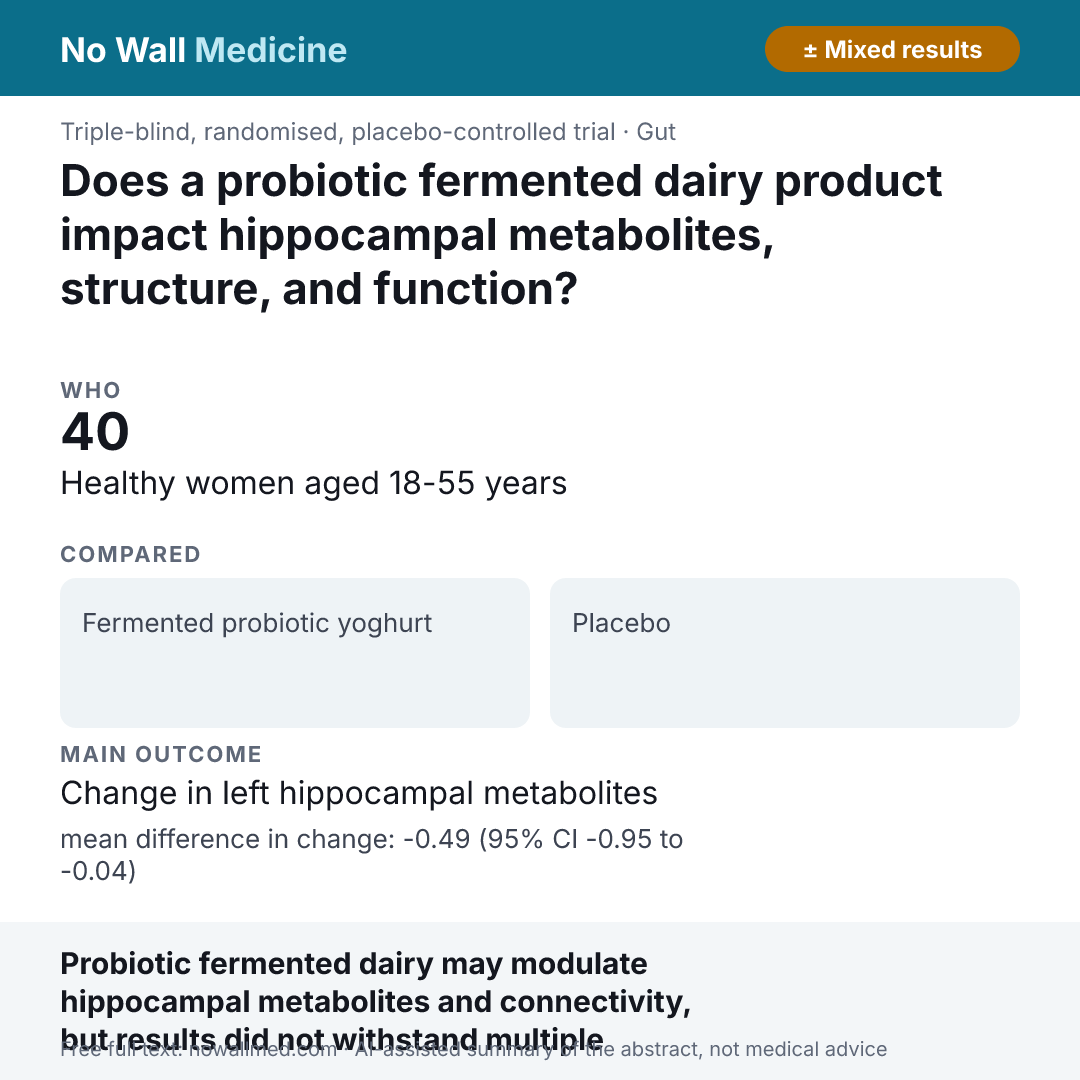
Clinical question: Does a probiotic fermented dairy product impact hippocampal metabolites, structure, and function?
Why it matters: The impact of fermented foods on brain structure and function through the gut-brain axis is currently underexplored.
Key points
- Researchers studied 40 healthy women aged 18-55 years by comparing 130g of probiotic yoghurt per day to a placebo for 8 weeks.
- The yoghurt group showed differences in left hippocampal glutathione concentration, brain volume, and connectivity between the left hippocampus and left frontal pole.
- The study also found a significant change in gut microbiome beta diversity, which refers to the variety of bacteria in the gut.
Headline and key points written with AI from the paper’s abstract, with every number checked against it. Read the paper before relying on them.
Was this summary helpful?
Abstract
Background
Fermented foods are a promising yet underexplored intervention for influencing brain function and mental health through the gut-brain axis. Objective
The objective of this study was to evaluate the impact of a dairy product fermented with probiotic bacteria on aspects of brain structure and function. Design
In a triple-blind, randomised, placebo-controlled trial, 40 healthy women aged 18-55 years were randomised to consume either 130 g per day of a fermented probiotic yoghurt or a placebo for 8 weeks. The primary outcome was the between-group differential change from baseline to week 8 in left hippocampal metabolites, measured using magnetic resonance spectroscopy. Secondary outcomes included changes in brain structure and function, faecal microbiome composition and functional potential, mental health, gastrointestinal symptoms, memory and blood markers of oxidative stress and inflammation. Results
There was a between-group difference in the change in average left hippocampal glutathione concentration (mean difference in change: -0.49; 95% CI -0.95 to -0.04), as well as brain volume in the hippocampus and nucleus accumbens, although these results did not withstand correction for multiple comparisons. There were between-group differences in the change in average functional connectivity between the left hippocampus and left frontal pole. There was also a significant between-group change in gut microbiome beta diversity. There were no differences in other secondary measures. Conclusion
This study provides preliminary evidence that a probiotic fermented dairy product can modulate hippocampal-related outcomes. Trial registration number
ACTRN12622000622707.
Abstract reproduced under the article’s CC BY NC licence.
Headline, design, result, key points, caveat and citation as plain text.
Cite this article
Marx W, Suo C, Dissanayaka T, et al. Effects of a probiotic fermented dairy product on hippocampal metabolites, structure and function: an 8-week randomised, placebo-controlled trial in healthy women. Gut. 2025;75(3). doi:10.1136/gutjnl-2025-335398
Spotted a mistake? Suggest a correction