Effects of acetazolamide on exercise performance in patients with COPD going to high altitude: randomised controlled trial
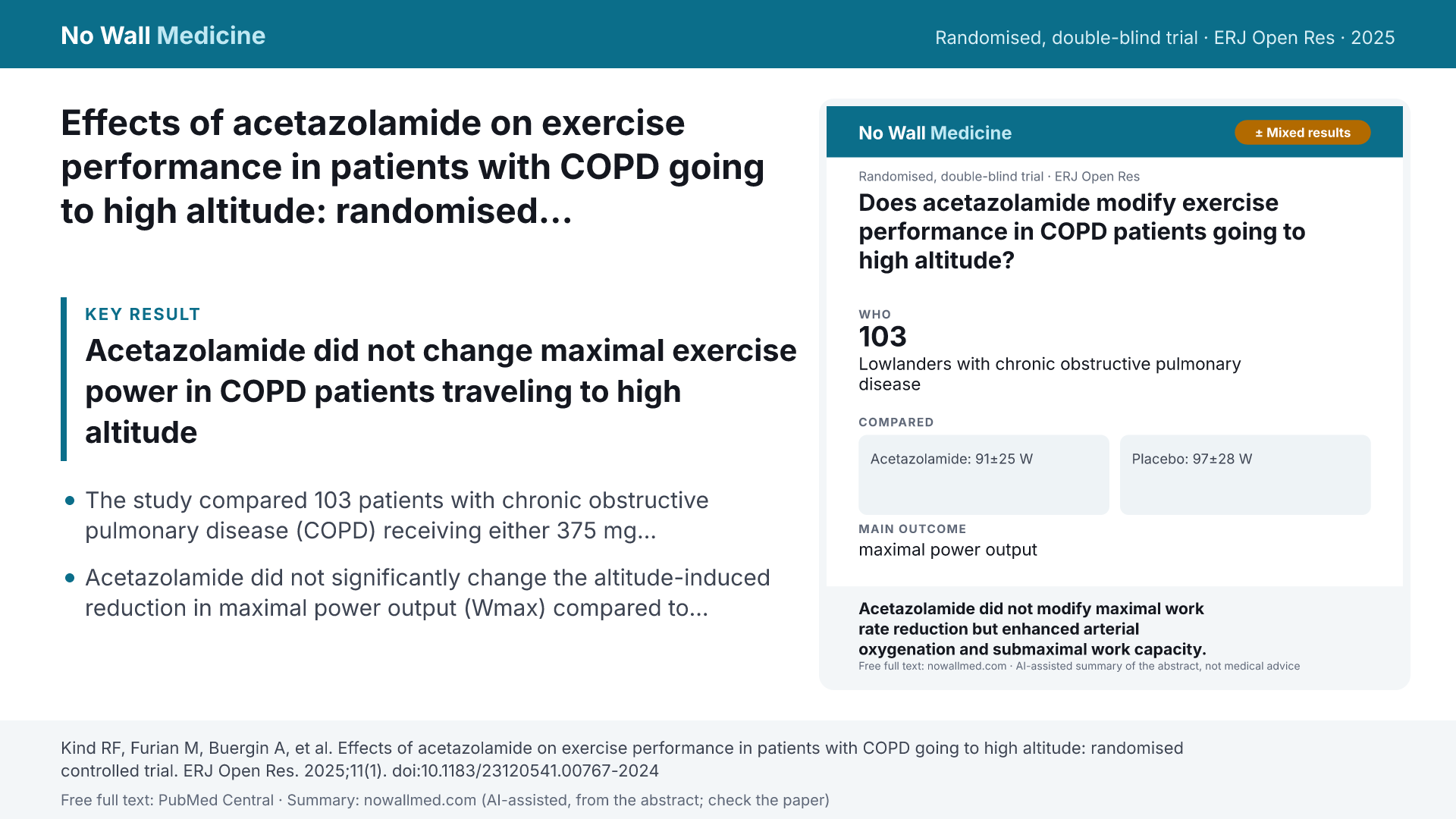
Key result: Acetazolamide did not change maximal exercise power in COPD patients traveling to high altitude
Randomised, double-blind trialMixed results
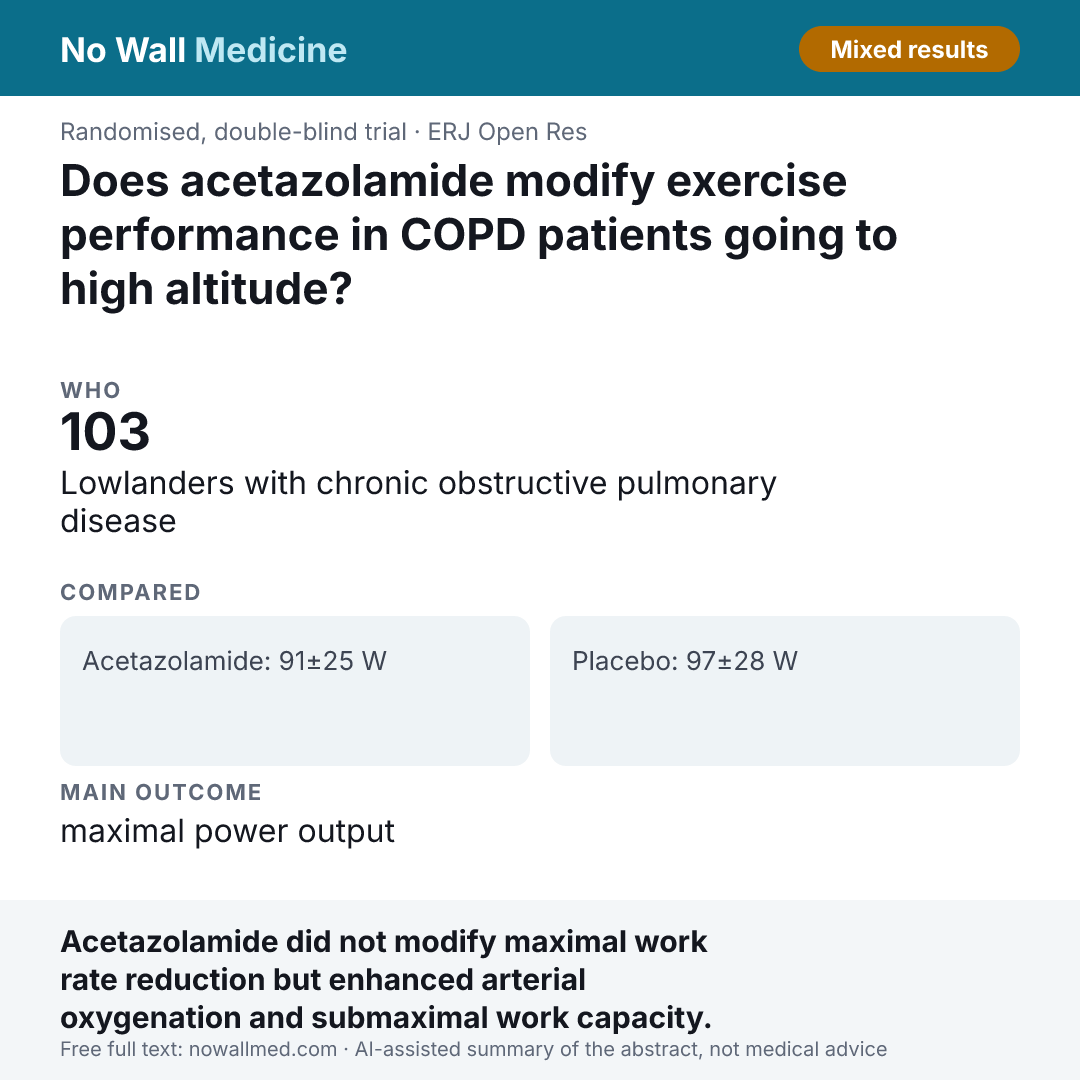
Does acetazolamide modify exercise performance in COPD patients going to high altitude?
Who
103
Lowlanders with chronic obstructive pulmonary disease
Compared
Acetazolamide: 91±25 W
Placebo: 97±28 W
Main outcome
maximal power output
Result: -3.0 W (-8.7 to +2.7, p=0.305)
Bottom line: Acetazolamide did not modify maximal work rate reduction but enhanced arterial oxygenation and submaximal work capacity.
ERJ Open Res · 2025-01-19 · Save PNG
Key points
- The study compared 103 patients with chronic obstructive pulmonary disease (COPD) receiving either 375 mg of acetazolamide or a placebo before ascending to 3100 m.
- Acetazolamide did not significantly change the altitude-induced reduction in maximal power output (Wmax) compared to placebo, with a difference of -3.0 W (95% CI -8.7 to +2.7).
- Acetazolamide was associated with a 0.7 kPa increase in arterial oxygen pressure and a 10.1 W higher maximal work rate at moderate intensities compared to placebo.
Discussion prompts
- Would these patients look like yours? Who was left out?
- Is the main outcome one that matters to patients?
- Is the difference large enough to change what you do?
Cite: Kind RF, Furian M, Buergin A, et al. Effects of acetazolamide on exercise performance in patients with COPD going to high altitude: randomised controlled trial. ERJ Open Res. 2025;11(1). doi:10.1183/23120541.00767-2024
Free full text: PubMed Central · Summary and visual abstract: nowallmed.com/a/effects-of-acetazolamide-on-exercise-performance-in-patients-with-1nucaxp/ (AI-assisted from the abstract; check the paper before relying on it).