Effects of an actuated ankle exoskeleton on walking stability in healthy adults: a controlled laboratory study
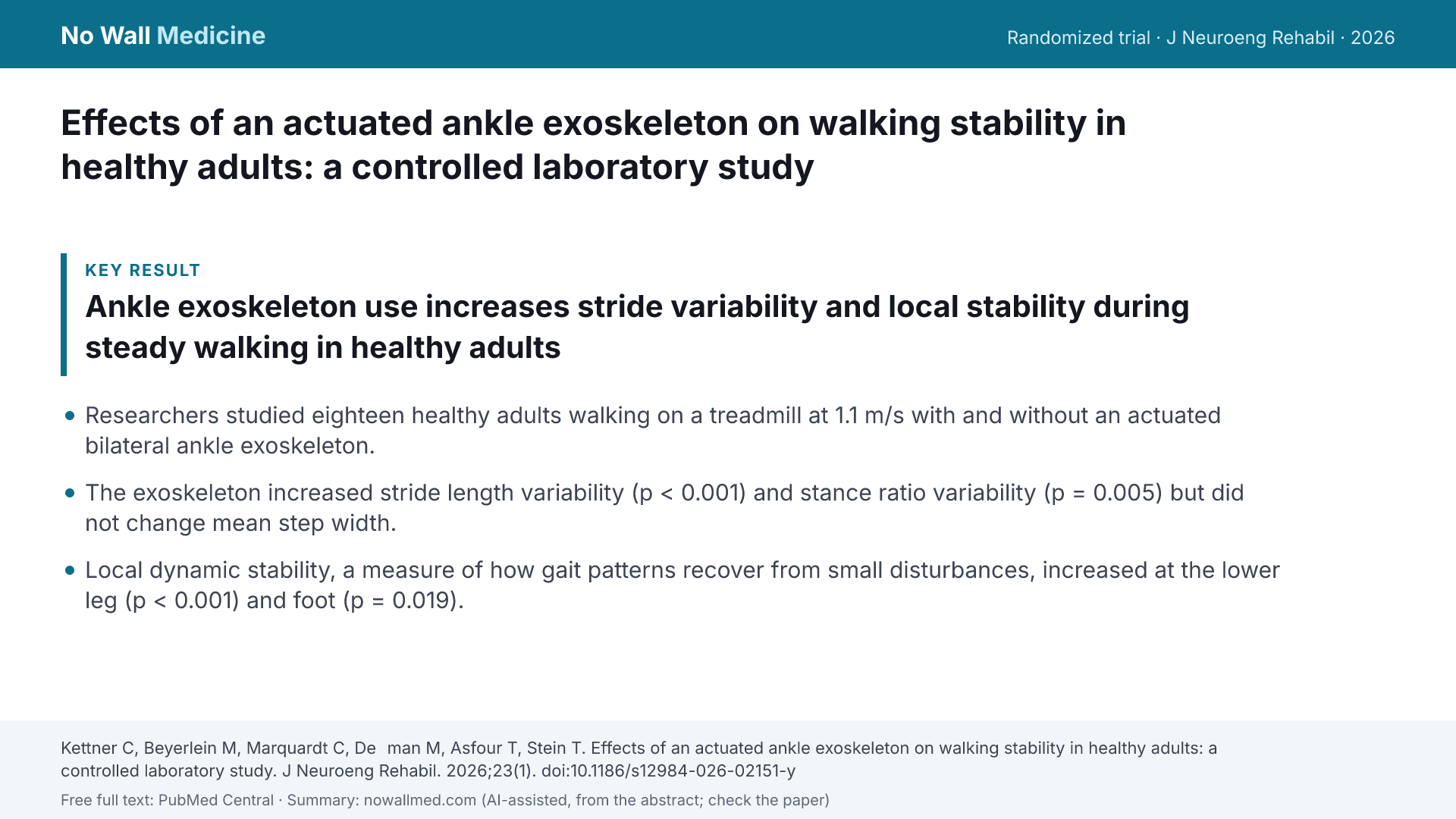
Key result: Ankle exoskeleton use increases stride variability and local stability during steady walking in healthy adults
Key points
- Researchers studied eighteen healthy adults walking on a treadmill at 1.1 m/s with and without an actuated bilateral ankle exoskeleton.
- The exoskeleton increased stride length variability (p < 0.001) and stance ratio variability (p = 0.005) but did not change mean step width.
- Local dynamic stability, a measure of how gait patterns recover from small disturbances, increased at the lower leg (p < 0.001) and foot (p = 0.019).
Why it matters: The effects of ankle exoskeletons on different aspects of walking stability during steady gait are not yet sufficiently understood.
Discussion prompts
- Would these patients look like yours? Who was left out?
- Is the main outcome one that matters to patients?
- Is the difference large enough to change what you do?
Cite: Kettner C, Beyerlein M, Marquardt C, Dežman M, Asfour T, Stein T. Effects of an actuated ankle exoskeleton on walking stability in healthy adults: a controlled laboratory study. J Neuroeng Rehabil. 2026;23(1). doi:10.1186/s12984-026-02151-y
Free full text: PubMed Central · Summary and visual abstract: nowallmed.com/a/effects-of-an-actuated-ankle-exoskeleton-on-walking-stability-in-sb8yfv/ (AI-assisted from the abstract; check the paper before relying on it).