Web-based training improved confidence and knowledge in Chinese physical therapists managing knee osteoarthritis
Effects of an e-Learning Program (Physiotherapy Exercise and Physical Activity for Knee Osteoarthritis [PEAK]) on Chinese Physical Therapists' Confidence and Knowledge: Randomized Controlled Trial
Randomized controlled trialBenefit found
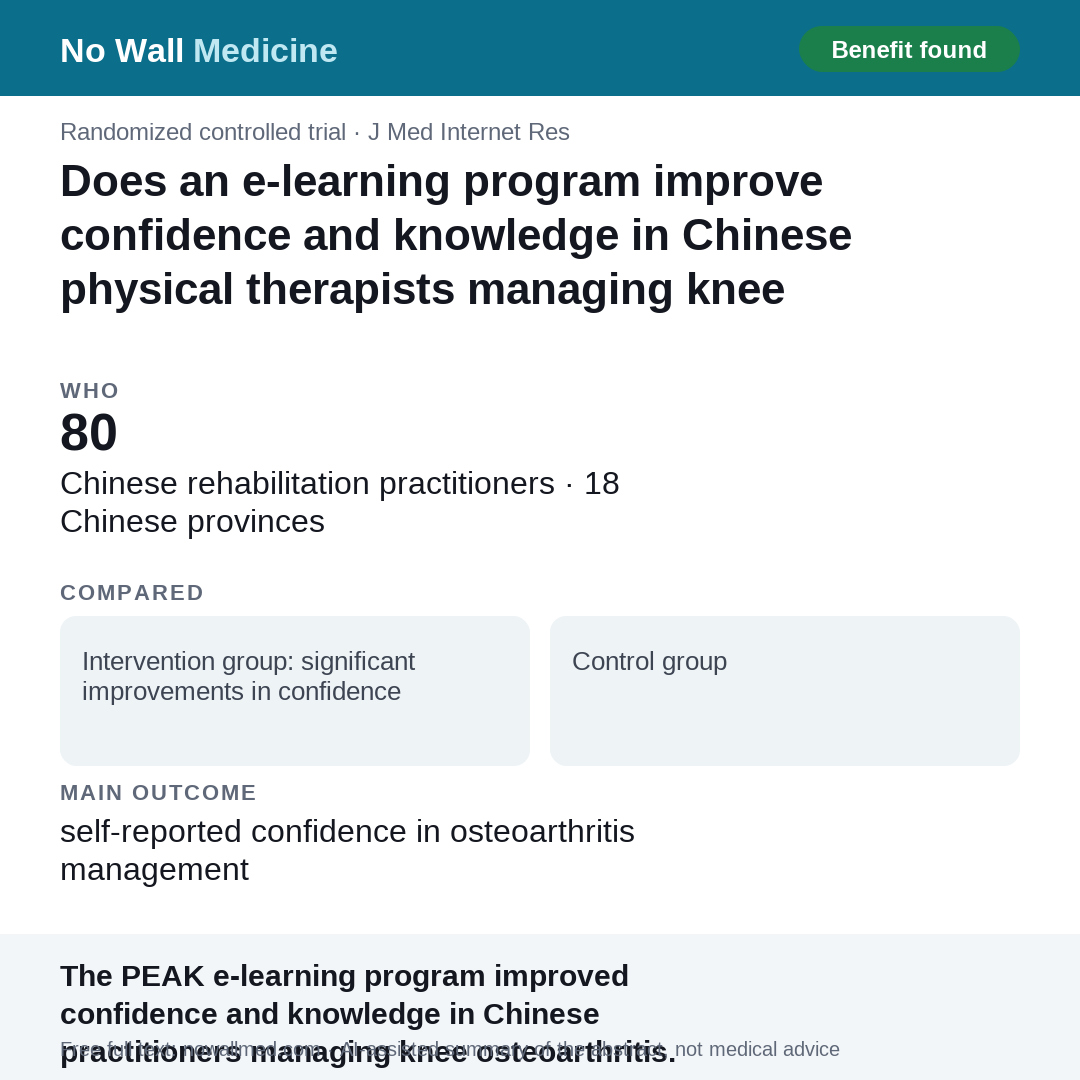
Does an e-learning program improve confidence and knowledge in Chinese physical therapists managing knee osteoarthritis?
Who
80
Chinese rehabilitation practitioners · 18 Chinese provinces
Compared
Intervention group: significant improvements in confidence
Control group
Main outcome
self-reported confidence in osteoarthritis management
Result: adjusted mean difference 3.27 (95% CI 2.72-3.81)
Bottom line: The PEAK e-learning program improved confidence and knowledge in Chinese practitioners managing knee osteoarthritis.
Limitation: Certain belief bias related to osteoarthritis concepts and scan use remained unchanged.
J Med Internet Res · 2025-04-18Download image
Clinical question: Does an e-learning program improve confidence and knowledge in Chinese physical therapists managing knee osteoarthritis?
Why it matters: Limited practitioner training and inadequate telehealth integration hinder effective management of knee osteoarthritis in China.
Key points
- The study randomized 81 rehabilitation practitioners from 18 Chinese provinces to receive either a 4-week web-based training program or no training.
- The training group showed higher confidence in managing osteoarthritis with exercise (adjusted mean difference=3.27), prescribing exercise (adjusted mean difference=3.13), and delivering telehealth (adjusted mean difference=4.41).
- Knowledge scores improved with a mean change of 9.46, though belief bias regarding osteoarthritis concepts and scan use remained unchanged for 61% and 66% of participants.
Headline and key points written with AI from the paper’s abstract, with every number checked against it. Read the paper before relying on them.
Topics
Cite this article
Wang ZR, Wang Y, Duan S, Chen X, Ni G. Effects of an e-Learning Program (Physiotherapy Exercise and Physical Activity for Knee Osteoarthritis [PEAK]) on Chinese Physical Therapists' Confidence and Knowledge: Randomized Controlled Trial. J Med Internet Res. 2025. doi:10.2196/71057
Spotted a mistake? Suggest a correction