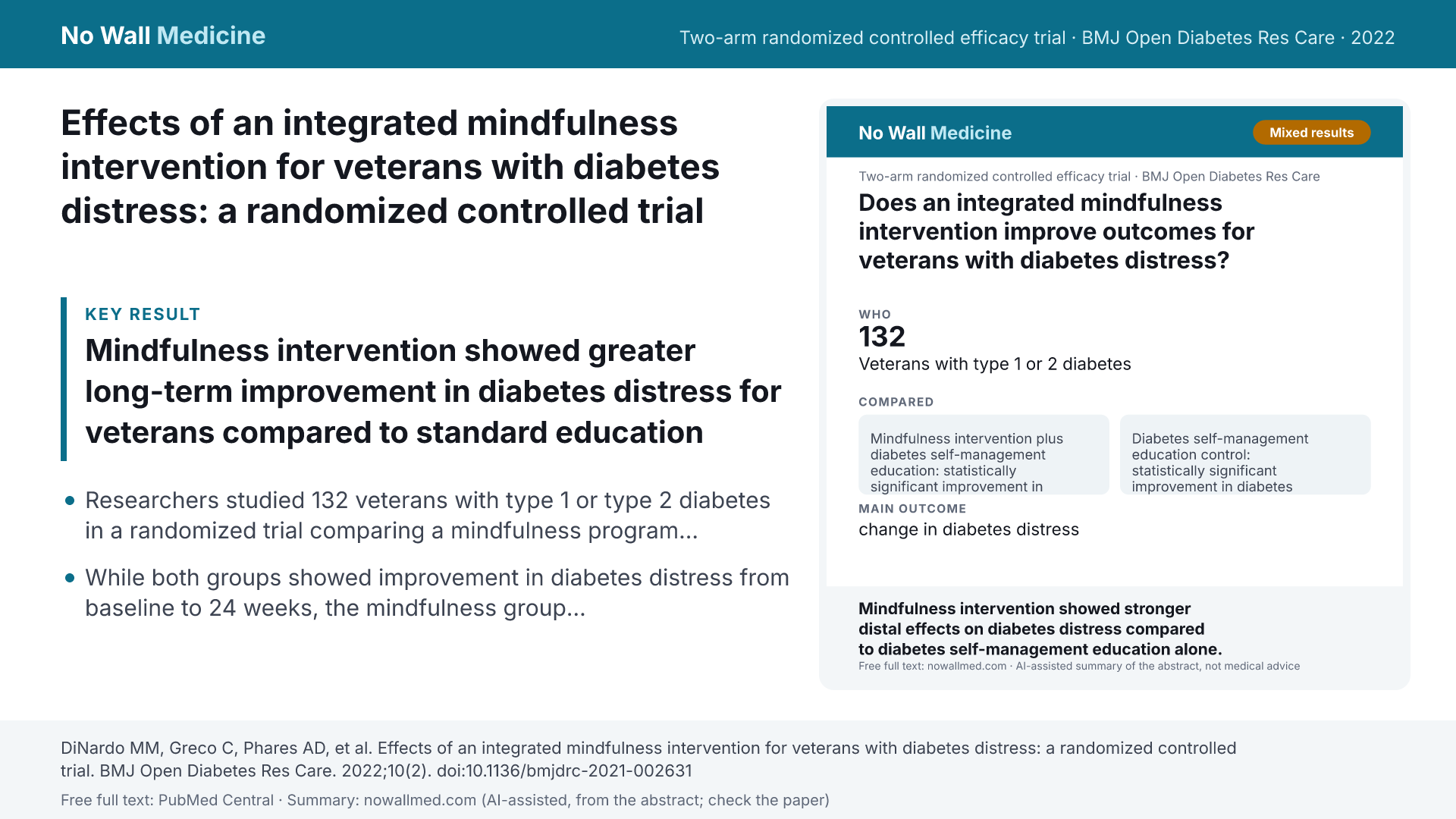
Mindfulness intervention showed greater long-term improvement in diabetes distress for veterans compared to standard education
Effects of an integrated mindfulness intervention for veterans with diabetes distress: a randomized controlled trial
Two-arm randomized controlled efficacy trialMixed results
Does an integrated mindfulness intervention improve outcomes for veterans with diabetes distress?
Who
132
Veterans with type 1 or 2 diabetes
Compared
Mindfulness intervention plus diabetes self-management education: statistically significant improvement in diabetes distress
Diabetes self-management education control: statistically significant improvement in diabetes distress
Main outcome
change in diabetes distress
Bottom line: Mindfulness intervention showed stronger distal effects on diabetes distress compared to diabetes self-management education alone.
BMJ Open Diabetes Res Care · 2022-03-29 · Save PNG
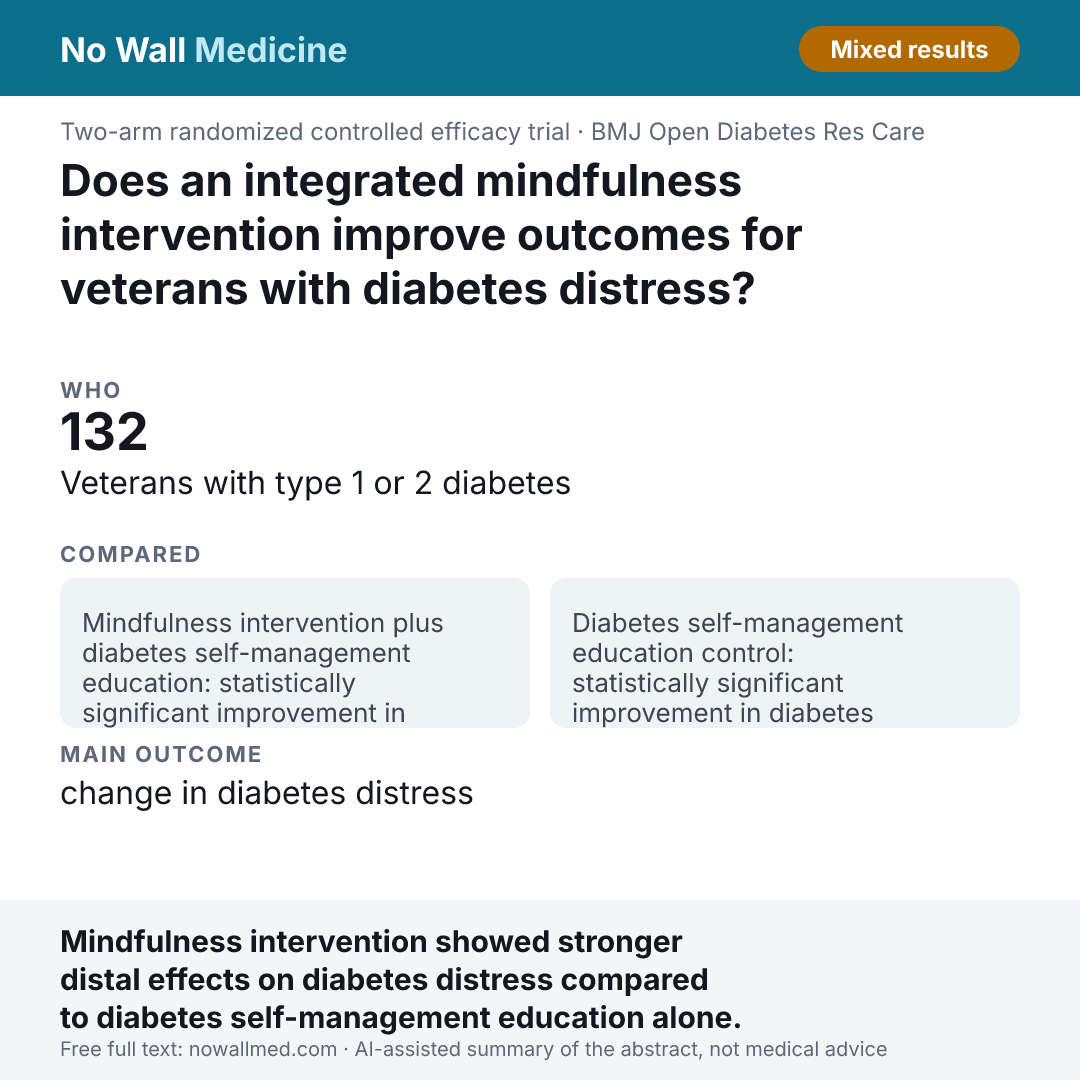
Clinical question: Does an integrated mindfulness intervention improve outcomes for veterans with diabetes distress?
Key points
- Researchers studied 132 veterans with type 1 or type 2 diabetes in a randomized trial comparing a mindfulness program with standard diabetes self-management education and support.
- While both groups showed improvement in diabetes distress from baseline to 24 weeks, the mindfulness group showed significantly greater improvement between weeks 12 and 24.
- Secondary outcomes including diabetes self-efficacy, post-traumatic stress disorder, depression, and hemoglobin A1C (average blood sugar level) improved in both groups without a significant difference between them.
Headline and key points written with AI from the paper’s abstract, with every number checked against it. Read the paper before relying on them.
Was this summary helpful?
Abstract
Introduction
US military veterans have disproportionately high rates of diabetes and diabetes-related morbidity in addition to being at risk of comorbid stress-related conditions. This study aimed to examine the effects of a technology-supported mindfulness intervention integrated into usual diabetes care and education on psychological and biobehavioral outcomes. Research design and methods
Veterans (N=132) with type 1 or 2 diabetes participated in this two-arm randomized controlled efficacy trial. The intervention arm received a one-session mindfulness intervention integrated into a pre-existing program of diabetes self-management education and support (DSMES) plus one booster session and 24 weeks of home practice supported by a mobile application. The control arm received one 3-hour comprehensive DSMES group session. The primary outcome was change in diabetes distress (DD). The secondary outcomes were diabetes self-care behaviors, diabetes self-efficacy, post-traumatic stress disorder (PTSD), depression, mindfulness, hemoglobin A1C (HbA1C), body weight, and blood pressure. Assessments were conducted at baseline, 12 weeks, and 24 weeks. Participant satisfaction and engagement in home practice were assessed in the intervention group at 12 and 24 weeks. Results
Intention-to-treat group by time analyses showed a statistically significant improvement in DD in both arms without significant intervention effect from baseline to 24 weeks. Examination of distal effects on DD between weeks 12 and 24 showed significantly greater improvement in the intervention arm. Improvement in DD was greater when baseline HbA1C was <8.5%. A significant intervention effect was also shown for general dietary behaviors. The secondary outcomes diabetes self-efficacy, PTSD, depression, and HbA1C significantly improved in both arms without significant intervention effects. Mindfulness and body weight were unchanged in either group. Conclusions
A technology-supported mindfulness intervention integrated with DSMES showed stronger distal effects on DD compared with DSMES control. Examination of longer-term outcomes, underlying mechanisms, and the feasibility of virtual delivery is warranted. Trial registration number
NCT02928952.
Abstract reproduced under the article’s CC BY NC licence.
Subject terms
Headline, design, result, key points, caveat and citation as plain text.
Cite this article
DiNardo MM, Greco C, Phares AD, et al. Effects of an integrated mindfulness intervention for veterans with diabetes distress: a randomized controlled trial. BMJ Open Diabetes Res Care. 2022. doi:10.1136/bmjdrc-2021-002631
Spotted a mistake? Suggest a correction