Virtual reality gait training provided greater improvements in balance and walking than aquatic Tai Chi
Effects of Aquatic Tai Chi and Computer-Assisted Rehabilitation Environment-Based Virtual Reality Training on Rehabilitation in Patients With Parkinson Disease: A Randomized Controlled Trial
Single-blind, parallel-group randomized controlled trialBenefit found
Does aquatic Tai Chi or virtual reality gait training better improve Parkinson disease rehabilitation?
Who
40
Older adults with Parkinson disease and balance impairment · Outpatient rehabilitation pool and gait laboratory
Compared
Computer-Assisted Rehabilitation Environment-Based Virtual Reality Training: lower Unified Parkinson's Disease Rating Scale, Part III scores
Aquatic Tai Chi
Main outcome
Clinical function, spatiotemporal gait parameters, and gait symmetry
Bottom line: Both interventions improved function, but virtual reality training produced greater and more sustained improvements in gait and balance.
Arch Phys Med Rehabil · 2026-08-28 · Save PNG
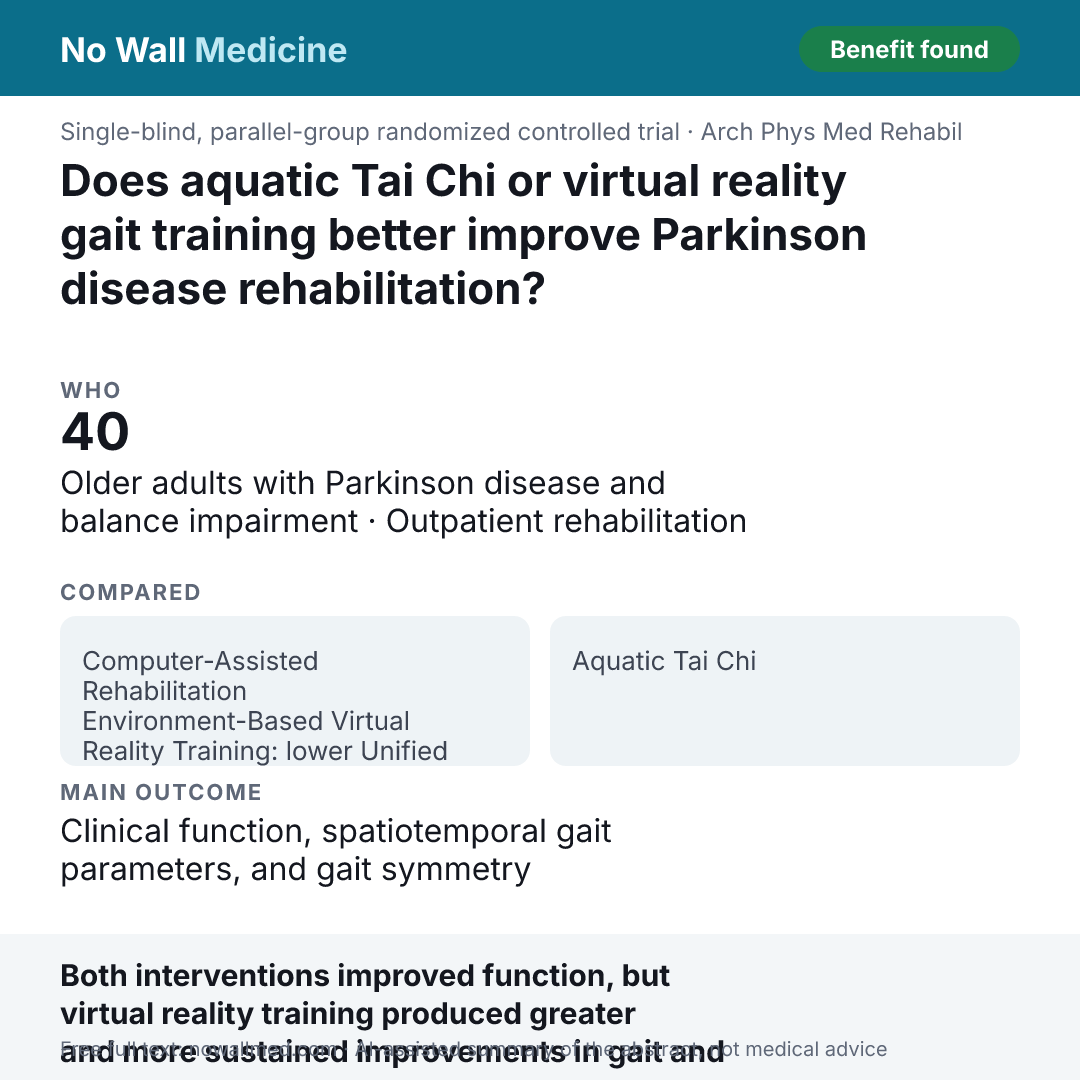
Clinical question: Does aquatic Tai Chi or virtual reality gait training better improve Parkinson disease rehabilitation?
Key points
- Fifty older adults with Parkinson disease and balance impairment were randomly assigned to either computer-assisted virtual reality training or aquatic Tai Chi.
- At week 12, the virtual reality group showed higher Berg Balance Scale scores and longer 6-minute walk test distances than the aquatic Tai Chi group.
- The virtual reality group also demonstrated faster gait speed, longer step length, and better overall gait symmetry compared to the aquatic Tai Chi group.
Headline and key points written with AI from the paper’s abstract, with every number checked against it. Read the paper before relying on them.
Was this summary helpful?
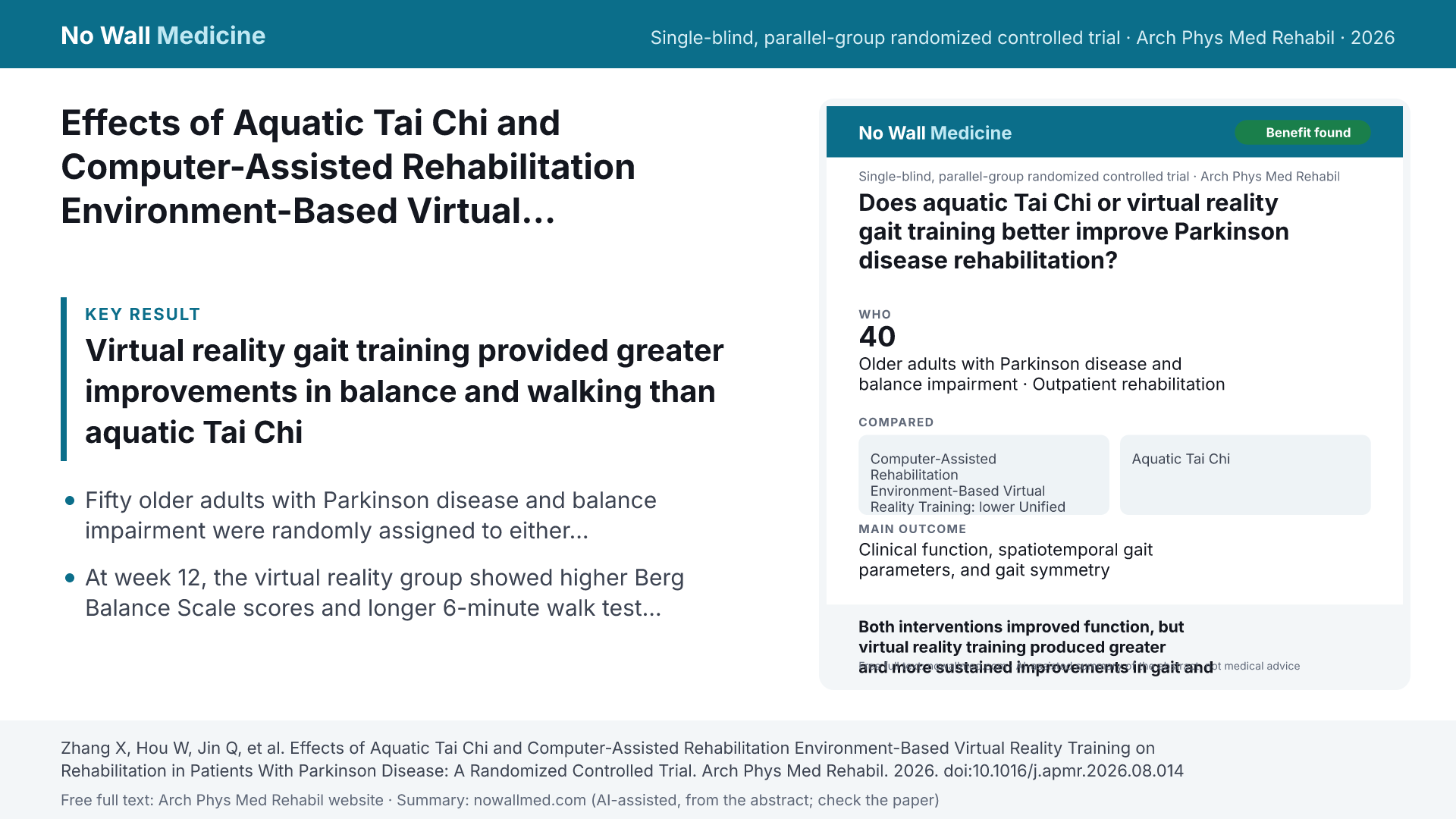
Headline, design, result, key points, caveat and citation as plain text.
Cite this article
Zhang X, Hou W, Jin Q, et al. Effects of Aquatic Tai Chi and Computer-Assisted Rehabilitation Environment-Based Virtual Reality Training on Rehabilitation in Patients With Parkinson Disease: A Randomized Controlled Trial. Arch Phys Med Rehabil. 2026. doi:10.1016/j.apmr.2026.08.014
Spotted a mistake? Suggest a correction