Effects of artificial intelligence implementation on efficiency in medical imaging-a systematic literature review and meta-analysis
Systematic review and meta-analysisMixed results
Does artificial intelligence implementation improve efficiency in medical imaging clinical workflows?
Who
48
Clinical imaging workflows
Compared
AI implementation
No AI implementation
Main outcome
Efficiency including workflow adaptation, task time, and clinician workload
Bottom line: Artificial intelligence predominantly reveals efficiency enhancements, though three meta-analyses of twelve studies showed no significant effects.
Limitation: Considerable heterogeneity in available studies renders robust inferences regarding overall effectiveness.
NPJ Digit Med · 2024-09-30Download image
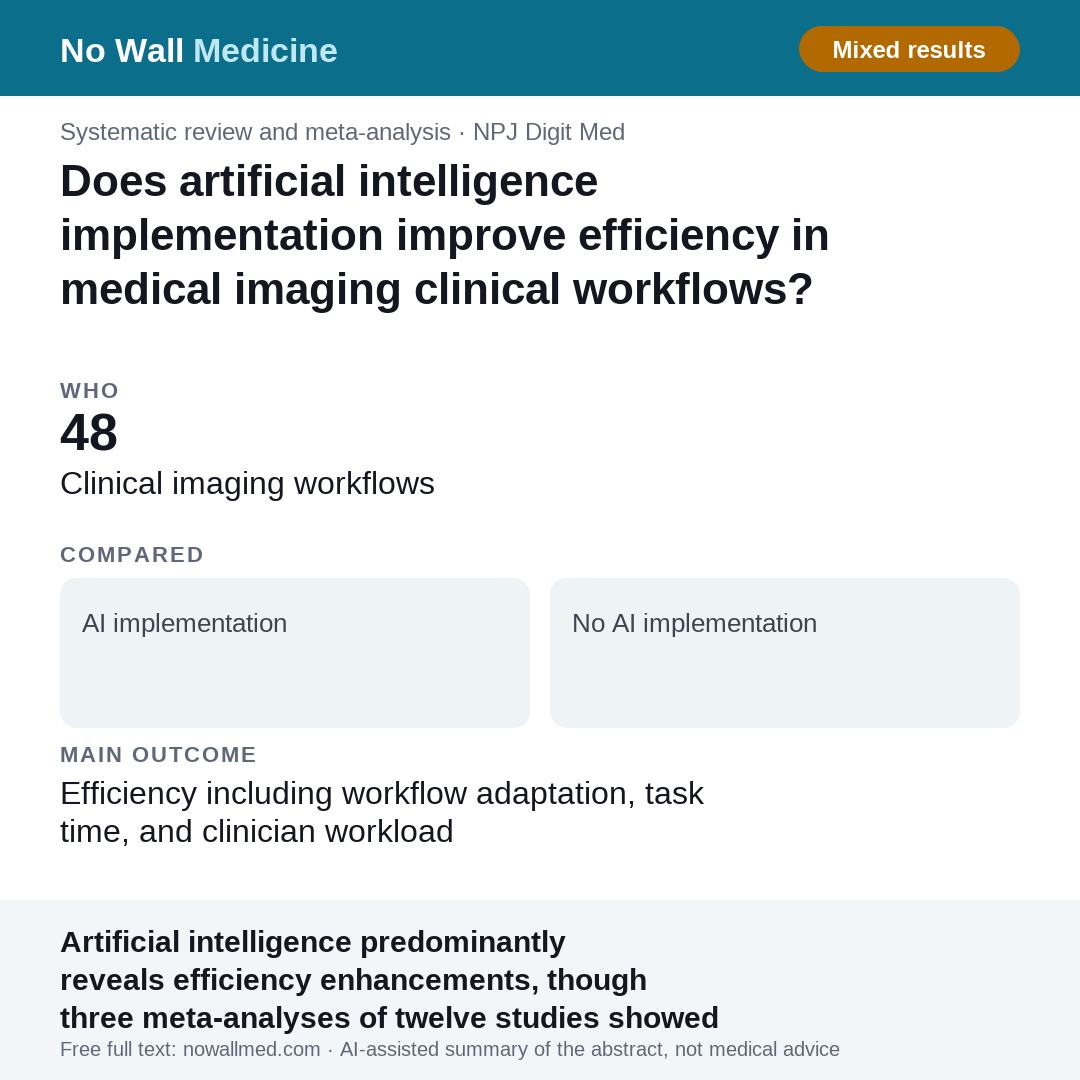
Clinical question: Does artificial intelligence implementation improve efficiency in medical imaging clinical workflows?
Abstract
In healthcare, integration of artificial intelligence (AI) holds strong promise for facilitating clinicians' work, especially in clinical imaging. We aimed to assess the impact of AI implementation for medical imaging on efficiency in real-world clinical workflows and conducted a systematic review searching six medical databases. Two reviewers double-screened all records. Eligible records were evaluated for methodological quality. The outcomes of interest were workflow adaptation due to AI implementation, changes in time for tasks, and clinician workload. After screening 13,756 records, we identified 48 original studies to be incuded in the review. Thirty-three studies measured time for tasks, with 67% reporting reductions. Yet, three separate meta-analyses of 12 studies did not show significant effects after AI implementation. We identified five different workflows adapting to AI use. Most commonly, AI served as a secondary reader for detection tasks. Alternatively, AI was used as the primary reader for identifying positive cases, resulting in reorganizing worklists or issuing alerts. Only three studies scrutinized workload calculations based on the time saved through AI use. This systematic review and meta-analysis represents an assessment of the efficiency improvements offered by AI applications in real-world clinical imaging, predominantly revealing enhancements across the studies. However, considerable heterogeneity in available studies renders robust inferences regarding overall effectiveness in imaging tasks. Further work is needed on standardized reporting, evaluation of system integration, and real-world data collection to better understand the technological advances of AI in real-world healthcare workflows. Systematic review registration: Prospero ID CRD42022303439, International Registered Report Identifier (IRRID): RR2-10.2196/40485.
Cite this article
Wenderott K, Krups J, Zaruchas F, Weigl M. Effects of artificial intelligence implementation on efficiency in medical imaging-a systematic literature review and meta-analysis. NPJ Digit Med. 2024. doi:10.1038/s41746-024-01248-9
Spotted a mistake? Suggest a correction
Top studies every Monday
The week’s key trials and guidelines in your specialties, plus any topics you follow. By email, free.
Get the weekly digest