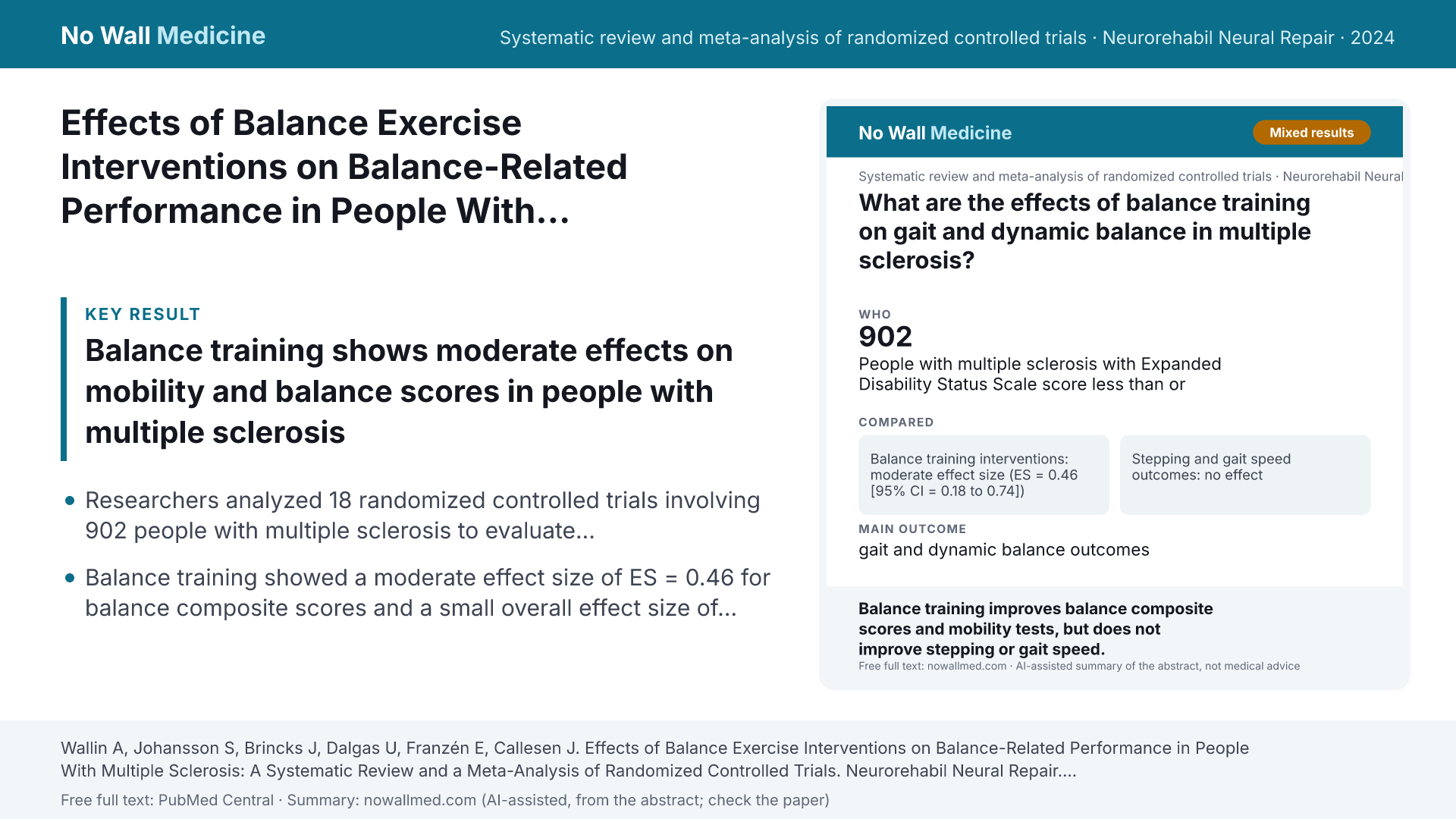
Effects of Balance Exercise Interventions on Balance-Related Performance in People With Multiple Sclerosis: A Systematic Review and a Meta-Analysis of Randomized Controlled Trials
Key result: Balance training shows moderate effects on mobility and balance scores in people with multiple sclerosis
Systematic review and meta-analysis of randomized controlled trialsMixed results
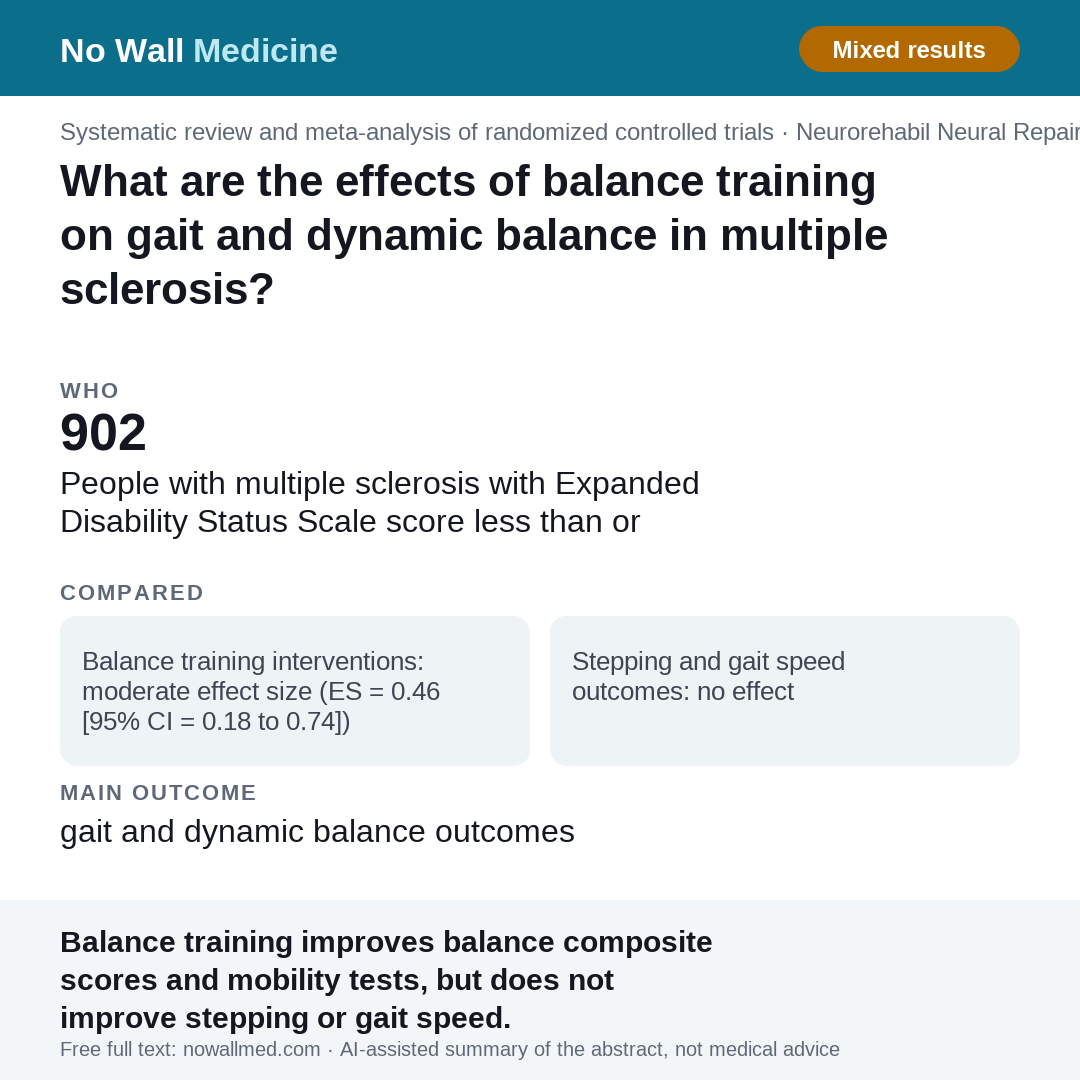
What are the effects of balance training on gait and dynamic balance in multiple sclerosis?
Who
902
People with multiple sclerosis with Expanded Disability Status Scale score less than or equal to 7.5
Compared
Balance training interventions: moderate effect size (ES = 0.46 [95% CI = 0.18 to 0.74])
Stepping and gait speed outcomes: no effect
Main outcome
gait and dynamic balance outcomes
Result: ES = 0.19 [95% CI = 0.01-0.36]
Bottom line: Balance training improves balance composite scores and mobility tests, but does not improve stepping or gait speed.
Limitation: A definition of intensity in balance training is needed for evaluation.
Neurorehabil Neural Repair · 2024-08-20Download image
Key points
- Researchers analyzed 18 randomized controlled trials involving 902 people with multiple sclerosis to evaluate different balance training interventions.
- Balance training showed a moderate effect size of ES = 0.46 for balance composite scores and a small overall effect size of ES = 0.19 for mobility tests.
- Cognitive dual-task training, which involves performing balance tasks while simultaneously using mental skills, showed a significant effect of ES = 0.81 on mobility measures.
Discussion prompts
- Would these patients look like yours? Who was left out?
- Is the main outcome one that matters to patients?
- Is the difference large enough to change what you do?
Cite: Wallin A, Johansson S, Brincks J, Dalgas U, Franzén E, Callesen J. Effects of Balance Exercise Interventions on Balance-Related Performance in People With Multiple Sclerosis: A Systematic Review and a Meta-Analysis of Randomized Controlled Trials. Neurorehabil Neural Repair. 2024. doi:10.1177/15459683241273402
Free full text: PubMed Central · Summary and visual abstract: nowallmed.com/a/effects-of-balance-exercise-interventions-on-balance-related-181ykbb/ (AI-assisted from the abstract; check the paper before relying on it).