Different classes of rheumatoid arthritis drugs show varying effects on patient pain and fatigue
Effects of biologic and targeted synthetic disease modifying antirheumatic drugs (b/tsDMARDs) on patient-reported outcome domains in rheumatoid arthritis: a systematic review and network meta-analyses
Systematic review and network meta-analysisMixed results
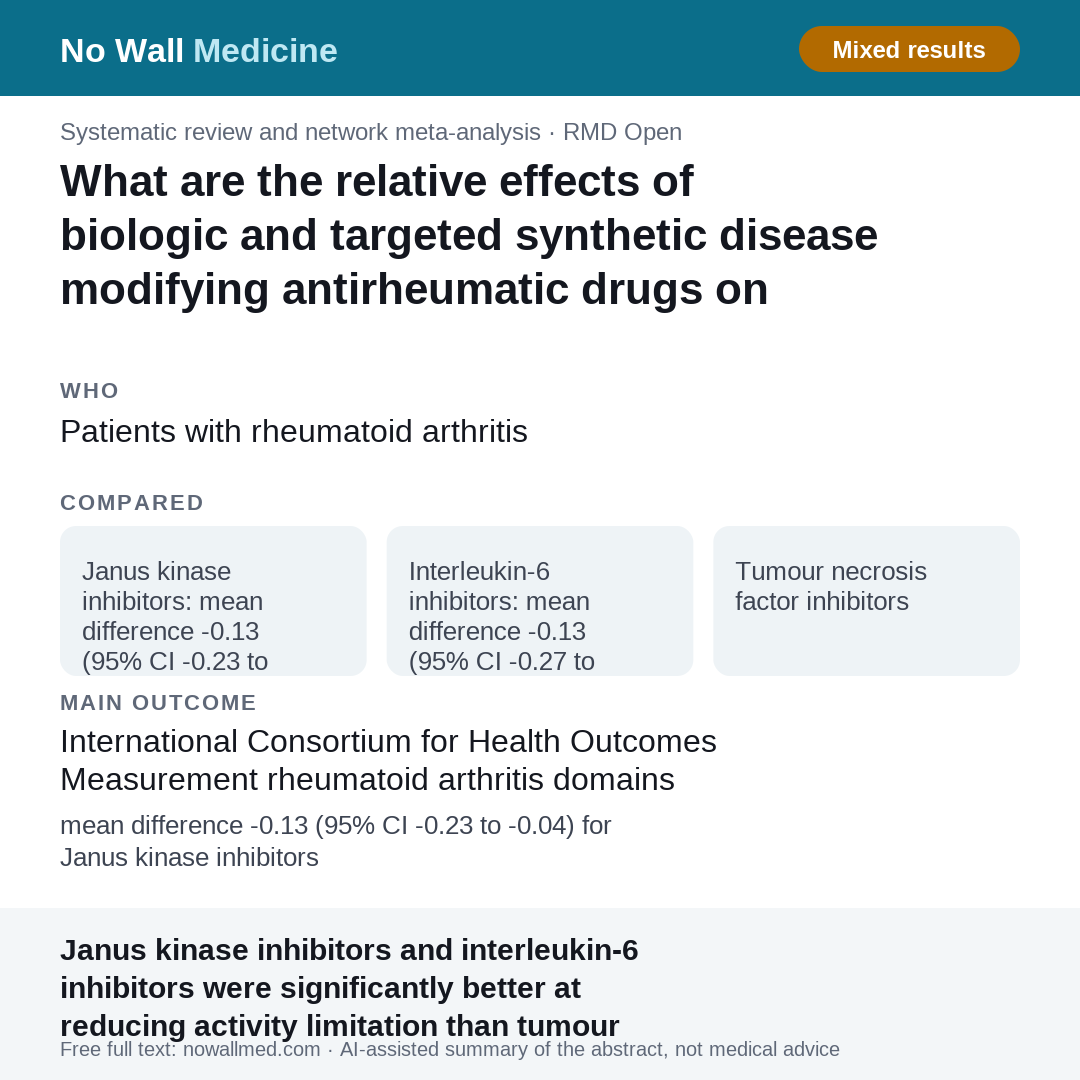
What are the relative effects of biologic and targeted synthetic disease modifying antirheumatic drugs on patient-reported outcomes?
Who
Patients with rheumatoid arthritis
Compared
Janus kinase inhibitors: mean difference -0.13 (95% CI -0.23 to -0.04)
Interleukin-6 inhibitors: mean difference -0.13 (95% CI -0.27 to -0.00)
Tumour necrosis factor inhibitors
Main outcome
International Consortium for Health Outcomes Measurement rheumatoid arthritis domains
Result: mean difference -0.13 (95% CI -0.23 to -0.04) for Janus kinase inhibitors
Bottom line: Janus kinase inhibitors and interleukin-6 inhibitors were significantly better at reducing activity limitation than tumour necrosis factor inhibitors.
Limitation: Heterogeneity within comparisons ranged from low to very high (I²=0%-96%).
RMD Open · 2026-06-24Download image
Clinical question: What are the relative effects of biologic and targeted synthetic disease modifying antirheumatic drugs on patient-reported outcomes?
Why it matters: Evidence from head-to-head comparisons of these specific rheumatoid arthritis drugs on patient-reported outcomes is lacking.
Key points
- Researchers analyzed 99 randomized controlled trials comparing biologic and targeted synthetic disease-modifying antirheumatic drugs against placebos or other drugs.
- Janus kinase inhibitors and interleukin-6 inhibitors were significantly better at reducing activity limitation than tumor necrosis factor inhibitors.
- Rituximab ranked best overall, while interleukin-6 inhibitors ranked highest for the mental health domain at 82%.
Limitation the authors note: The study noted that heterogeneity within comparisons ranged from low to very high (I²=0%-96%).
Headline and key points written with AI from the paper’s abstract, with every number checked against it. Read the paper before relying on them.
Abstract
Introduction
Evidence from head-to-head comparisons of biologic/targeted synthetic disease-modifying antirheumatic drugs (b/tsDMARDs) on patient-reported outcomes (PROs) in patients with rheumatoid arthritis (RA) is lacking. This systematic review and network meta-analysis (NMA) aims to evaluate the relative effects of b/tsDMARDs on the International Consortium for Health Outcomes Measurement (ICHOM) RA-relevant domains of pain, fatigue, activity limitation, and physical and mental health. Methods
A systematic literature search was conducted using the machine learning tool ASReview. Randomised controlled trials were included that compared DMARDs with placebo or other DMARDs and reported the effects on PROs from the ICHOM standard set for inflammatory arthritis. Random effects NMA were performed on PROs. Results
In total, 99 studies were included, with heterogeneity within comparisons ranging from low to very high (I²=0%-96%). Janus kinase inhibitors (mean difference (MD) Health Assessment Questionnaire: -0.13; 95% CI-0.23 to -0.04) and IL-6 inhibitors (MD: -0.13; 95% CI -0.27 to -0.00) were significantly better at reducing activity limitation than tumour necrosis factor inhibitors. Other significant differences between b/tsDMARD classes were not observed. The surface under the cumulative ranking curve demonstrated that rituximab was overall ranked best among b/tsDMARDs. IL-6 inhibitors ranked highest in the mental health domain (82%). Early RA (<3 years diagnosis) and worse baseline PRO scores were associated with larger improvements of PROs (p<0.05). Conclusions
Despite heterogeneity, the results of this study may help rheumatologists guide selection of b/tsDMARDs, taking into account PROs that are important to the patient or reflect their primary symptoms. Future research should investigate within-class differences between specific b/tsDMARDs and emphasise individualised, PRO-based augmentation within treat-to-target strategies. Prospero registration number
CRD42020147514.
Abstract reproduced under the article’s CC BY NC licence.
Topics
Cite this article
van Esveld L, Dikkenberg MVD, Luurssen-Masurel N, de Jong P, Kok MR, Bosch T. Effects of biologic and targeted synthetic disease modifying antirheumatic drugs (b/tsDMARDs) on patient-reported outcome domains in rheumatoid arthritis: a systematic review and network meta-analyses. RMD Open. 2026. doi:10.1136/rmdopen-2025-006578
Spotted a mistake? Suggest a correction